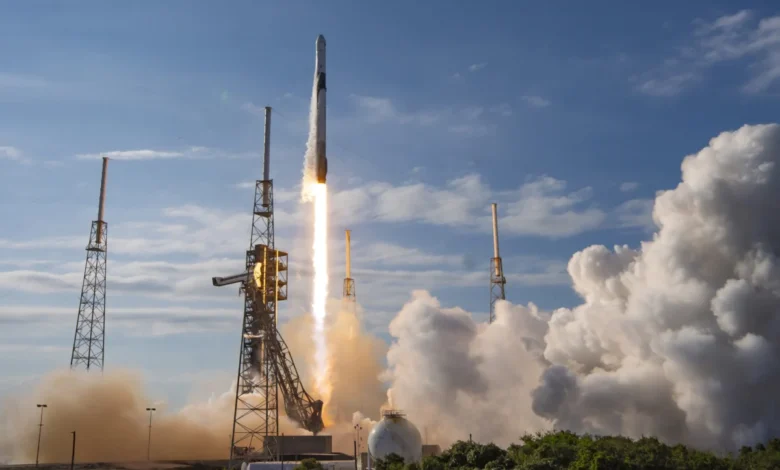
The National Aeronautics and Space Administration (NASA) has officially opened media accreditation for one of the most technologically significant cargo resupply missions to the International Space Station (ISS) in recent years. SpaceX’s upcoming 35th commercial resupply services (CRS-35) mission will leverage a Falcon 9 rocket and a Cargo Dragon spacecraft to ferry vital scientific experiments, crew supplies, and critical infrastructure to humanity’s premier orbiting laboratory. Liftoff is targeted for no earlier than October, launching from Space Launch Complex 40 at Cape Canaveral Space Force Station in Florida.
As commercial spaceflight continues to redefine the boundaries of low Earth orbit operations, this upcoming flight underscores the indispensable partnership between NASA and private aerospace industry leaders. The mission will not only sustain the ongoing daily operations of the astronauts living and working aboard the station but will also deliver equipment that directly influences the station’s future power capabilities, as well as groundbreaking biomedical and material science investigations designed to benefit both life on Earth and future deep-space exploration efforts.
Media Credentialing Guidelines and Deadlines
In preparation for the launch, NASA has instituted a rigorous credentialing process for journalists, photographers, and broadcasters wishing to cover the prelaunch milestones and the liftoff itself. According to the space agency’s advisory, media accreditation for this operation is currently restricted exclusively to U.S.-based media representatives.
Interested journalists must submit their applications online through the official NASA Kennedy Space Center media portal at https://media.ksc.nasa.gov. The strict deadline for all submission requests is 11:59 p.m. EDT on Thursday, Oct. 1. Applicants will receive an automated confirmation email upon approval, which will also detail instructions for badge pickup and access parameters at Cape Canaveral Space Force Station.
Coverage of these complex launches requires adherence to NASA’s agencywide media accreditation policy, which is fully accessible via the agency’s digital reference library. For newsrooms and reporters requiring special logistical support or facing technical issues with the application portal, NASA has established a dedicated communication channel via email at [email protected]. Additional inquiries can be directed to the Kennedy Space Center newsroom directly at 321-867-2468. Public affairs specialists Josh Finch and Jimi Russell at NASA Headquarters in Washington, Steven Siceloff at the Kennedy Space Center, and Sandra Jones and Joseph Zakrzewski at the Johnson Space Center in Houston are managing media relations for the mission.
Powering the Future: The Final IROSA Installation
Beyond routine provisions, food, and hardware, the SpaceX Dragon spacecraft will carry a payload of immense structural importance to the orbital complex: the final sets of International Space Station Roll-Out Solar Arrays, commonly referred to as IROSA.
The delivery of these advanced arrays represents the culmination of a multi-year, highly strategic power-augmentation campaign designed to upgrade the station’s aging electrical grid. The original photovoltaic arrays, launched and installed decades ago, have degraded naturally over time due to exposure to the harsh space environment, atomic oxygen, and micrometeoroid impacts. While still functional, they no longer generate the peak electrical capacity required to support the modern suite of heavy-duty scientific hardware, commercial payloads, and life support systems operating simultaneously aboard the station.
During subsequent extravehicular activities (EVVs), or spacewalks, NASA astronauts will venture outside the airlock to mount these new compact, flexible solar blankets over the existing structural wings of the station’s power channels. Once fully integrated and deployed, the IROSA units will restore the station’s total power generation capacity to approximately 160 kilowatts—an increase of nearly 30 percent.
Engineers emphasize that this power boost is not merely a convenience; it is an absolute necessity for sustaining critical station operations through the remainder of the laboratory’s operational lifecycle. Crucially, the enhanced power grid will support the specialized systems required to execute a safe, controlled, and eventual deorbit of the ISS when it is retired at the end of the decade, ensuring that the disposal phase is managed with maximum precision and safety.
Cutting-Edge Science and Microgravity Research
The scientific payload manifest aboard the SpaceX CRS-35 mission highlights the expanding horizons of microgravity research. By utilizing the unique environment of free fall—where gravitational forces are reduced to micro-levels—researchers are able to isolate physical and biological processes that are otherwise obscured or heavily influenced by Earth’s gravity.
Among the standout investigations making the journey to the orbital laboratory is specialized hardware designed to manufacture artificial retinas in space. By leveraging the microgravity environment, researchers hope to fabricate retinal tissue structures with a degree of structural integrity and cellular organization that is nearly impossible to achieve in terrestrial laboratories. If successful, this technology could eventually help restore vision for millions of patients suffering from degenerative eye diseases on Earth.
In the realm of biotechnology, the flight will transport advanced 3D heart cell models. These sophisticated biological constructs are intended to advance large-scale pharmacological drug testing, allowing researchers to observe how human cardiac tissue responds to novel pharmaceutical compounds in real time. This capability will be particularly valuable for assessing cardiovascular health risks on future long-duration space missions, while simultaneously accelerating drug discovery timelines for terrestrial medicine.
Material scientists will also closely monitor an experiment studying how a new type of glass forms in the absence of convective currents and sedimentation forces. Microgravity allows for the creation of unique glass and ceramic compositions that exhibit superior optical and thermal properties, potentially leading to breakthroughs in fiber optics, laser technology, and aerospace manufacturing.
Perhaps some of the most emotionally resonant and medically vital payloads are the brain organoids slated for delivery. These miniature, simplified versions of human brain tissue will be utilized to uncover potential treatment targets for debilitating neurodegenerative diseases, including Alzheimer’s disease, Parkinson’s disease, and multiple sclerosis. By studying how these neural structures age or deteriorate under the influence of spaceflight stressors, scientists hope to unlock molecular pathways that have eluded terrestrial researchers for decades.
The Evolution and Impact of Commercial Resupply Services
The upcoming CRS-35 mission is part of a broader, highly successful operational framework that has revolutionized how NASA manages its supply chain to low Earth orbit. For more than 25 years, humanity has maintained a continuous, unbroken human presence aboard the International Space Station. This milestone is a testament to international engineering collaboration and the reliability of modern logistical networks.
The advent of NASA’s Commercial Resupply Services contracts—initially awarded to private aerospace companies like SpaceX and Northrop Grumman—fundamentally transformed the economics and cadence of space station operations. Following the retirement of the Space Shuttle fleet in 2011, the United States briefly lost its domestic capability to launch cargo and crew independently. The rise of commercial cargo providers restored that national capability, injecting cost-efficiency, rapid innovation, and flexibility into NASA’s operational planning.
Today, commercial resupply missions ensure that the ISS is perpetually stocked with the consumables and investigative hardware needed to maintain peak operational output. These flights have exponentially increased NASA’s capacity to conduct complex, multi-disciplinary research across biology, biotechnology, physical sciences, and Earth observation. Every successful launch represents not just a delivery of boxes and equipment, but a fresh installment of potential breakthroughs that directly impact life on Earth.
Broader Implications: The Path to the Moon and Mars
The operational cadence of missions like CRS-35 holds profound strategic implications for the future of human space exploration. The International Space Station serves as the ultimate proving ground for NASA’s grander cosmic ambitions, functioning as a stepping stone under the agency’s Artemis program and future crewed missions to Mars.
Operating a complex habitat in the hostile vacuum of space teaches engineers and astronauts invaluable lessons regarding life support reliability, closed-loop water and air recycling, radiation shielding, and psychological resilience during long-duration confinement. Furthermore, the robust commercial ecosystem fostered by programs like CRS is actively laying the economic groundwork for a thriving commercial marketplace in low Earth orbit. As NASA transitions away from being the sole operator and landlord of orbital infrastructure, commercial entities are preparing to build and operate private space stations that will succeed the ISS in the 2030s.
By ensuring a seamless handover of scientific and logistical capabilities from government stewardship to a robust commercial economy, NASA is securing a permanent, sustainable human foothold in space. As the Falcon 9 rocket roars off the pad at Cape Canaveral this October carrying the CRS-35 cargo, it will do so bearing not only the supplies of today, but the technological foundations of tomorrow’s interplanetary society. Journalists and media organizations approved during the upcoming accreditation window will have a front-row seat to this ongoing chapter of space exploration history, documenting a milestone that bridges immediate station maintenance with the dawn of a new era in human spaceflight.