Deep Sea Oasis Discovered at the Bottom of the Mariana Trench Challenges Existing Models of Life on Earth

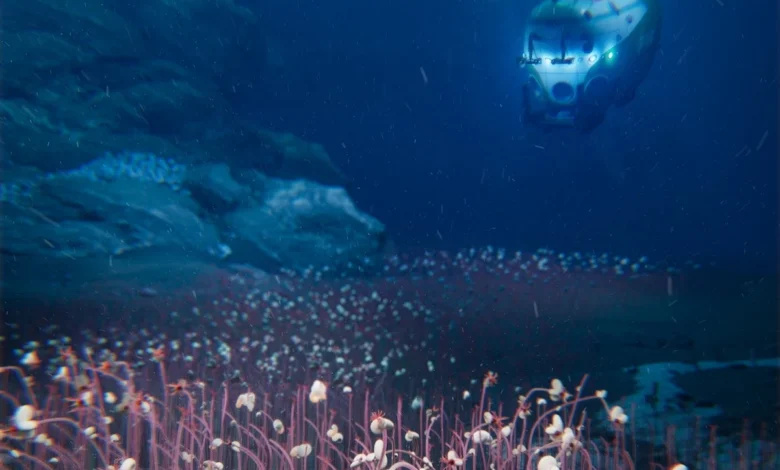
In a landmark achievement for marine biology, researchers utilizing the Chinese manned submersible Fendouzhe have identified the deepest and most extensive chemosynthesis-based animal colonies ever observed. Located in the Hadal zone—the deepest reaches of the world’s ocean trenches—these vibrant ecosystems were discovered nearly six miles below the surface of the Pacific Ocean. The findings, recently published in the journal Nature, reveal that thousands of mollusks, tubeworms, and crustaceans are thriving in total darkness, challenging long-standing scientific assumptions about the limitations of life in high-pressure, nutrient-poor environments.
The Expedition and the Discovery
The research team, led by scientists from the Institute of Deep-sea Science and Engineering at the Chinese Academy of Sciences, conducted a series of 23 dives into the Mariana Trench and surrounding regions over the course of the last year. While the Mariana Trench is famous for being the deepest point on Earth—extending further down than the height of Mount Everest—it has long been viewed as a desolate, "alien" landscape.
The Fendouzhe submersible, a vehicle capable of navigating the crushing pressures of the Hadal zone, allowed researchers to map a massive community of organisms spanning a distance of approximately 1,553 miles. These communities were found at depths ranging from 3.6 to 5.92 miles. The discovery is significant not only for its depth but for the density of the life forms observed. Video footage captured by the submersible shows expansive fields of tubeworms, some reaching up to a foot in length, alongside dense clusters of clams, bivalves, sea lilies, sea cucumbers, and various spiky crustaceans.
The Mechanics of Hadal Life
In the absence of sunlight, which precludes the possibility of photosynthesis, these organisms rely entirely on chemosynthesis. This process allows life to flourish by converting chemical energy from inorganic molecules into biological sustenance. Isotopic analysis performed on samples and environmental data gathered during the expedition indicates that these communities are sustained by fluids rich in hydrogen sulfide and methane.
These chemicals are transported to the seafloor along geological faults that traverse deep sediment layers. The methane itself is produced through microbial processes involving deposited organic matter. The researchers observed a symbiotic relationship between these fauna and the environment; for example, tubeworms were frequently found clustering around "snow-like" microbial mats, which act as a primary food source or a foundational element of the local food web. This discovery suggests that Hadal trenches are not barren, isolated pockets of life, but rather connected, thriving oases that potentially exist across the globe wherever similar geological conditions prevail.
A Chronology of Deep-Sea Exploration
Human interaction with the deepest parts of the ocean has been historically sporadic, defined by massive technological hurdles.

- 1960: The first human descent to the bottom of the Mariana Trench was completed by Jacques Piccard and Don Walsh aboard the bathyscaphe Trieste. They spent only a short time on the floor, characterizing the experience as a brief, pioneering exploration.
- 2012: Filmmaker James Cameron completed the first solo dive to the Challenger Deep, the deepest point in the Mariana Trench. His observations reinforced the prevailing view that the environment was "desolate" and largely devoid of complex life.
- 2020–2024: The development and deployment of the Fendouzhe submersible marked a shift toward systematic, high-tech exploration. The vehicle was designed specifically to withstand the extreme pressures of the Hadal zone, which exceed 1,000 times standard atmospheric pressure at sea level.
- 2025: The publication of the current study provides the most comprehensive data set to date on the biological diversity of these deep-sea regions, effectively moving the needle from "exploration" to "ecological survey."
Scientific Analysis and Implications
The discovery forces a revision of current models regarding deep-ocean carbon cycling. Previously, it was believed that the scarcity of organic carbon at such extreme depths would limit the biomass of any potential animal life. However, the discovery of these extensive communities suggests that the transport of methane and hydrogen sulfide through geological faults provides a consistent, albeit localized, energy source that supports a surprisingly high level of biodiversity.
"Given the geological similarities between these trenches and other Hadal zones around the world, it is highly probable that these chemosynthesis-based communities are more widespread than previously anticipated," noted lead author Xiatong Peng. The implications of this are vast: if life can flourish at these depths, the "biological footprint" of the Earth is significantly larger than conventional models previously accounted for. This necessitates a new understanding of how carbon is sequestered and processed in the deepest parts of our planet.
Environmental Policy and the Threat of Deep-Sea Mining
The timing of this discovery is critical, as it coincides with intense international debates regarding deep-sea mining. As global demand for battery minerals such as cobalt, nickel, and manganese rises, corporations and nations are looking toward the seabed as a potential source for extraction.
Ocean scientists and environmental advocacy groups have raised alarms, warning that the seafloor—much of which remains unmapped and unexplored—harbors fragile ecosystems that could be permanently destroyed by industrial mining. The International Seabed Authority (ISA) is currently under pressure to finalize regulations that would govern these activities. However, critics argue that the lack of baseline data on ecosystems like the one discovered in the Mariana Trench makes it impossible to conduct an adequate environmental impact assessment.
The discovery of a "vibrant oasis" in what was once thought to be a desert emphasizes the risks of proceeding with mining operations before the full extent of deep-sea biodiversity is understood. If these communities are indeed widespread, the potential for irreversible loss of biodiversity is significantly higher than earlier studies suggested.
Conclusion: Unveiling a Hidden World
The Fendouzhe expedition has successfully peeled back a layer of mystery surrounding the Earth’s most inaccessible environments. By documenting complex, interconnected animal communities at nearly six miles below sea level, the researchers have fundamentally altered our perspective on the limits of life. As marine geochemist and co-author Mengran Du noted, the experience of diving into these depths is akin to traveling through time and unveiling a hidden realm.
Moving forward, the scientific community expects this discovery to catalyze a new wave of oceanographic research. With the evidence provided by the Fendouzhe team, the global scientific community now has a new benchmark for what constitutes a "habitable" zone in the deep ocean. As humanity continues to weigh the economic benefits of resource extraction against the preservation of the planet’s final wild frontiers, these findings serve as a stark reminder of how little we know about the systems that underpin the health of the global ocean—and how much there is left to lose.