Stargazing Meets High-Energy Astrophysics: Perseid Meteor Streaks Past Advanced Gamma-Ray Telescope Under the Milky Way

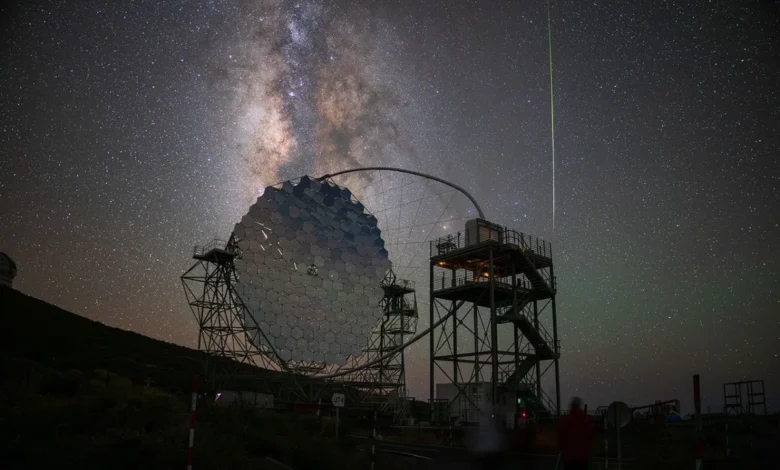
On August 15, astrophotographers and astronomers gathered under the pristine skies of the Canary Islands were treated to a breathtaking convergence of atmospheric phenomena and cutting-edge scientific instrumentation. Captured by photographer Jeff Dai, a vibrant Perseid meteor traced a luminous path across the heavens directly above the Observatorio del Roque de los Muchachos on La Palma, Spain. This fleeting streak of cosmic debris illuminated a nightscape featuring the glowing ribbon of our Milky Way galaxy and the imposing, futuristic silhouette of the Large-Sized Telescope 1 (LST-1), a prototype instrument belonging to the next-generation Cherenkov Telescope Array Observatory (CTAO).
The resulting image, selected as NASA’s Astronomy Picture of the Day (APOD), offers more than just aesthetic brilliance. It serves as a striking visual metaphor for the intersection of traditional optical astronomy, transient cosmic events, and the specialized domain of high-energy gamma-ray astronomy. As observatories around the globe push the boundaries of how we view the universe, images like this highlight the delicate choreography between Earth’s upper atmosphere, our local solar system, and the violent, energetic processes occurring in the deep cosmos.
Anatomy of a Celestial Alignment
The dramatic backdrop of the captured photograph features the central region of the Milky Way galaxy. Visible from dark-sky locations, the galactic core is densely packed with billions of stars, punctuated by vast, twisting lanes of dark interstellar dust that absorb visible light. Set against this stellar nursery and ancient population of stars, the Perseid meteor cut a sharp, colorful trajectory through the Earth’s mesosphere.
The Perseids are an annual meteor shower associated with the comet Swift-Tuttle. Every year in July and August, Earth passes through the trail of debris left behind by the comet. As these tiny, sand-to-pebble-sized meteoroids slam into Earth’s atmosphere at speeds of approximately 59 kilometers per second (132,000 miles per hour), they compress and heat the air in front of them. This thermal ionization produces a glowing streak of light—a meteor. While the peak of the Perseid shower typically occurs around mid-August, sporadic meteors and late-stage shower activity can produce stunning, colorful trails days before and after the nominal peak, as demonstrated by the August 15 event.
However, what elevates this astronomical snapshot from a standard landscape astrophotography piece to a document of scientific curiosity is its terrestrial subject: the 23-meter-diameter reflector dish of the LST-1.
Inside the LST-1: A New Era of Gamma-Ray Astronomy
Positioned prominently in the foreground of the image is the massive, segmented mirror dish of the LST-1. Located at the Roque de los Muchachos Observatory on the island of La Palma, the LST-1 is the pioneering prototype for the Large-Sized Telescopes that will populate the northern hemisphere site of the Cherenkov Telescope Array Observatory (CTAO).
The CTAO represents a massive international collaborative effort to build the world’s largest and most sensitive ground-based gamma-ray observatory. Unlike traditional optical telescopes that collect visible light from stars and galaxies, the CTAO is designed to detect Cherenkov radiation—faint, ultra-brief flashes of blue light produced when high-energy gamma rays from the cosmos slam into Earth’s upper atmosphere.
Gamma rays are the most energetic form of light in the universe, originating from extreme cosmic accelerators such as supernova remnants, pulsars, active galactic nuclei, and gamma-ray bursts. Because Earth’s atmosphere blocks these gamma rays from reaching the ground directly, scientists must rely on the indirect detection of atmospheric showers. When a high-energy gamma ray enters the atmosphere, it creates a cascade of secondary particles traveling faster than the speed of light in air. This cascade emits a faint blue flash of Cherenkov light that lasts only a billionth of a second.

To capture these unimaginably brief flashes, the LST-1 utilizes a parabolic reflector dish with a diameter of 23 meters, composed of 198 individual hexagonal mirror segments. This massive light-gathering surface focuses the faint blue light onto a high-speed, pixelized camera system mounted at the focal plane. On the night of August 15, the mirrors of the LST-1 were not only scanning the heavens for distant gamma-ray sources but also inadvertently reflecting the bright, multi-colored atmospheric flash of the Perseid meteor, capturing a terrestrial and celestial light show in a single frame.
Chronology of the Event and Observational Context
The alignment captured on August 15 is the result of a precise convergence of seasonal meteor activity, dark-sky preservation, and the operational cadence of modern observatories.
- Early August: The Earth deepens its trajectory through the debris stream of Comet Swift-Tuttle, resulting in elevated meteor activity across the Northern Hemisphere.
- August 15: Astrophotographer Jeff Dai captures the scene at the Observatorio del Roque de los Muchachos on La Palma. The framing places the central Milky Way vertically above the horizon, flanked by the dark volcanic terrain of the Canary Islands.
- Mid-August Night Operations: While amateur astronomers and photographers track meteor showers with wide-field cameras, professional facilities like the LST-1 conduct routine calibrations and sky-mapping routines, preparing to detect transient high-energy phenomena.
- Image Processing and Release: The composite image undergoes technical review and is subsequently selected by professional astronomers for presentation as NASA’s Astronomy Picture of the Day, drawing public attention to both meteor science and the development of the CTAO network.
The Canary Islands, and La Palma in particular, are globally renowned for astronomical research. Protected by stringent light-pollution laws and benefiting from high elevation and stable atmospheric conditions above the marine inversion layer, the Roque de los Muchachos Observatory hosts a diverse fleet of world-class astronomical instruments, ranging from optical and infrared telescopes like the Gran Telescopio Canarias (GTC) to specialized high-energy detectors like the MAGIC and LST systems.
Scientific Implications and Technological Synergy
The intersection of meteor observation and high-energy gamma-ray instrumentation highlights a fascinating overlap in observational techniques. Both fields rely heavily on capturing transient, highly energetic phenomena against a dark background.
For the Cherenkov Telescope Array Observatory, instruments like the LST-1 must possess extreme temporal resolution and photon-counting sensitivity. The camera systems are engineered to record events occurring on nanosecond timescales. While the atmospheric flash of a Perseid meteor lasts significantly longer than the billionth-of-second Cherenkov flashes produced by cosmic gamma rays—and occurs much closer to Earth, within the mesosphere—the optical mechanics required to track and reflect both types of atmospheric emissions share common engineering principles.
Furthermore, public engagement initiatives driven by platforms like NASA’s APOD play a crucial role in bridging the gap between complex astrophysical research and public understanding. By presenting advanced scientific hardware within the accessible framework of nightscape photography, institutions can demystify large-scale international science projects like the CTAO.
Broader Impacts on Global Astronomy
The deployment of the LST-1 on La Palma marks a transformative step for ground-based gamma-ray astronomy. As the CTAO expands to include additional telescopes across both the northern and southern hemispheres (with a southern site planned for Paranal, Chile), astronomers anticipate a tenfold increase in sensitivity compared to current instruments.
This leap in capability will allow researchers to detect hundreds of new gamma-ray sources, shedding light on some of the universe’s most violent mechanisms, including the origins of cosmic rays, the nature of dark matter candidates, and the physics surrounding stellar-mass and supermassive black holes.
At the same time, images capturing these advanced facilities interacting with natural celestial occurrences—such as a Perseid meteor streaking past a multi-million-dollar gamma-ray collector—remind the scientific community and the public alike of our place within a dynamic, interconnected solar system and galaxy. As observatories continue to probe the furthest reaches of space, the skies above Earth remain a shared canvas where ancient cosmic debris and futuristic technology meet.