Julianne Hough is shifting the focus of her career and personal presentation away from external validation, addressing recent public scrutiny surrounding her wardrobe choices during season 35 of Dancing With the Stars. As co-host of ABC’s flagship dance competition alongside Alfonso Ribeiro, Hough has leaned into a more daring and intentional aesthetic, a stylistic pivot she developed in collaboration with her longtime stylist, Brad Goreski.
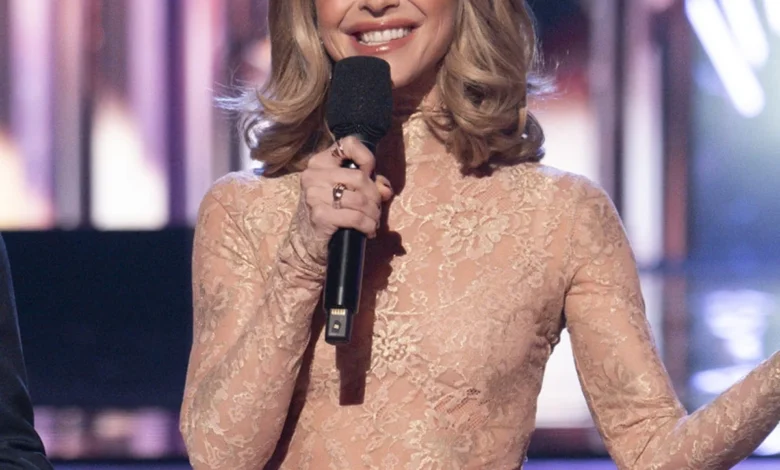
The conversation surrounding Hough’s wardrobe intensified following the November 17 episode, during which she wore a bold Valentino ensemble featuring a skin-toned leotard beneath a sheer skirt. The look sparked polarized reactions across social media, with some viewers offering sharp critiques and viral commentary regarding her styling. Rather than retreating from the discourse, Hough and Goreski have embraced the public conversation as a natural byproduct of high-stakes television fashion.
Stepping Into a New Era of Personal and Professional Expression
In an interview published late November, Hough discussed her evolution both on screen and off, describing her current phase as her "leading lady era." Entering her late thirties, the performer and host noted a distinct shift in her priorities regarding appearance and public perception.
"When you get into your late 30s, you just don’t give a f–k anymore," Hough shared with Glamour, explaining that her choices are now driven by personal empowerment rather than chasing transient trends. "You’re like, ‘Who am I? What do I want to wear? What makes me feel incredible?’ It has more intention rather than trying to fit into what’s hot."
As part of her co-hosting duties on season 35, Hough intentionally departed from her historical "girl-next-door" image, opting for a sharper, more sophisticated visual identity. Collaborating closely with Goreski, she sought to project a character-driven presence on the ballroom stage.
"I’ve gone a little bit more vixen-y this year than I have girl next door because we’re trying to find that character," she explained. "It’s very strategic."
Stylist Brad Goreski Defends Creative Risks
While social media reactions ranged from high praise to calls for stylistic changes—including one viral video demanding a change in wardrobe personnel—Goreski defended the collaborative process. Drawing on his 15-year career as a celebrity stylist, Goreski maintained that generating discussion is the ultimate goal of high-fashion moments on television.
"Any conversation, good or bad, around fashion is great," Goreski noted. "I think Jules ultimately brings the looks to life. I’m glad that there’s another part of the show that people talk about. Not every person’s going to love every look. I know that from being a stylist for 15 years. And that’s okay."
Hough echoed this sentiment, adopting the guiding philosophy that indifference poses a greater challenge to public figures than criticism. "Apathy is the enemy," she remarked, highlighting that public engagement—whether favorable or critical—is essential for cultural visibility. "The reason things exist and have charge and stay visible [is] people either love it or hate it. They still want to talk about it."
A Behind-the-Scenes Look at Dancing With the Stars
The public fascination with Hough’s wardrobe reflects a broader, enduring curiosity regarding the inner workings of Dancing With the Stars. As one of television’s most durable unscripted franchises, the production operates as a massive enterprise involving rigorous physical training, complex contractual agreements, and rapid-fire creative execution.
Financial Structures and Compensation Models
Public interest frequently centers on the financial compensation for both celebrity contestants and professional dancers. While ABC does not officially disclose financial figures, reporting and insider accounts over the years have provided a clearer picture of the show’s compensation structure.
According to reports published by Variety in 2019, celebrity contestants traditionally secure a baseline payment covering the rehearsal period and the initial two weeks of competition, historically cited around $125,000. As contestants advance through weekly eliminations, incremental bonuses raise their earning potential, with historical maximums estimated near $295,000 for finalists.
However, compensation models can vary significantly. During a September 2025 appearance on Jason Tartick’s Trading Secrets podcast, season 27 champion Bobby Bones revealed that his earnings exceeded standard estimates following his victory with partner Sharna Burgess. Describing a per-episode escalation structure, Bones noted that late-stage contestants could earn upwards of $50,000 per episode, bringing his total earnings closer to $400,000.
Professional dancers navigate a similarly structured system. While base salaries are guaranteed for a specific number of weeks to protect pros from immediate first-week elimination financial shortfalls, earnings scale with longevity in the competition. Jenna Johnson, a veteran pro who has secured victories with partners such as Adam Rippon and Joey Graziadei, explained on the podcast The Morning After that while winning the Len Goodman Mirrorball Trophy does not yield a cash prize, reaching the finale guarantees full-season pay alongside a performance bonus.
Demotions, conversely, can significantly impact earnings. Former pro Lindsay Arnold revealed on Trading Secrets that her compensation was reduced by more than 50 percent following a transition from the main professional roster to the dance troupe.
The Rigorous Partner-Matching Process
The pairing of professional dancers with celebrity partners remains one of the most closely guarded elements of the pre-season rollout. According to former participants, the decision rests entirely with the production team, leaving the professional dancers with virtually no input.
"You get no say," Arnold stated on the Hot Smart Rich podcast. "It’s very much just, ‘Here’s your partner. Make it work.’"
The matching process itself is executed under strict confidentiality to preserve spontaneous reactions during the live premiere. Jenna Johnson noted that producers intentionally withhold partner identities until the moment cameras roll.
Historically, production management relies on specific physical and interpersonal metrics. Former showrunner Rob Wade explained that pairings are carefully calibrated based on height, physical build, and psychological compatibility. The intensive nature of the rehearsal schedule—often demanding four to six hours of daily practice over multiple months—requires a harmonious working relationship to prevent interpersonal friction.
The Demands of the Rehearsal Schedule
For the professional dancers and their celebrity partners, Dancing With the Stars functions as a full-time, highly demanding professional commitment. Current and former cast members frequently emphasize the lack of downtime during the active broadcast season.
Rylee Arnold, speaking on the Lightweights Podcast, detailed the grueling daily routine required to maintain competitive readiness. Dancers typically commit to structured four-hour rehearsal blocks daily, supplementing physical practice with media obligations, choreographic planning, and strategic review.
The weekly timeline leaves virtually no room for rest. Following the live Tuesday broadcast, competitors resume rehearsals Wednesday through Sunday, transition to technical camera blocking on Monday, and return to live performance on Tuesday evening.
The High-Speed Production of Custom Costumes
Complementing the rigorous physical training is an equally demanding wardrobe and design department capable of turning out entirely custom garments under extreme time constraints.
Costume designer Daniela Gschwendtner outlined the intense pace of the department in past interviews, noting that the team has a maximum window of five days to conceptualize, construct, and embellish dozens of unique outfits for each live show. With a dedicated staff of approximately 20 artisans supported by an independent tailoring shop, the department designs original garments weekly for each competing pair.
Fellow costume designer Steven Norman Lee noted that while certain baseline items for male competitors may occasionally be repurposed, competitive performance wear is almost exclusively custom-built for each routine. This rapid turnaround ensures that the visual presentation of the ballroom remains dynamic, matching the evolving artistic ambitions of hosts like Julianne Hough as they navigate their respective professional eras on screen.