This Homemade Crosskart Is Designed to Rival Supercar Performance With 300 Horsepower and Street-Legal Ambitions

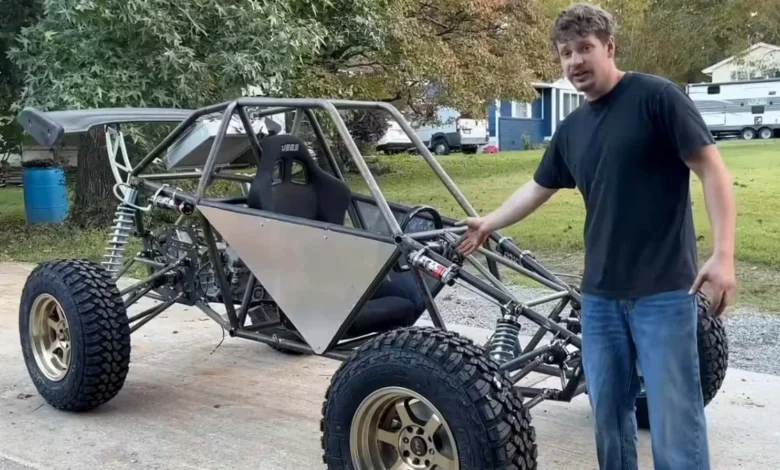
The automotive world has long been defined by the pursuit of extreme power-to-weight ratios, but few projects capture the essence of raw engineering quite like the latest build from YouTuber Vasiliy Builds. The project, which involves the construction of a high-performance Crosskart, aims to bridge the gap between specialized off-road racing machinery and road-legal transport. By marrying a lightweight tube-frame chassis with a turbocharged motorcycle powertrain, the build seeks to challenge the performance metrics of established supercars while maintaining the versatility required for multi-terrain navigation.
At its core, a Crosskart is a purpose-built, open-wheel vehicle traditionally utilized in rallycross and autocross competitions. These machines are characterized by their minimalist construction, prioritizing a low center of gravity and high power density. Vasiliy’s rendition, however, deviates from the standard competition blueprint by incorporating advanced suspension geometry and forced induction, positioning it as an outlier in the world of custom fabrication.
Engineering the Chassis and Powertrain Architecture
The structural foundation of the vehicle utilizes a custom-welded tubular steel frame. This design choice is critical, as it provides the necessary rigidity to support a high-output engine while keeping the overall mass of the vehicle well under the 1,000-pound threshold. Achieving a sub-1,000-pound curb weight in a vehicle equipped with long-travel suspension and a robust drivetrain is a significant engineering challenge, requiring meticulous material selection and weight distribution strategies.
The beating heart of the machine is a Suzuki Hayabusa motorcycle engine. Renowned in the automotive and motorcycle industries for its immense durability and tuning potential, the Hayabusa’s 1,340cc inline-four powerplant is a favorite among custom builders. In its stock configuration, the engine produces approximately 190 horsepower. However, Vasiliy has opted to integrate a turbocharger system, aiming to push the output to 300 horsepower.
When calculated against the vehicle’s target weight, the power-to-weight ratio becomes staggering. With 300 horsepower propelling a machine weighing less than 1,000 pounds, the Crosskart effectively achieves a ratio of approximately 0.3 horsepower per pound, or 600 horsepower per ton. For context, this ratio exceeds that of many contemporary production supercars, suggesting that the vehicle will possess extreme acceleration capabilities both on loose surfaces and asphalt.
Chronology of the Development Process
The development of the project has followed a systematic, albeit complex, timeline typical of bespoke automotive engineering. The initial phase focused on the conceptualization of the chassis geometry, specifically the integration of the long-travel suspension system. Inspired by the performance characteristics of professional trophy trucks, the suspension is designed to handle high-speed impacts over rough terrain while maintaining tire contact patch integrity.
Following the completion of the primary chassis skeleton, the secondary phase involved the iterative fitting of the Hayabusa drivetrain. This stage proved to be the most labor-intensive, as the builder faced significant spatial constraints within the tight confines of the tube frame. Integrating the cooling system, the turbocharger plumbing, and the custom intake manifold required precise fabrication to ensure that all components could function without interference.
Currently, the project is moving into the final assembly and systems integration phase. This involves the complex task of wiring the ECU (Engine Control Unit) to manage the forced induction system, as well as the implementation of active aerodynamics. While active aero is rarely seen on small-scale karts, its inclusion here suggests an attempt to manage downforce and drag as the vehicle approaches higher velocity thresholds, further emphasizing its intended versatility.
The Challenge of Street Legality
Perhaps the most ambitious aspect of the build is the stated goal of achieving street-legal status. Obtaining road-legal registration for a custom-built, open-wheel tube-frame vehicle is a notoriously difficult process that varies significantly by jurisdiction. In most regions, such vehicles must undergo rigorous inspections to ensure they meet basic safety requirements, including headlights, turn signals, brake lights, mirrors, and, in many cases, emissions compliance.
From a regulatory standpoint, the primary obstacles for such a vehicle include:
- Lighting and Visibility: Ensuring the electrical system can support street-certified lighting components.
- Safety Equipment: Meeting requirements for seat belts, windshields, or windshield substitutes, and occupant protection.
- Emissions and Noise: Modifying the turbocharged Hayabusa engine to meet local decibel limits and, if required, exhaust emission standards.
- Structural Certification: Providing documentation that the chassis meets the necessary safety standards for public road usage.
While the builder has expressed intent to navigate these hurdles, the process remains a significant point of concern. If successful, the vehicle would be a rare example of a "kart-style" machine that is capable of being driven on public roads, effectively creating a new sub-category of personal transport that sits between a dedicated track toy and a street-legal supercar.
Broader Implications and Industry Context
The rise of high-end project car builds documented on social media platforms reflects a shift in automotive enthusiast culture. Historically, custom car fabrication was largely an insular hobby confined to workshops and local car meets. Today, platforms like YouTube allow builders to document their processes, share technical challenges, and receive real-time feedback from a global audience.
This democratization of automotive engineering allows for the exploration of unconventional designs, such as the one being pursued by Vasiliy. The industry has observed an increase in "extreme projects"—builds that push traditional platforms beyond their intended design limits. These projects serve as a form of grassroots research and development, often identifying the limits of stock components and forcing the creation of new, bespoke solutions.
Furthermore, the focus on power-to-weight optimization mirrors the design philosophy of high-end manufacturers like Ariel, BAC (Briggs Automotive Company), and KTM. By focusing on minimal weight rather than brute engine displacement, these manufacturers—and now independent builders—demonstrate that superior performance is often a result of mass management.
Technical Analysis: Performance Expectations
Based on the projected specifications, the vehicle is expected to exhibit performance characteristics rarely seen outside of dedicated racing circuits. The combination of a high-revving motorcycle engine and a lightweight chassis suggests an exceptional torque curve and rapid throttle response.
The long-travel suspension, while providing excellent off-road capability, will require precise tuning to ensure the vehicle remains stable during high-speed cornering on paved surfaces. The center of gravity, while low, must be balanced against the increased ride height required for off-road clearance. Should the builder successfully integrate the active aero, the vehicle may be able to adjust its aerodynamic profile to provide increased downforce during acceleration, potentially mitigating the inherent instability of a short-wheelbase, high-power machine.
Future Outlook and Final Considerations
As the project approaches completion, the focus will likely shift to real-world testing and validation. The transition from a static workshop project to a functional, street-legal machine will be the ultimate test of the builder’s fabrication skills. Whether the Crosskart meets all legal requirements for road use remains to be seen, but the engineering effort itself is a testament to the capabilities of modern independent builders.
The project highlights a growing interest in vehicles that offer a visceral, unassisted driving experience. As automotive manufacturers lean toward increasingly complex driver-assistance systems and electric powertrains, there is a clear demand for mechanical, driver-centric machines that emphasize weight reduction and raw power.
Ultimately, the success of this build will not be measured solely by its ability to pass a registration inspection, but by its performance as a proof-of-concept for what can be achieved with off-the-shelf motorcycle technology and custom chassis design. As the automotive landscape continues to evolve, these grassroots projects will continue to provide a window into the potential of extreme performance, challenging the dominance of traditional, mass-produced vehicles in both speed and ingenuity. For now, the automotive community remains observant, waiting to see if this monster can successfully translate its theoretical power into a tangible, road-legal reality.