NASA’s SWEET-15 Structural Wing Experiment Evaluates Breakthrough Design for Ultra-Efficient Aircraft, Exceeding Expectations in Rigorous Testing.

NASA researchers recently concluded a series of grueling structural tests on a novel wing design, known as the Structural Wing Experiment Evaluating Truss-bracing (SWEET-15), pushing the long, thin, and lightweight structure far beyond its intended operational limits. The remarkable resilience demonstrated by the 15-foot test article has left the team highly encouraged, underscoring its significant potential to revolutionize commercial aviation and contribute to a more sustainable future for air travel. This pivotal evaluation marks a crucial step in NASA’s ongoing mission to develop ultra-efficient aircraft, specifically advancing the agency’s earlier Transonic Truss-Braced Wing (TTBW) concept.
The Quest for Ultra-Efficient Flight: A New Paradigm in Wing Design
The global aviation industry faces mounting pressure to reduce its environmental footprint and enhance operational efficiency. With ambitious targets like achieving net-zero carbon emissions by 2050, radical innovations in aircraft design are no longer optional but essential. Traditional commercial aircraft predominantly utilize cantilever wings, which are self-supporting structures extending directly from the fuselage. While robust, this design often necessitates a compromise between wing aspect ratio (the ratio of wingspan to average chord) and structural weight. Higher aspect ratios generally lead to reduced induced drag, improving fuel efficiency, but require heavier wings to withstand flight loads, counteracting some of the benefits.
Enter the truss-braced wing concept. By introducing an aerodynamic strut, or truss, extending from the lower fuselage to the wing, the design provides additional structural support. This external bracing allows for significantly longer, thinner wings – wings with much higher aspect ratios than conventionally feasible. The increased aspect ratio drastically reduces drag, translating directly into substantial fuel savings. NASA’s Transonic Truss-Braced Wing (TTBW) concept, first explored decades ago, predicted fuel consumption reductions of up to 30% compared to current designs, a figure that could reshape airline economics and global emissions targets. The SWEET-15 article is a tangible realization of this theoretical promise, designed to validate the structural integrity and performance of such a configuration under real-world conditions.
The Genesis of SWEET-15: Collaboration and Advanced Manufacturing
The journey of SWEET-15 began as a testament to inter-center collaboration and pioneering manufacturing techniques within NASA. The concept for the SWEET-15 design originated from the strategic integration of five distinct advanced composite manufacturing and assembly technologies. These innovations were critical in enabling the novel structural design, which leverages the inherent strength-to-weight advantages of composite materials. Unlike traditional aluminum alloys, advanced composites, such as carbon fiber reinforced polymers (CFRPs), offer superior stiffness and strength while being significantly lighter. This characteristic is paramount for high-aspect-ratio wings, where minimizing weight is crucial to maximize aerodynamic efficiency gains.
The 15-foot-long test article was meticulously designed and fabricated at NASA’s Langley Research Center in Hampton, Virginia, a hub of aeronautical innovation. A key enabler in this process was the Integrated Structural Assembly of Advanced Composites (ISAAC) robot. This state-of-the-art robotic system at NASA Langley is specifically engineered to produce lighter and stronger composite structures for aerospace vehicles, optimizing the placement and curing of composite plies with unprecedented precision. The automation offered by ISAAC not only improves manufacturing consistency and quality but also accelerates the production timeline for complex composite components, making designs like SWEET-15 economically viable for future commercial applications. Following its fabrication, the SWEET-15 article embarked on a cross-country journey to NASA’s Armstrong Flight Research Center in Edwards, California, where it would face its ultimate challenge in the Flight Loads Laboratory.
Chronology of Rigorous Testing: Simulating the Stresses of Flight
Upon its arrival at NASA Armstrong, the SWEET-15 wing was prepared for a comprehensive test campaign spanning several months. The objective was clear: to understand precisely how the lightweight structural design, with its long, thin profile and innovative bracing, would behave under the immense forces experienced during flight.
Early 2023 – Mid-2023: Preparation and Initial Setup
Engineers at NASA Langley, having completed the design, analysis, and manufacturing phases, also undertook extensive safety preparations and lab setup in collaboration with their Armstrong counterparts. This involved calibrating test fixtures, ensuring proper installation of the wing, and integrating a vast network of sensors.
Mid-2023 – Late 2023: Gradual Load Application and Data Collection
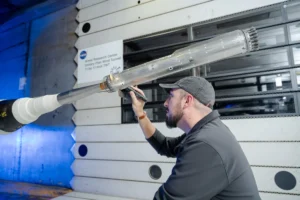
Over several months, NASA engineers in the Flight Loads Laboratory systematically subjected the SWEET-15 test wing to increasingly strenuous loads. This process was not a single, dramatic event but a carefully orchestrated series of experiments designed to simulate a full spectrum of in-flight conditions, from gentle maneuvers to extreme gust encounters. The wing was intentionally bent, twisted, and stressed to mirror the aerodynamic forces it would endure.
To capture every nuance of the wing’s response, a dense array of strain and load sensors was strategically placed throughout the structure. Among these were cutting-edge fiber-optic strain sensors, part of NASA’s advanced Fiber Optic Sensing System (FOSS). Unlike traditional electrical strain gauges, fiber-optic sensors offer superior immunity to electromagnetic interference, higher spatial resolution, and the ability to operate across a wider range of temperatures, making them ideal for monitoring complex composite structures. These sensors provided real-time, high-fidelity data on how stress and strain propagated through the wing’s skin, spars, ribs, and critical joint connections. The FOSS, developed to gather data on both aircraft and spacecraft, proved instrumental in collecting the granular information needed to validate theoretical predictions.
Initial Findings and Model Validation
The data streaming from the hundreds of sensors confirmed the predictions generated by NASA’s sophisticated computer models. This validation is a critical milestone, as it builds confidence in the computational tools used for designing future aircraft. According to initial findings, the SWEET-15 wing successfully withstood all anticipated in-flight forces without exhibiting any structural anomalies or unexpected behaviors. This robust performance provided the research team with immense confidence in the new manufacturing approaches and the innovative methods used to connect the various wing components, particularly the interfaces between the main wing box, the primary strut, and the secondary "jury strut." The successful validation of these manufacturing and assembly techniques is paramount for scaling up such designs for larger, commercial applications.
The Ultimate Test: Pushing to Failure
While validating performance within the design envelope is crucial, understanding how a structure behaves when pushed beyond its limits is equally, if not more, vital for safety and future design optimization. The SWEET-15 test campaign culminated in a deliberate "test-to-failure" event. This phase is designed to identify the exact point at which a structure fails and, crucially, the mode and location of that failure.
Engineers progressively increased the applied loads well beyond the wing’s design limits. The suspense in the control room would have been palpable as the load percentages climbed. Ultimately, the SWEET-15 structure failed at approximately 127% of its design limit load. This is a remarkable testament to its inherent strength and the accuracy of its design and fabrication. For context, commercial aircraft are typically certified to withstand 1.5 times (150%) the maximum anticipated load, with a safety factor built in. Exceeding the design limit load by 27% provides a substantial margin of safety.
Visible damage eventually appeared near the back edge of the wing and in the upper wing cover, indicating the areas where the structural integrity was finally compromised. This specific failure mode provides invaluable insight. It suggests potential areas for further reinforcement or design refinement in subsequent iterations. Critically, this element of testing provided a deeper understanding of how the complex joints connecting the wing to its main strut and the secondary jury strut behave under forces far exceeding the expected flight envelope. Understanding these failure mechanisms is essential for designing robust and fail-safe aircraft. This comprehensive structural evaluation marks the first time a representative composite truss-braced wing configuration has undergone such an extensive and deliberate test-to-failure.
Broader Implications and the Future of Aviation
The successful testing of SWEET-15 carries profound implications for the future of aviation, aligning directly with NASA’s broader Subsonic Flight Demonstrator project within the agency’s Research Technology Mission Directorate.
Fuel Efficiency and Environmental Impact:
The primary driver behind the truss-braced wing concept is fuel efficiency. If the TTBW concept, validated by SWEET-15, can achieve its projected 20-30% fuel burn reduction, the economic and environmental benefits would be monumental. For airlines, this translates into significantly lower operating costs, potentially leading to more affordable air travel. Environmentally, a 20-30% reduction in fuel consumption directly corresponds to a proportionate decrease in carbon dioxide (CO2) emissions and other greenhouse gases. Given that aviation currently accounts for roughly 2.5% of global CO2 emissions, such a reduction from a new generation of aircraft could play a critical role in mitigating climate change and helping the industry achieve its sustainability targets.
Technological Advancement and Manufacturing Innovation:
The SWEET-15 project has not only validated a wing design but also proved the efficacy of advanced composite manufacturing and assembly techniques, particularly those utilizing robotic systems like ISAAC. These innovations are crucial for producing complex, lightweight structures efficiently and cost-effectively, paving the way for wider adoption of advanced materials in future aircraft designs, not just wings. The Fiber Optic Sensing System (FOSS) also demonstrated its capabilities as an indispensable tool for structural health monitoring, which could extend to in-service aircraft for enhanced safety and maintenance.
Paradigm Shift in Aircraft Design:
The success of SWEET-15 suggests a potential paradigm shift away from traditional cantilever wing designs towards high-aspect-ratio, strut-braced configurations. This architectural change could influence not only long-haul commercial airliners but also regional jets and even future cargo aircraft, leading to entirely new aircraft families optimized for efficiency. While challenges remain in integrating such large wings with existing airport infrastructure and developing suitable engine configurations, the fundamental structural viability has now been strongly affirmed.
Strengthening Collaboration and Research:
The project serves as an excellent example of NASA’s collaborative power, leveraging the distinct expertise and resources of centers like Langley and Armstrong. This inter-center synergy is vital for tackling complex engineering challenges that underpin transformative technologies. The insights gained from SWEET-15 will inform a multitude of future airframe designs and continue to fuel NASA’s ongoing efforts to develop a suite of more efficient aviation technologies.
The Road Ahead: Data Analysis and Future Iterations
With the grueling tests now complete, the research team faces the critical task of thoroughly analyzing the vast amounts of data collected. Every strain reading, every load profile, and every detail of the failure mode will be meticulously scrutinized. This analysis will refine existing computer models, identify areas for further optimization, and guide the development of the next generation of ultra-efficient aircraft.
The SWEET-15 project is a significant milestone within NASA’s broader Sustainable Flight National Partnership, which aims to accelerate the maturation of key aviation technologies. The successful testing of this innovative composite truss-braced wing configuration is not merely an engineering achievement; it is a beacon of progress towards a future where air travel is more efficient, more sustainable, and more accessible. As researchers delve deeper into the data, the lessons learned from SWEET-15 will undoubtedly shape the skies of tomorrow, promising a cleaner, quieter, and more economical era of flight.