Expedition 74 Crew Safely Aboard International Space Station, Commences Extensive Research Mission Following Successful Baikonur Launch

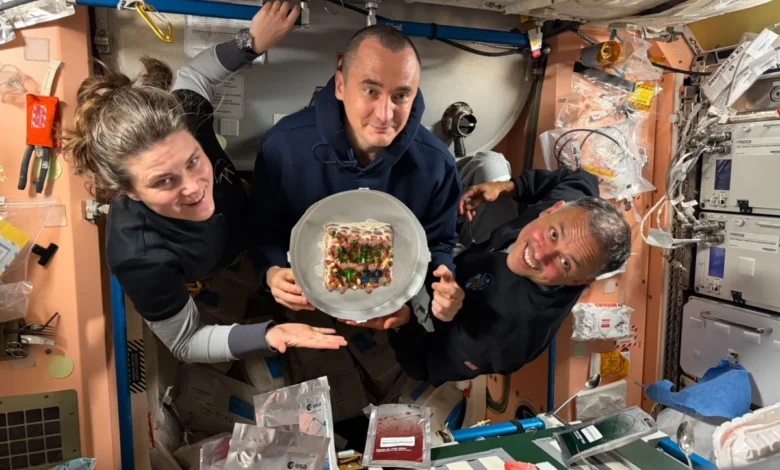
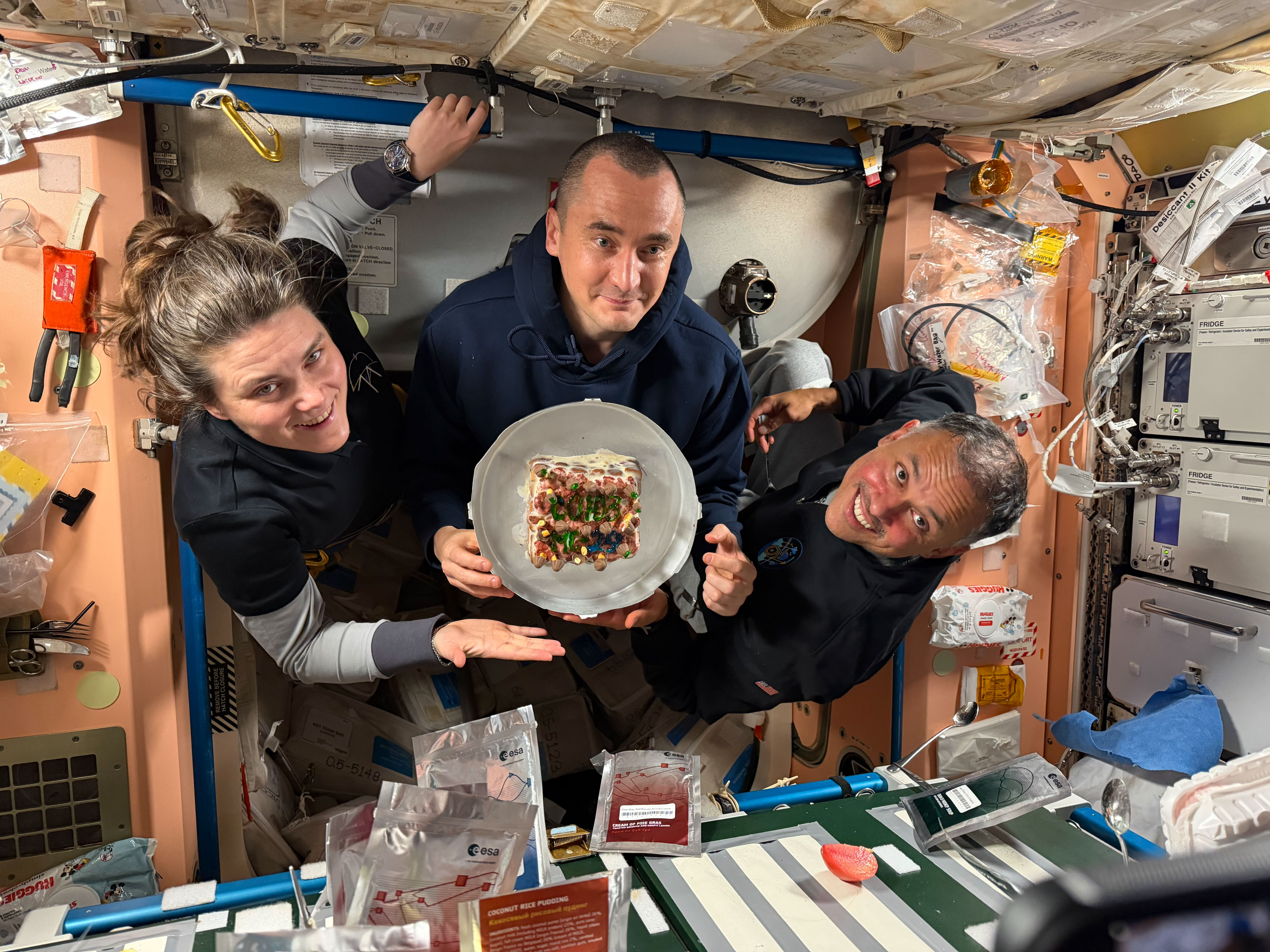
The International Space Station (ISS) welcomed its newest residents, Expedition 74 flight engineers Anna Kikina and Pyotr Dubrov of Roscosmos, and Anil Menon of NASA, on July 14, 2026. The trio, having successfully launched from the historic Baikonur Cosmodrome in Kazakhstan earlier the same day, quickly settled into their orbital home, marking the commencement of a planned eight-and-a-half-month scientific mission. Just four days after their arrival, on July 18, 2026, the crew gathered for a celebratory photo, holding a cake to commemorate their successful journey and the start of their demanding scientific endeavor. This moment underscored not only the personal triumph of reaching orbit but also the enduring spirit of international collaboration that defines the ISS program.
The arrival of Kikina, Dubrov, and Menon brings the ISS complement to its standard operating capacity, allowing for continuous human presence and robust research activities in the unique microgravity environment. As they embark on their second week in orbit, the new crew members are actively engaged in familiarization with the station’s complex systems, while simultaneously beginning to utilize their specialized skills for a diverse range of space research projects. Their mission is critical for advancing scientific understanding across various disciplines, contributing to technological innovation, and preparing for future deep-space human exploration.
The Journey to Orbit: A Testament to International Partnership
The successful launch from the Baikonur Cosmodrome, a site steeped in space history, was executed with precision. The trio boarded a Soyuz spacecraft, a workhorse of human spaceflight, for their rapid transit to the orbiting laboratory. The Baikonur Cosmodrome, located in Kazakhstan and leased by Russia, has been the launchpad for countless historic missions, including Sputnik 1, the first artificial satellite, and Vostok 1, which carried Yuri Gagarin, the first human in space. Its continued use for crewed missions underscores its strategic importance in global space operations.
The decision for NASA astronaut Anil Menon to launch alongside his Roscosmos counterparts from Baikonur highlights the robust and essential cooperation between the United States and Russia in space, a partnership that has historically transcended terrestrial geopolitical complexities. This integrated approach ensures redundant access to space for astronauts and cosmonauts, bolstering the resilience of the ISS program. The approximately six-hour journey from launch to docking is a marvel of orbital mechanics and engineering, demonstrating the maturity and reliability of the Soyuz system. Upon docking with the ISS, a series of pressure equalization checks and hatch openings culminated in the warm welcome of the new crew by the existing Expedition 74 members.
Meet the Crew of Expedition 74
The newly arrived flight engineers bring a wealth of experience and diverse backgrounds to the ISS.
- Anna Kikina (Roscosmos): As one of Russia’s prominent cosmonauts, Kikina has garnered significant attention for her dedication and contributions to the space program. Her assignment to Expedition 74 further solidifies her role in advancing Russian space exploration objectives and maintaining a continuous presence on the ISS. Cosmonauts like Kikina typically undergo rigorous training regimes, encompassing everything from advanced engineering and scientific protocols to survival skills and extensive simulations of spacecraft operations and emergency procedures.
- Pyotr Dubrov (Roscosmos): Dubrov is an experienced cosmonaut with a background in engineering, bringing valuable expertise to the station’s maintenance and operational demands. His previous missions have provided him with a deep understanding of long-duration spaceflight, which is invaluable for the current expedition. Roscosmos cosmonauts are often selected for their strong scientific or engineering backgrounds, coupled with exceptional physical and psychological resilience required for extended periods in space.
- Anil Menon (NASA): Anil Menon, a NASA astronaut, represents the agency’s continued commitment to international collaboration and cutting-edge research. Menon’s profile, accessible via NASA’s official channels, details his professional journey prior to becoming an astronaut. Typically, NASA astronauts come from diverse fields such as medicine, engineering, military test piloting, or scientific research. Their training at the Johnson Space Center involves mastering the complex systems of the ISS, conducting spacewalks, operating robotic arms, and preparing for a wide array of scientific experiments. Menon’s presence on a Soyuz flight from Baikonur further exemplifies the integrated nature of ISS crew rotations.
The synergy of these diverse backgrounds is crucial for the successful execution of the demanding mission ahead, allowing the crew to tackle complex scientific problems and manage the intricate operations of the space station effectively.
Life and Work Aboard the Orbital Laboratory
The International Space Station serves as humanity’s premier microgravity laboratory, a unique environment where phenomena behave differently than on Earth. For the next eight-and-a-half months, Kikina, Dubrov, and Menon will join their colleagues in maintaining the station and conducting a vast array of scientific experiments that are impossible to perform on Earth.
Key areas of research on the ISS include:
- Human Physiology: Studying the effects of long-duration spaceflight on the human body, including bone density loss, muscle atrophy, cardiovascular changes, and psychological impacts. This research is vital for planning future missions to the Moon and Mars.
- Biology and Biotechnology: Experiments range from growing protein crystals for drug development to studying plant growth in microgravity, which could inform future space agriculture.
- Physical Sciences: Investigating fluid physics, combustion science, and materials science to understand fundamental processes and develop new technologies. For example, studying how fire behaves in microgravity can lead to improved fire safety on Earth and in space.
- Earth Observation: Using the station’s vantage point to monitor Earth’s climate, weather patterns, and environmental changes, providing critical data for scientists on the ground.
- Technology Demonstrations: Testing new technologies and systems designed for future spacecraft and missions, such as advanced life support systems, robotics, and communication technologies.
The crew’s daily routine is meticulously planned, balancing scientific research with station maintenance, exercise, and communication with ground control. Exercise, typically two hours a day, is critical to mitigate the adverse effects of microgravity on the human body. Familiarization with the station’s myriad modules, from the U.S. segment’s Destiny laboratory to the Russian segment’s Zvezda service module, is an ongoing process, given the station’s sprawling and intricate layout.
The Enduring Legacy of International Collaboration
The International Space Station stands as the largest and most complex international scientific project in history. It is a collaborative effort involving five space agencies: NASA (United States), Roscosmos (Russia), ESA (European Space Agency), JAXA (Japan Aerospace Exploration Agency), and CSA (Canadian Space Agency). More than 15 countries have contributed to its construction and operation. Since its first component launched in 1998, the ISS has continuously hosted human crews since November 2000, making it the longest continuously inhabited human outpost in space.
The continuous presence of U.S., Russian, and other international astronauts and cosmonauts on the ISS symbolizes a profound commitment to peaceful cooperation in space, even amidst periods of geopolitical tension on Earth. This unique partnership has enabled unparalleled scientific discovery and technological advancement, serving as a model for future large-scale international endeavors. The ability for a NASA astronaut like Anil Menon to launch on a Russian Soyuz rocket from Kazakhstan, alongside Russian cosmonauts, is a powerful demonstration of this sustained and vital collaboration. This redundancy in crew transport capabilities ensures that the ISS remains fully crewed and operational, regardless of individual launch vehicle availability.
Broader Implications and Future Horizons
The success of Expedition 74, from its flawless launch to the crew’s enthusiastic start of their mission, reinforces the critical role of the ISS in the global space agenda. The scientific data collected during this eight-and-a-half-month mission will not only expand humanity’s knowledge base but also directly inform future endeavors in human spaceflight.
The insights gained from studying human adaptation to long-duration spaceflight are indispensable for NASA’s Artemis program, which aims to return humans to the Moon and eventually establish a sustainable lunar presence, a stepping stone for missions to Mars. Similarly, Roscosmos continues to develop its capabilities for future deep-space missions and potential independent orbital stations, drawing on the vast experience accumulated from the ISS.
Furthermore, the technological innovations developed and tested on the ISS have widespread benefits on Earth, from advanced water purification systems to improved medical diagnostics and materials science. The station also serves as an unparalleled educational platform, inspiring new generations to pursue careers in STEM fields.
As Expedition 74 progresses through its mission, the world will be closely watching the scientific breakthroughs and operational successes achieved by Anna Kikina, Pyotr Dubrov, and Anil Menon. Their journey exemplifies the human drive to explore, to understand, and to collaborate, pushing the boundaries of what is possible and laying the groundwork for humanity’s future in the cosmos. Regular updates on their activities and the ongoing research can be followed through official channels such as the International Space Station blog, providing a window into daily life and scientific progress aboard this extraordinary orbital outpost. The photograph of the three flight engineers celebrating their arrival with a cake serves as a poignant reminder of the human element at the heart of this grand endeavor – a shared journey into the unknown, fueled by curiosity, courage, and camaraderie.