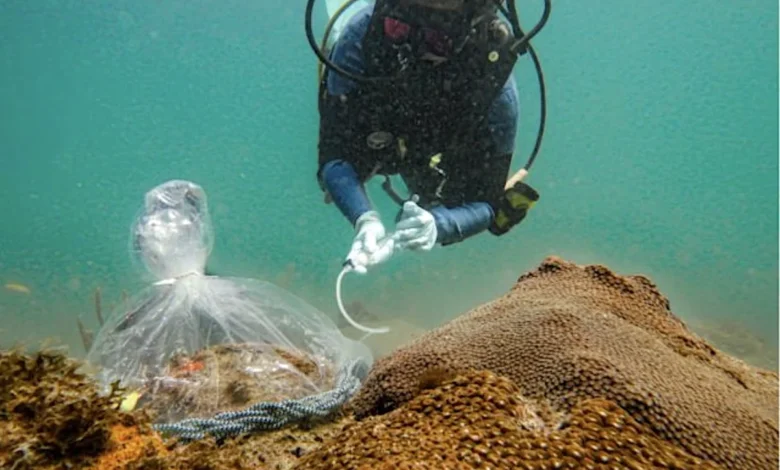
Probiotic treatment of Montastraea cavernosa colonies using a whole-colony bagging technique. Frontiers in Marine Science

The devastating progression of Stony Coral Tissue Loss Disease (SCTLD) across the Florida Reef Tract and throughout the Caribbean has presented one of the most significant challenges to marine conservation in modern history. First identified near Miami in 2014, this lethal malady has systematically decimated coral populations, characterized by a rapid loss of living tissue that often leaves behind nothing but white skeleton. However, a landmark study recently published in the journal Frontiers in Marine Science has unveiled a potent biological weapon in the fight against this aquatic plague: a beneficial bacterial probiotic known as MCH1-7.
The research, led by scientists at the Smithsonian Marine Station, highlights a transformative approach to coral rehabilitation. By utilizing a "whole-colony bagging" technique to administer the probiotic strain MCH1-7, researchers have demonstrated a significant reduction in tissue loss among great star coral (Montastraea cavernosa). This breakthrough suggests that the introduction of specific, naturally occurring bacteria can bolster the immune defenses of entire coral colonies, offering a more sustainable and effective alternative to traditional antibiotic treatments that carry the risk of promoting environmental drug resistance.
The Genesis of a Biological Defense: The MCH1-7 Strain
The discovery of the MCH1-7 probiotic strain dates back to 2018, during a period of intense field observation by Smithsonian researchers. While surveying reefs heavily impacted by SCTLD, scientists noticed an anomaly: certain coral colonies remained healthy and vibrant despite being surrounded by diseased neighbors. This phenomenon suggested a natural resistance, prompting the team to investigate the microbial communities residing on these "survivor" corals.
From these resistant colonies, scientists isolated the MCH1-7 strain. Laboratory analysis revealed that this bacterium produces a specific chemical compound known as tetrabromopyrrole (TBP). In the complex ecosystem of a coral reef, TBP serves multiple roles. It is known to act as a "settlement cue," a chemical signal that tells coral larvae that a particular surface is a healthy and suitable place to attach and grow. Beyond its role in recruitment, TBP exhibits potent antimicrobial properties, effectively inhibiting the growth of pathogens associated with SCTLD.
The implications of this dual-purpose compound are profound. As Jennifer Sneed, a biologist at the Smithsonian Marine Station, noted, the production of TBP creates a feedback loop of health. If the bacteria produce a compound that both protects the coral from disease and encourages new larvae to settle in the same area, the reef’s capacity for natural regeneration is significantly enhanced.
Methodology: Bagging vs. Direct Application
To move from laboratory potential to field effectiveness, the research team designed a rigorous experiment focusing on Montastraea cavernosa, a hardy reef-building species. The primary objective was to determine the most effective delivery mechanism for the MCH1-7 probiotic. Two distinct methods were tested: a localized paste application and a whole-colony immersion technique.
In the localized treatment, researchers developed a specialized paste infused with the probiotic, which was applied directly to the active lesions of the diseased corals. This method aimed to stop the disease at the point of impact. Conversely, the "whole-colony bagging" technique involved a more comprehensive approach. Divers placed large, weighted plastic bags over entire coral colonies, creating a temporary enclosed environment. The MCH1-7 probiotic was then injected into the seawater trapped within the bag. After a period of immersion, the bags were removed, allowing the coral to have absorbed or integrated the beneficial bacteria across its entire surface area.
The monitoring phase of the study was exceptionally long-term, spanning 2.5 years. This duration allowed researchers to observe not only the immediate cessation of tissue loss but also the long-term resistance of the treated colonies against reinfection or disease progression.
Comparative Results and Quantitative Success
The data yielded from the 2.5-year monitoring period provided a clear distinction between the two methods. The whole-colony bagging technique emerged as the superior strategy. Corals treated with this method experienced an average tissue loss of only 7% over the course of the study. In stark contrast, the control group—untreated corals in the same environment—suffered a devastating average tissue loss of 35% due to SCTLD.
Furthermore, the localized paste application proved largely ineffective at providing long-term protection. While it may have slowed the disease at the specific site of the lesion for a short period, it failed to provide the systemic protection necessary to prevent new lesions from forming elsewhere on the colony. The success of the bagging method suggests that the probiotic needs to be integrated into the coral’s "holobiont"—the entire community of organisms including the coral animal, its symbiotic algae, and its resident microbes—to be truly effective.

The researchers also conducted safety trials to ensure that the introduction of MCH1-7 would not have unintended negative consequences for other Caribbean coral species. The results confirmed that the probiotic is safe for the surrounding environment, reinforcing its potential as a broad-scale conservation tool.
Chronology of the SCTLD Crisis and Research Response
To understand the weight of this study, one must look at the timeline of the Stony Coral Tissue Loss Disease outbreak:
- 2014: SCTLD is first reported off the coast of Virginia Key, Florida. It spreads rapidly, unlike any previous coral disease outbreak in terms of its geographic range and the number of species affected.
- 2015-2017: The disease moves north to the St. Lucie Inlet and south through the Florida Keys, reaching the Marquesas Keys. Mortality rates among susceptible species like pillar coral and maze coral approach 90-100% in affected areas.
- 2018: Smithsonian researchers identify MCH1-7 on resistant colonies, sparking the shift from reactive monitoring to proactive biological intervention.
- 2019-2021: Initial laboratory trials and small-scale field applications begin. The focus shifts to identifying the specific compounds (like TBP) that drive the probiotic’s success.
- 2022-2024: The long-term study on Montastraea cavernosa concludes, providing the first multi-year data set proving the efficacy of whole-colony probiotic treatment.
- 2025: The findings are published in Frontiers in Marine Science, providing a roadmap for future large-scale reef restoration projects.
Logistical Challenges and the Path to Scalability
While the results are overwhelmingly positive, the researchers are quick to point out the logistical hurdles associated with the whole-colony bagging method. The process is labor-intensive, requiring skilled scuba divers to transport heavy materials, deploy the bags, manage the probiotic injections, and return later for retrieval. This "material transport" makes the method more expensive and time-consuming than applying a simple paste or liquid spray.
However, the authors of the study argue that the "cost-to-benefit" ratio justifies the effort. Given that the bagging method provides resistance for over two years, it reduces the need for frequent repeat interventions. Kelly Pitts, the lead author of the study, emphasized that while this is not a "cure-all" that can be applied to every square inch of the ocean, it is a vital tool for protecting high-value reef areas and "mother" colonies that are essential for spawning and reef recovery.
The next phase of research will likely focus on streamlining the delivery process. Scientists are investigating the possibility of using "slow-release" mechanisms or autonomous underwater vehicles (AUVs) to assist in the application, which could lower the reliance on human divers and allow for the treatment of deeper or more remote reef systems.
Ecological and Economic Implications
The health of the Florida Reef Tract is not merely a matter of environmental concern; it is a cornerstone of the regional economy. Florida’s reefs support more than 70,000 jobs and contribute approximately $8 billion in economic activity through tourism, fishing, and coastal protection. Corals act as natural breakwaters, absorbing wave energy and protecting shorelines from erosion and storm surges—a function that is becoming increasingly critical as sea levels rise and hurricane intensity increases.
The success of the MCH1-7 probiotic offers a glimmer of hope for preserving these ecosystem services. By maintaining the structural integrity of reef-building species like Montastraea cavernosa, the treatment helps ensure that the reefs can continue to provide habitat for thousands of marine species.
Furthermore, this research signals a paradigm shift in marine biology. For decades, the primary response to environmental degradation has been "passive restoration"—simply reducing stressors like pollution and overfishing. While these remain essential, the Smithsonian study highlights the necessity of "active restoration"—intervening biologically to help species adapt to a rapidly changing and increasingly pathogen-rich ocean.
Conclusion: A Foundation for Future Intervention
The publication of this study in Frontiers in Marine Science marks a significant milestone in coral reef conservation. It proves that the marine microbiome can be harnessed to fight disease, much like probiotics are used in human medicine to restore gut health.
As the global community grapples with the impacts of climate change, which often exacerbates the spread of marine diseases by stressing coral hosts, the development of targeted biological treatments like MCH1-7 will be essential. The Smithsonian team’s work provides more than just a treatment for one disease in one species; it provides a scientific framework for the "probiotic revolution" in ocean conservation.
While more research is needed to adapt these methods for other coral species and to scale the technology for regional impact, the move from 35% tissue loss to just 7% represents a monumental victory. In the race against extinction for the Caribbean’s stony corals, science has just gained a powerful new ally.