
The global dietary supplement market, currently valued at over $170 billion, presents a complex landscape for consumers seeking to improve their daily health routines. As wellness trends shift toward functional foods and adaptogenic herbs, products like mushroom coffee and herbal extracts have become staples in the modern pantry. However, the surge in availability has brought a significant challenge: the decoding of marketing terminology versus regulatory reality. Terms such as "FDA-registered," "GMP-certified," and "third-party tested" are frequently used as badges of quality, yet they represent distinct layers of oversight that are often misunderstood by the general public.
To make informed choices, consumers must look past the aesthetic of a label and understand the structural framework of supplement manufacturing. A common point of confusion is the role of the U.S. Food and Drug Administration (FDA). Unlike pharmaceutical drugs, which require rigorous pre-market approval to prove safety and efficacy, dietary supplements are regulated under a different set of rules. The burden of proof for safety largely rests on the manufacturer before the product hits the shelves, and the FDA generally only intervenes after a product is on the market if it is found to be misbranded or adulterated.
The Regulatory Framework: Understanding the Role of the FDA
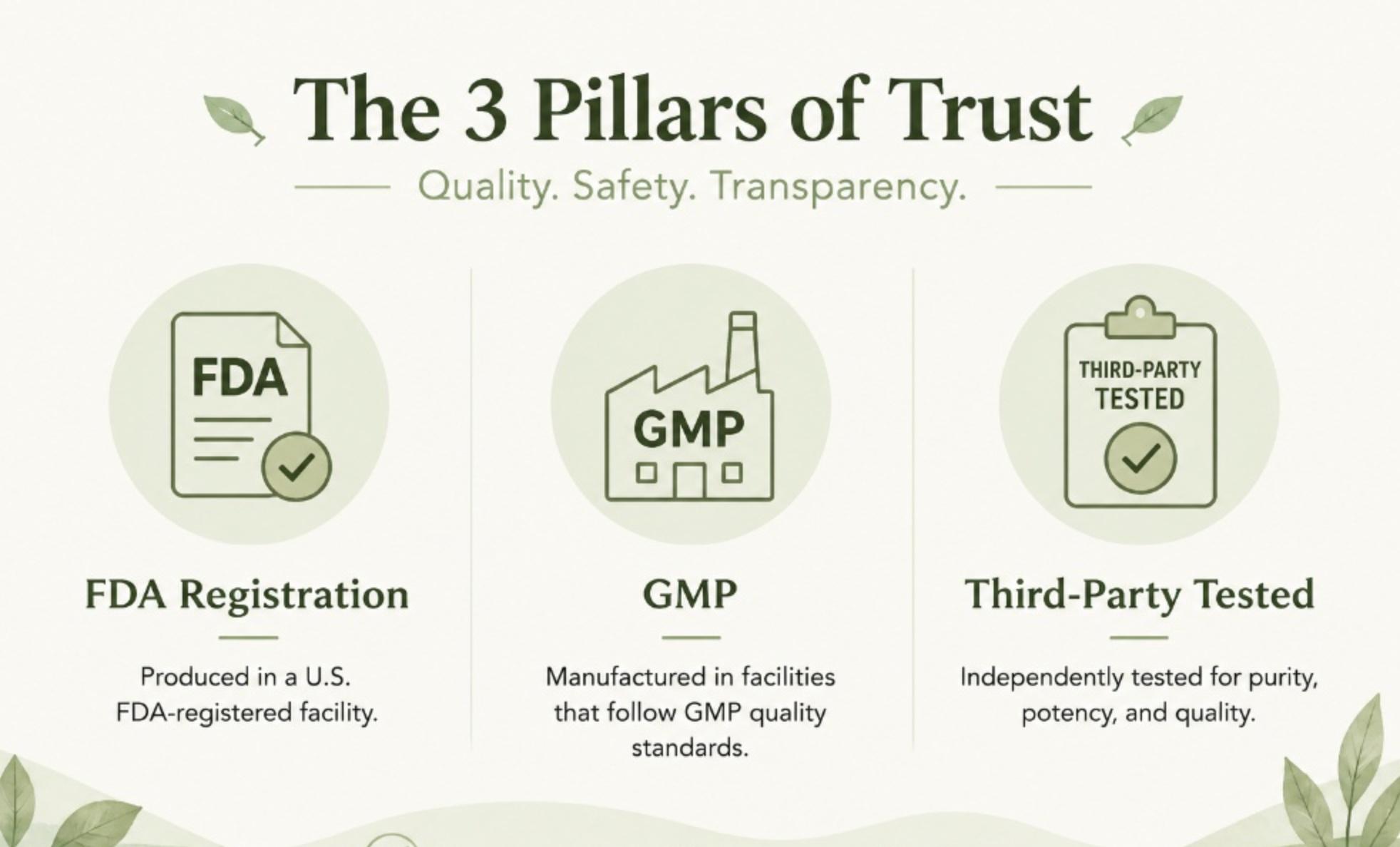
The foundation of modern supplement regulation in the United States is the Dietary Supplement Health and Education Act (DSHEA) of 1994. Under this act, supplements are categorized as a subset of food rather than drugs. This distinction is critical because it dictates that the FDA does not "approve" supplements. When a label claims a product is "FDA-registered," it refers specifically to the facility where the product was manufactured.
Under the Public Health Security and Bioterrorism Preparedness and Response Act of 2002, facilities that manufacture, process, pack, or hold food intended for consumption in the U.S. must register with the FDA. This registration allows the agency to know where products are being made and enables them to conduct inspections. It is a mandatory administrative requirement, not a verification of the product’s health benefits or the purity of its ingredients. Therefore, a facility can be registered with the FDA while still producing a product that may not meet a consumer’s specific quality expectations.
Good Manufacturing Practices: The Standard for Consistency
While FDA registration covers the "where," Good Manufacturing Practices (GMP) cover the "how." GMP standards, specifically 21 CFR Part 111 in the United States, are a set of requirements designed to ensure that dietary supplements are produced in a consistent manner. These regulations aim to prevent common manufacturing errors, such as the inclusion of the wrong ingredients, the addition of too much or too little of an active component, or the risk of contamination by toxins, bacteria, or heavy metals.

A GMP-compliant facility must adhere to strict protocols regarding:
- Personnel: Ensuring staff are properly trained and follow hygiene protocols.
- Physical Plant and Grounds: Maintaining a clean and controlled environment to prevent cross-contamination.
- Equipment: Regular calibration and cleaning of machinery.
- Production and Process Control: Documenting every step of the manufacturing process to ensure the final product matches the intended formula.
- Record Keeping: Maintaining a "paper trail" that allows for the tracking of any batch back to its raw material sources.
For the consumer, a GMP-certified or GMP-compliant label suggests that the brand has invested in a professional manufacturing process. However, because the FDA does not have the resources to inspect every facility every year, many brands seek private, third-party audits to verify their GMP compliance.
Third-Party Testing: The Independent Verification Layer
The third pillar of supplement quality is independent, third-party testing. Because a manufacturer’s internal lab might have a vested interest in passing a batch, an outside laboratory provides an objective analysis of what is actually inside the bottle. These labs test for three primary factors: purity, potency, and identity.
Identity testing confirms that the "Lion’s Mane" listed on the label is, in fact, Lion’s Mane. Potency testing ensures that the amount of an active ingredient—such as the 300 mg of ashwagandha found in Nature Echo Mushroom Coffee—actually matches the label’s claims. Purity testing is perhaps the most vital, as it screens for harmful contaminants including lead, mercury, arsenic, mold, and salmonella.
A key document that emerges from this process is the Certificate of Analysis (COA). A COA is a batch-specific report that details the lab results. Transparent brands often make these documents available to consumers upon request or via a QR code on the packaging. The absence of a COA or a refusal to share testing data is often viewed as a red flag by industry experts and advocacy groups.
Case Study: Analyzing Nature Echo Mushroom Coffee
To see these principles in practice, one can examine the mushroom coffee category, which has seen exponential growth as an alternative to traditional high-caffeine beverages. Nature Echo Mushroom Coffee serves as a representative example of how a brand might structure its transparency.

The product is manufactured in an FDA-registered and GMP-certified facility, addressing the first two pillars of quality. In terms of formulation, the brand discloses a "11-in-1" mushroom blend totaling 2,000 mg per serving. This blend includes well-known species such as Reishi, Cordyceps, and Chaga. Additionally, the formula includes 300 mg of ashwagandha, an adaptogen frequently studied for its role in stress management.
One of the critical challenges in the supplement industry is the use of "proprietary blends." This is a labeling loophole where a brand lists a group of ingredients but only provides the total weight of the group, not the individual amounts of each ingredient. This makes it difficult for consumers to know if they are receiving an "effective dose" based on scientific research. In the case of Nature Echo, the disclosure of specific amounts, such as the 300 mg of ashwagandha and the total 6g serving size, allows consumers to compare the product more accurately against clinical data and other market competitors. At a price point of approximately $0.67 per cup, it also highlights the economic factor: transparency does not necessarily have to come at a premium price, but it does require a brand to be open about its sourcing and testing.
Chronology of Supplement Regulation and Market Evolution
The journey toward modern supplement standards has been marked by several key milestones:
- 1906: The Pure Food and Drug Act is passed, the first major federal law regulating food and drugs.
- 1938: The Federal Food, Drug, and Cosmetic Act (FD&C Act) gives the FDA more authority over food and drugs.
- 1994: DSHEA is enacted, creating the current framework for dietary supplements and defining them as food.
- 2007: The FDA issues the Final Rule on Dietary Supplement Current Good Manufacturing Practices (cGMPs), requiring all companies to comply by 2010.
- 2010s-Present: The "Clean Label" movement gains momentum. Consumers begin demanding more transparency, leading to the rise of third-party verification programs and public-facing COAs.
This timeline illustrates a clear shift from a "buyer beware" environment to one where the industry is increasingly self-regulating through third-party audits to meet rising consumer expectations.
The Economic and Health Implications of Transparency
The shift toward higher manufacturing standards is not merely a matter of compliance; it has significant economic and health implications. For the consumer, the risk of consuming a contaminated supplement can lead to acute illness or long-term heavy metal toxicity. Economically, the lack of potency in a supplement means the consumer is wasting money on a product that cannot deliver its promised benefits.
Industry analysts suggest that brands that prioritize transparency are likely to see higher long-term customer retention. A 2023 consumer survey indicated that nearly 70% of supplement users are "very concerned" about the purity of the products they ingest, and a majority are willing to pay a slight premium for products that provide verified testing data.
Furthermore, as the market for functional mushrooms and adaptogens like ashwagandha continues to grow—projected to reach over $19 billion by 2030—the pressure on the supply chain increases. Ensuring that mushrooms are grown in clean environments and extracted properly (using methods like dual extraction to unlock beneficial compounds like beta-glucans) is essential for the industry’s credibility.
How to Verify Supplement Quality: A Consumer Checklist
For those looking to integrate supplements into their daily routine, experts recommend a systematic approach to verification:
- Examine the Label for the "Three Pillars": Ensure the brand mentions an FDA-registered facility, GMP standards, and third-party testing.
- Research the Brand’s Transparency: Does the company website explain their sourcing? Do they provide access to batch-specific COAs?
- Check for "Red Flag" Language: Be wary of products that claim to "cure" or "treat" specific diseases, as these are illegal drug claims for supplements.
- Analyze the Dosage: Look for specific milligram counts rather than just "proprietary blends." Compare these dosages to those used in peer-reviewed clinical trials.
- Verify the Testing Body: Not all third-party labs are equal. Look for testing performed by reputable, ISO-accredited laboratories.
Broader Impact on the Wellness Industry
The push for better standards in the supplement world is part of a larger movement toward "functional wellness." As consumers move away from synthetic additives and toward plant-based solutions, the integrity of the natural products industry becomes paramount. The example of mushroom coffee—blending a traditional daily ritual with ancient herbal wisdom—represents a bridge between the past and the future of nutrition.
However, this bridge is only as strong as the regulations and voluntary standards that support it. While the FDA provides the baseline for facility registration, it is the combination of GMP consistency and independent third-party verification that creates a trustworthy product. By understanding these terms, consumers transition from passive purchasers to active participants in their own health, ensuring that their daily wellness choices are backed by more than just marketing.
As the industry continues to evolve, it is likely that more rigorous digital tracking, such as blockchain-enabled supply chain transparency, will become the new standard. Until then, the "Three-Pillar System"—FDA registration, GMP manufacturing, and third-party testing—remains the most reliable map for navigating the complex and ever-expanding world of dietary supplements.