Understanding FDA Registration GMP Standards and Third-Party Testing to Make Informed Daily Wellness Choices


The global dietary supplement market has experienced an unprecedented surge over the last decade, transitioning from a niche health-store industry to a multi-billion-dollar global powerhouse. As consumers increasingly prioritize preventative health and holistic wellness, the shelves of both digital and physical retailers have become crowded with products promising everything from enhanced cognitive function to improved metabolic health. However, this explosion of choice has brought with it a significant challenge: a complex and often misunderstood regulatory landscape. For the average consumer, terms like "FDA-registered," "GMP-certified," and "third-party tested" are frequently viewed as interchangeable seals of approval, yet they represent vastly different benchmarks of quality, safety, and oversight. Understanding these distinctions is no longer just a matter of curiosity; it is a fundamental requirement for navigating a market where the burden of verification largely rests on the buyer.
The Regulatory Framework: FDA Registration Versus Approval
One of the most persistent myths in the wellness industry is the belief that the U.S. Food and Drug Administration (FDA) "approves" dietary supplements for safety and effectiveness before they reach the market. In reality, the regulatory framework for supplements is governed by the Dietary Supplement Health and Education Act of 1994 (DSHEA). Under this federal law, dietary supplements are regulated more like food than drugs. Unlike pharmaceutical medications, which must undergo rigorous clinical trials and receive formal FDA approval before being sold, dietary supplements do not require pre-market approval.
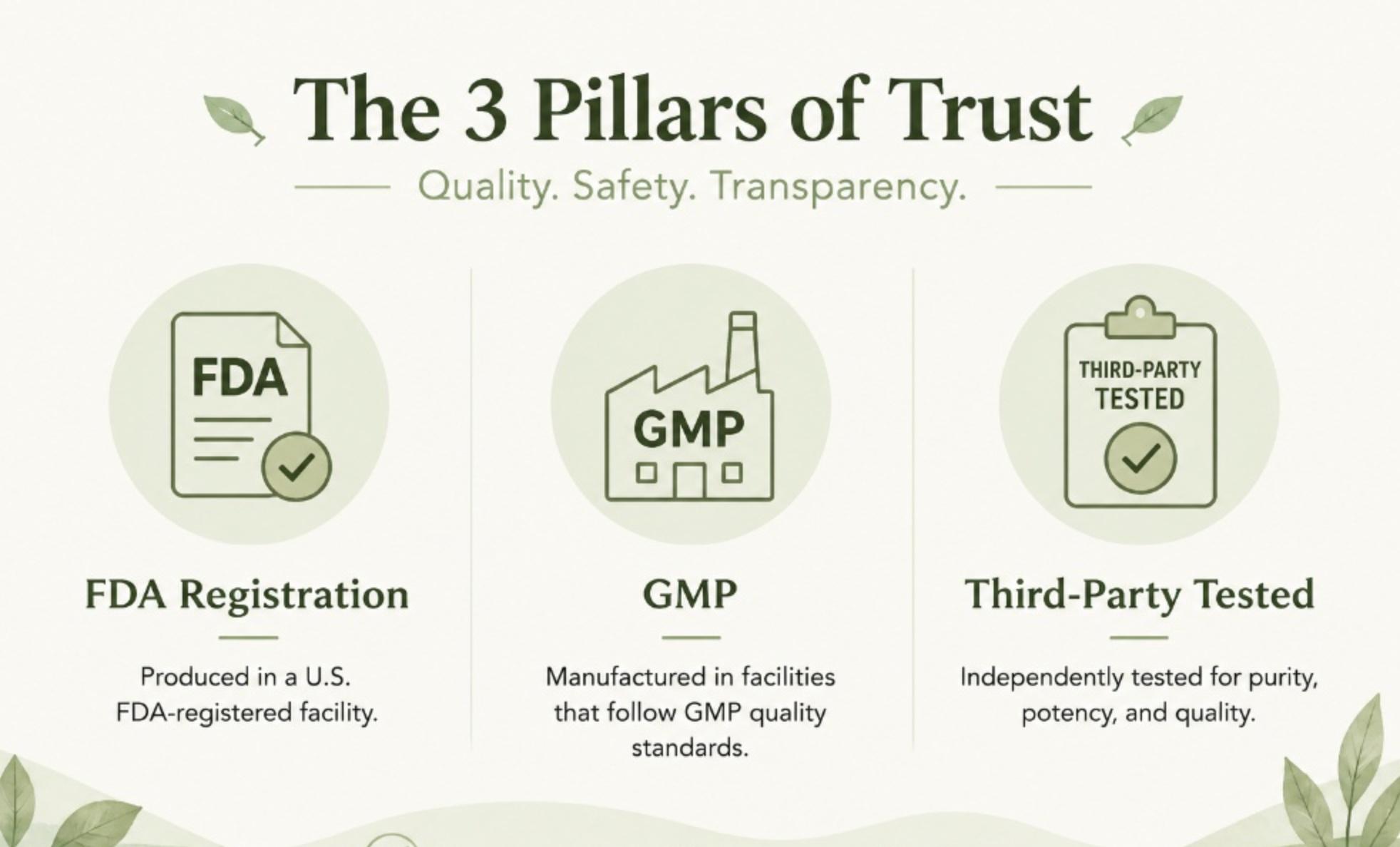
When a brand states that its products are manufactured in an "FDA-registered facility," it is disclosing a baseline administrative requirement rather than a product-specific endorsement. Under the Public Health Security and Bioterrorism Preparedness and Response Act of 2002, all facilities that manufacture, process, pack, or hold food (including supplements) for consumption in the U.S. must register with the FDA. This registration allows the agency to know where products are made so they can conduct inspections and respond to public health emergencies. It does not, however, mean the FDA has tested the specific formula, verified the label claims, or guaranteed the efficacy of the product inside the bottle.
The Evolution of Quality: A Chronology of Supplement Regulation
To understand why current quality standards matter, one must look at the timeline of how the industry reached its current state. The journey from unregulated "snake oils" to modern, high-tech manufacturing has been marked by several key legislative milestones:

- 1906: The Pure Food and Drug Act: The first major federal law to address food and drug safety, focusing primarily on preventing misbranding and adulteration.
- 1938: The Federal Food, Drug, and Cosmetic Act (FD&C Act): This expanded the FDA’s authority, requiring drugs to be proven safe before marketing, though supplements remained in a gray area.
- 1994: Dietary Supplement Health and Education Act (DSHEA): This landmark legislation defined "dietary supplements" as a category of food and shifted the burden of proof. The FDA must prove a supplement is unsafe before it can be removed from the market, rather than the manufacturer proving it is safe before it is sold.
- 2007: Final Rule on GMPs: The FDA issued a final rule requiring all dietary supplement manufacturers to comply with current Good Manufacturing Practices (cGMPs). This was a turning point for industry quality control.
- 2011: Food Safety Modernization Act (FSMA): This shifted the focus from responding to contamination to preventing it, adding more layers of facility oversight.
Defining GMP: The Foundation of Manufacturing Consistency
While FDA registration identifies where a product is made, Good Manufacturing Practices (GMP) dictate how it is made. GMP standards, specifically 21 CFR Part 111 in the United States, are a set of requirements designed to ensure that supplements are produced in a consistent and controlled manner. These standards are intended to prevent common manufacturing errors, such as the inclusion of the wrong ingredients, the presence of too much or too little of a stated nutrient, and the risk of contamination by toxins, bacteria, or heavy metals.
A GMP-compliant facility must adhere to strict protocols regarding:
- Personnel: Ensuring staff are properly trained and follow hygiene protocols.
- Physical Plant and Grounds: Maintaining a clean and suitable environment for production.
- Equipment: Regularly calibrating and cleaning machinery to prevent cross-contamination.
- Production and Process Controls: Utilizing "Master Manufacturing Records" to ensure every batch is identical to the last.
- Labeling and Packaging: Ensuring the product in the bottle matches the description on the outside.
For the consumer, a "GMP-certified" label suggests that the manufacturer has invested in the infrastructure necessary to produce a reliable product. However, because the FDA does not have the resources to inspect every facility every year, many reputable brands seek voluntary audits from third-party organizations like NSF International or USP to verify their GMP compliance.
Third-Party Testing: The Shield Against Contamination
Even with perfect manufacturing processes, the raw materials used in supplements can be a source of risk. Mushrooms, herbs, and minerals are often sourced globally, and soil quality or harvesting methods can introduce contaminants like lead, arsenic, mercury, or mold. This is where third-party testing becomes essential.
Third-party testing involves sending finished products or raw ingredients to an independent, accredited laboratory that has no financial stake in the brand. These labs perform several critical checks:

- Purity: Checking for the presence of "unlisted" ingredients or fillers.
- Potency: Verifying that the amount of active ingredient (e.g., milligrams of caffeine or ashwagandha) matches the label.
- Safety: Screening for microbial contaminants (E. coli, Salmonella) and heavy metals.
A key document that emerges from this process is the Certificate of Analysis (COA). A COA is a batch-specific report that details the results of these tests. Transparent brands often make these documents available to consumers upon request or via QR codes on their packaging. If a brand cannot or will not provide a COA, it raises questions about the rigor of their quality control.
Case Study: Analyzing Transparency in the Mushroom Coffee Market
The "functional mushroom" sector provides a clear example of why these standards are necessary. Mushroom coffee—typically a blend of traditional coffee beans and extracts from fungi like Lion’s Mane, Reishi, or Cordyceps—has become a staple for those seeking "jitter-free" energy and cognitive support. However, the quality of these products varies wildly depending on whether the brand uses the "fruiting body" (the actual mushroom) or the "mycelium" (the root system, often grown on grain fillers).
Nature Echo Mushroom Coffee serves as an illustrative example of the transparency modern consumers are beginning to demand. According to company data, the product is manufactured in an FDA-registered and GMP-certified facility. By disclosing a specific formula—containing 300 mg of ashwagandha and a 2,000 mg blend of 11 different mushroom species per serving—the brand allows consumers to compare its profile against clinical research.
Furthermore, the brand’s pricing model—approximately $0.67 per cup—highlights a broader industry trend where increased transparency does not necessarily equate to prohibitive costs. When a brand discloses its full ingredient profile rather than hiding behind a "proprietary blend," it empowers the consumer to evaluate the cost-to-benefit ratio. In the case of ashwagandha, for instance, many clinical studies on stress and focus utilize dosages between 300 mg and 600 mg. Without specific dosage disclosure, a consumer has no way of knowing if the product contains a therapeutic amount or a negligible "dusting" of the ingredient.
The Problem with Proprietary Blends
A significant hurdle in the supplement industry is the use of "proprietary blends." Under current labeling laws, brands can list a group of ingredients as a single "blend" and only disclose the total weight of that blend, rather than the weight of each individual component. While this is legally intended to protect trade secrets, it often serves to obscure the fact that the most expensive and effective ingredients may only be present in trace amounts.
Industry analysts suggest that the move away from proprietary blends toward "full-label transparency" is a hallmark of the "Supplement 2.0" era. Brands that provide individual dosages are generally viewed more favorably by health professionals and informed consumers because they allow for precise supplementation.
Broader Implications for Public Health and Industry Trust
The importance of understanding these three pillars—FDA registration, GMP standards, and third-party testing—extends beyond individual health. It impacts the stability of the entire wellness industry. When high-profile "scandals" occur—such as when major retailers were found to be selling supplements that contained none of the herbs listed on the label—it erodes public trust in all wellness products.
By demanding third-party verification and GMP compliance, consumers are effectively "voting with their wallets" for a more regulated and honest marketplace. This consumer pressure encourages more brands to adopt rigorous standards, which in turn reduces the likelihood of adverse events and improves the overall efficacy of the products on the market.
Conclusion: A Checklist for the Informed Consumer
As the wellness industry continues to evolve, the line between "marketing" and "medicine" will likely remain blurred. To navigate this safely, consumers should adopt a systematic approach to evaluating any new supplement:
- Verify the Facility: Is the product made in an FDA-registered, GMP-compliant facility?
- Demand Testing Proof: Does the brand offer a Batch-specific Certificate of Analysis (COA)?
- Evaluate the Label: Does the product avoid "proprietary blends" in favor of specific, milligram-level ingredient disclosures?
- Check for Fillers: Are there unnecessary additives, artificial colors, or "other ingredients" that seem out of place?
- Contextualize Claims: Remember that while these quality standards ensure the product is clean and accurately labeled, they do not guarantee it will "cure" or "prevent" any specific condition—a disclaimer required by the FDA on every supplement label.
In an era of instant information, the tools for making informed wellness choices are more accessible than ever. By looking past the aesthetic of the packaging and into the specifics of the manufacturing process, consumers can ensure that their daily routines are supported by products that are as safe and effective as they are convenient.