WHO Director-General Concludes High-Level Visit to Jordan Highlighting Universal Health Coverage, Refugee Support, and Humanitarian Aid

The landscape of international humanitarian response and universal health coverage came into sharp focus this week as Dr. Tedros Adhanom Ghebreyesus, Director-General of the World Health Organization (WHO), completed the inaugural day of his landmark two-day state visit to the Hashemite Kingdom of Jordan. The visit served as a vital platform to underscore the profound and enduring partnership between the global health agency and the Jordanian government, emphasizing crucial intersections between national health systems, mental health integration, and emergency relief operations across the Middle East.
Against a backdrop of complex regional crises, the mission highlighted Jordan’s exceptional capacity to act as a humanitarian anchor. By hosting more than three million refugees—predominantly from neighboring Syria and conflict-stricken Gaza—the Hashemite Kingdom has consistently demonstrated a model of solidarity, resilience, and operational efficiency that international bodies frequently hold up as a global standard.
High-Level State Diplomacy and Strategic Discussions
A defining moment of the visit unfolded inside the royal palaces of Amman, where Dr. Tedros was officially received by His Majesty King Abdullah II. The high-level dialogue placed heavy emphasis on structural health system enhancements, strategies for broadening population-wide access to medical care, and the imperative of sustaining multilateral financial and logistical support for emergency medical responses throughout the region.
Discussions specifically targeted the acute medical needs of the Palestinian population, focusing heavily on patients medically evacuated from the Gaza Strip into Jordanian facilities for specialized treatment. Both leaders reviewed the mechanics of regional health corridors and the logistical challenges associated with maintaining high standards of care amid severe geopolitical friction.
Expressing deep gratitude during the meeting, Dr. Tedros lauded the monarch’s visionary leadership. “I wish to express my appreciation to His Majesty King Abdullah II for his commitment to advancing universal health coverage,” Dr. Tedros stated. “I also extend my thanks to His Majesty and the people of Jordan for their solidarity and generosity in providing health services to more than three million refugees, primarily from Gaza and Syria, who are living in the country.”
The WHO Director-General specifically drew attention to the Hashemite Kingdom’s innovative humanitarian architecture, highlighting the King’s Medical Corridor initiative. This specialized framework has proven instrumental in delivering life-saving medical interventions to critically ill and injured children evacuated from Gaza. Through such efforts, Jordan continues to articulate a clear message to the international community regarding the prioritization of health and human dignity above all else.
Ground-Level Realities: Visiting Evacuated Children and Frontline Workers
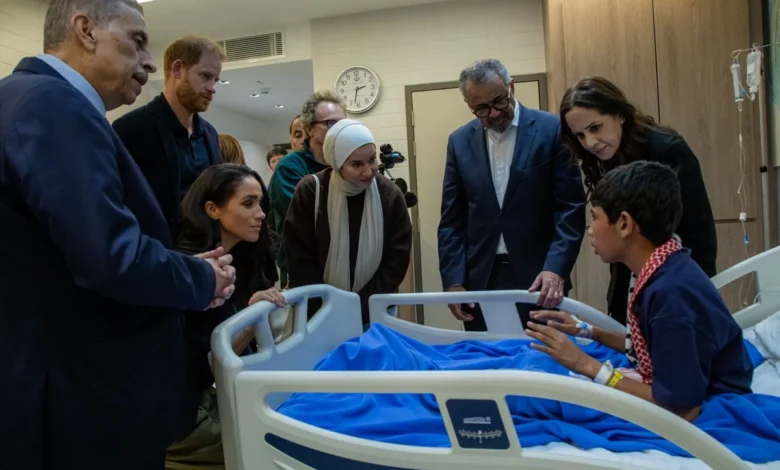
Moving beyond diplomatic chambers, Dr. Tedros transitioned from high-level policy talks to direct field engagement by visiting a specialized, WHO-supported hospital in Amman dedicated to treating pediatric patients evacuated from Gaza. The visit offered the Director-General an unvarnished look at the human toll of the ongoing regional conflict and the remarkable efforts of medical professionals working under intense pressure.
During the hospital tour, Dr. Tedros interacted directly with young patients, their families, and the multidisciplinary teams of frontline health workers. These medical personnel provide continuous, life-saving treatments for complex traumatic injuries, pediatric oncology cases, and other critical health conditions resulting from the breakdown of health infrastructure in conflict zones.
The field visit underscored the indispensable nature of the Jordan-facilitated medical evacuation corridor. It also served as a stark reminder to international donors that sustained financial backing is urgently required to keep these pathways open, ensuring that vulnerable pediatric patients and other critical cases can continue to cross borders for specialized interventions that are otherwise unavailable locally.
Mobilizing International Support: The High-Level Partner Convening
Recognizing that sustainable healthcare delivery requires robust financial architectures, Dr. Tedros convened a high-level strategic roundtable later in the day. The gathering brought together key stakeholders, including international donor governments, partner United Nations agencies, and major philanthropic foundations.
The primary agenda of the convening centered on mapping out immediate and medium-term financing priorities aimed at reinforcing Jordan’s national health infrastructure. Discussions also addressed the financial strains of maintaining expansive humanitarian health actions, scaling up community-level mental health services, and alleviating the resource pressures experienced by host-nation institutions.
Participants engaged in rigorous dialogue regarding burden-sharing models for countries accommodating large displaced populations. Dr. Tedros welcomed the concrete commitments articulated by institutional partners, emphasizing that sustained investment in Jordan’s health sector acts as an investment in broader regional stability and security.
Bilateral Health Sector Integration and Primary Care
In addition to multilateral engagements, Dr. Tedros held focused bilateral talks with Jordan’s Minister of Health. These discussions dissected the mechanics of Jordan’s broader healthcare strategy, particularly the nation’s progressive push toward universal health coverage (UHC) anchored by a robust primary health care (PHC) framework.
Jordan has steadily earned international recognition for embedding mental health services directly into routine primary care facilities. Rather than treating mental health as a secondary or specialized luxury, the Jordanian health system has operationalized mental health integration so that citizens and residents can access psychological support seamlessly alongside physical health services.
This progressive integration aligns closely with the objectives of the WHO Director-General’s Special Initiative for Mental Health. WHO officials reiterated their technical and strategic commitment to supporting Jordan as it refines these models, ensuring that primary healthcare centers remain equipped to handle both physical pathologies and psychological trauma.
Archewell Philanthropies and the Global Advocacy for Mental Health
A notable dimension of the state visit was the presence of Prince Harry, Duke of Sussex, and Meghan, Duchess of Sussex, who accompanied Dr. Tedros for several key engagements. Operating in their capacities as founders of Archewell Philanthropies—and as long-standing, high-profile advocates for WHO’s global health initiatives—the Duke and Duchess brought significant international visibility to the mission.
Archewell Philanthropies has a documented history of supporting WHO-led global health campaigns, ranging from advocating for equitable access to COVID-19 medical countermeasures to supporting targeted medical evacuation operations and trauma-informed mental health programs. During the Amman engagements, Prince Harry participated actively as a strategic ally of the WHO’s mental health mandate, emphasizing the urgent need to invest in psychological resilience across diverse communities, particularly within emergency settings, conflict zones, and vulnerable demographics such as men, adolescents, and children.
Dr. Tedros acknowledged the impact of this partnership, noting, “I want to thank our partners, including Prince Harry, Duke of Sussex and Meghan, Duchess of Sussex, whose commitment to mental health and humanitarian action has helped bring visibility, resources and hope to some of the world’s most vulnerable communities. Their collaboration is helping to advance WHO’s mission to ensure health for all.”
Reflecting on the mission, Prince Harry shared his perspective on the ground realities observed in Jordan. “It is an honour to join the Director-General of the World Health Organization in Jordan, a country that is leading by example in compassion, resilience and innovation,” the Duke of Sussex said. “Through our work with Archewell Philanthropies, my wife and I have seen first-hand the impact of WHO’s efforts to support mental health and deliver life-saving care in emergencies. We remain deeply committed to advancing awareness, reducing stigma and expanding access to mental health support for all those affected by conflict and crisis. Mental health is fundamental to recovery, dignity and long-term peace, and we are proud to stand with WHO and partners around the world to make it a global priority.”
Day Two Itineraries and Forward-Looking Agenda
As the two-day state visit progresses into its final phase, Dr. Tedros is scheduled to tour the National Center for Rehabilitation of Addicts in Jordan. Supported extensively by WHO, this facility represents a vital component of the nation’s healthcare architecture, offering comprehensive, integrated medical, psychological, and social rehabilitation services for individuals struggling with substance use disorders.
Furthermore, the Director-General will engage with prominent community leaders and grassroots women’s organizations, including representatives from the Jordanian Hashemite Fund for Human Development (JOHUD). These sessions are designed to explore community-led health initiatives and the crucial role that women play as frontline agents of health promotion and social cohesion.
The itinerary also features a high-profile visit to the globally renowned King Hussein Cancer Center (KHCC). Discussions at KHCC will center on cutting-edge advancements in oncology care, the expansion of specialized cancer treatment protocols, and opportunities for fostering cross-border regional collaboration in specialized medical research and oncology therapeutics.
The state visit is scheduled to conclude with a final series of consultations involving international humanitarian operators and institutional donors. These concluding meetings will cement Jordan’s strategic standing not merely as a temporary host of displaced populations, but as an indispensable regional nexus for medical evacuations, rapid emergency response coordination, and long-term health system resilience.
Through this high-level mission, WHO and its international partners have reinforced the reality that universal health coverage, mental health parity, and refugee health security are not abstract ideals, but urgent operational necessities requiring sustained global solidarity, innovative financing, and unwavering political will.