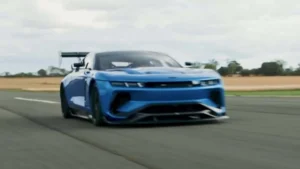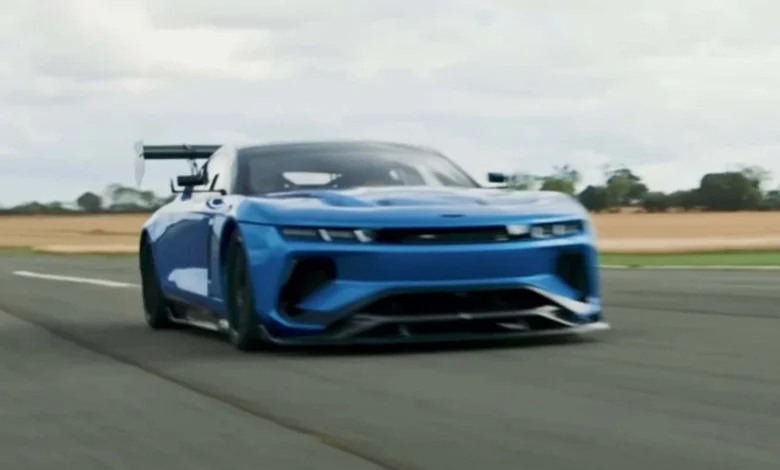
The automotive world has turned its attention to the re-emergence of a legendary British nameplate as the Jensen Interceptor GTX prototype breaks cover. While currently confined to the confines of a closed-circuit environment, this track-only prototype represents a significant milestone in the revival of a brand synonymous with grand touring luxury and raw American-sourced muscle. By blending classic British design philosophy with modern, high-output engineering, the new GTX serves as a technological testbed for a future road-going evolution.
A Legacy Reimagined: The Context of the Jensen Return
The Jensen Interceptor originally rose to prominence between 1966 and 1976, celebrated for its unique combination of sleek Italian styling by Carrozzeria Touring and powerful Chrysler V8 engines. It was the quintessential "gentleman’s express"—a car capable of effortless long-distance travel at high speeds. The decision to resurrect the Interceptor name is not merely a nostalgic exercise but a calculated attempt to occupy a specialized niche in the contemporary high-performance market.
The current development cycle for the GTX began with the goal of establishing a robust, race-proven foundation. By focusing on a track-only prototype, the engineering team is able to stress-test the chassis, cooling, and drivetrain components under extreme thermal and mechanical loads that are rarely experienced in public road use. This methodology allows for the iterative refinement of the vehicle’s handling characteristics, ensuring that when a road-legal variant eventually reaches the public, it will meet the stringent demands of modern luxury performance standards.
Mechanical Architecture and Engineering Rigor
At the heart of the Jensen Interceptor GTX lies a formidable 6.8-liter supercharged V8 engine. While the block finds its origins in the General Motors stable, the final product is a result of extensive collaboration with Texas-based Late Model Engines (LME). This partnership signifies the global nature of modern vehicle development, where specialized expertise is curated to achieve a specific performance target.
The engine transformation process is comprehensive. LME performs a total teardown and rebuild, replacing stock components with high-specification hardware designed for maximum output. The cylinder heads undergo precision CNC machining to optimize airflow, and titanium valves are integrated to reduce reciprocating mass, allowing for higher engine speeds. The rotating assembly is upgraded with forged components, ensuring the engine can withstand the immense internal pressures generated by the supercharger.
Control of this powerplant is managed by a Motec engine management system, a choice that underscores the professional-grade aspirations of the project. Currently, the GTX is tuned to produce 973 horsepower. However, technical documentation suggests the platform is capable of reaching up to 1,200 horsepower with further mapping adjustments. This staggering power output is delivered to the rear wheels through a traditional manual gearbox, a rarity in an era dominated by dual-clutch and automatic transmissions, providing a purist driving experience that aligns with the brand’s heritage.
Timeline and Developmental Milestones
The path toward the Interceptor GTX’s current state has been marked by a series of strategic announcements. Over the past several months, the company has teased the vehicle’s design, slowly building anticipation through updates on the chassis development and the eventual confirmation of its name.
- Initial Teasers: Jensen first signaled its return by highlighting the development of a modern, high-performance GT, emphasizing its commitment to luxury and power.
- Naming Convention: Following the teaser phase, the "Interceptor GTX" designation was officially confirmed, linking the new car to the historic lineage of the 1960s and 70s.
- Technical Reveal: The recent debut of the track-only prototype provided the first comprehensive look at the powertrain and the vehicle’s intended performance profile.
- Future Road Car Development: The current phase involves track testing and the refinement of the vehicle’s dynamic capabilities, which will inform the final specifications for the upcoming GT and GTR road-legal models.
Industry Implications and Market Positioning
The return of the Jensen brand arrives at a time when the automotive industry is undergoing a massive transition toward electrification. By choosing to center its debut around a high-displacement, supercharged V8, Jensen is positioning itself as a bastion of combustion-engine performance. This approach targets a specific demographic: collectors and driving enthusiasts who prioritize mechanical visceral engagement and acoustic presence over the silent, instantaneous torque of electric vehicles.
The implications of this move are significant. If Jensen succeeds in delivering a road-ready version of the GTX, it will compete in an ultra-exclusive market segment populated by restomod manufacturers and boutique supercar builders. The ability to bridge the gap between a raw race car and a usable grand tourer will be the true test of the company’s engineering maturity.
The Road Ahead: From Track to Public Consumption
Jensen has clearly outlined a dual-track strategy for the future. The development of the GTX race car serves as the primary data-gathering phase, providing engineers with real-world feedback on aerodynamics, suspension geometry, and power delivery. This data is essential for the planned "GT" (Grand Touring) and "GTR" (Sporting) models.
While official timelines for the production-spec road cars remain undisclosed, the project is clearly gaining momentum. The transition from a track-only prototype to a road-legal vehicle involves significant regulatory hurdles, including safety, emissions, and crash testing—factors that the company must navigate with precision.
Industry analysts suggest that the price point for a final production version will be substantial, reflecting the bespoke nature of the build and the high-performance components utilized throughout the vehicle. However, for a brand with such a storied history, the value proposition is as much about the provenance and the "soul" of the machine as it is about the raw performance metrics.
Conclusion: A New Chapter for a Classic Icon
The Jensen Interceptor GTX represents a bold attempt to resurrect a dormant British powerhouse. By prioritizing the development of a race-bred foundation, the company has demonstrated a commitment to substance over superficiality. The sight and sound of the 6.8-liter V8 at full throttle provide a sensory experience that is increasingly rare in the modern automotive landscape.
As the prototype continues its testing regimen, the automotive community waits to see if Jensen can successfully translate this raw power into a refined, road-going reality. Should they succeed, the Interceptor will not only reclaim its place in history but will also establish itself as a modern contender in the elite tier of high-performance grand tourers. For now, the focus remains on the track, where the GTX continues to refine its identity, one lap at a time. The sound of that supercharged V8 is more than just an engine note; it is the audible signal of a legendary name preparing for its second act.