
The data, released in full for the first time, provides a granular look at how the UK has navigated its obligations under UN climate treaties. Since 2021, the government has supported approximately 500 individual projects, ranging from solar energy infrastructure in Mozambique to high-integrity carbon offsetting initiatives in the Amazon basin. However, the path to hitting this target has been marked by accusations of creative accounting, with critics arguing that the inclusion of reclassified aid and indirect investments obscures the true level of support being provided to the world’s most climate-vulnerable nations.
A Chronology of Financial Commitment
The UK’s climate finance trajectory has been volatile over the last decade. The commitment to spend £11.6bn between 2021-22 and 2025-26 was first announced in 2019, positioning the UK as a leading donor in the global effort to mobilize $100bn annually to assist developing nations in their transition to net-zero and their adaptation to extreme weather.
The funding profile has evolved significantly:
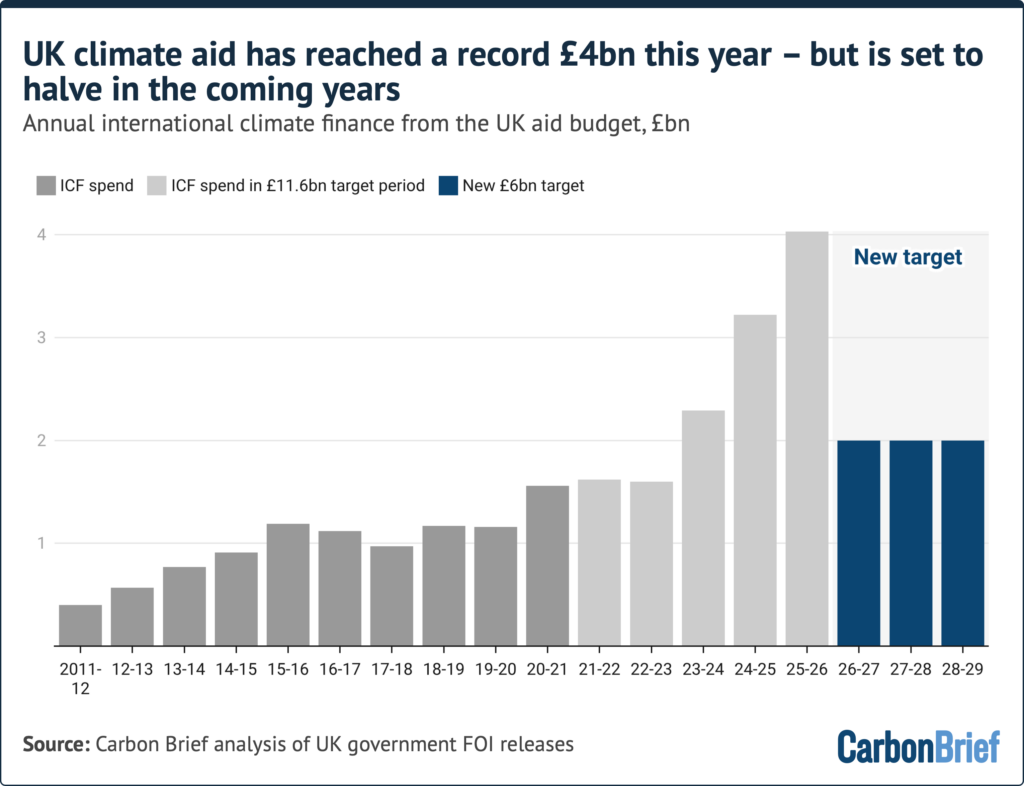
- 2011–2012: The UK initiates its international climate finance (ICF) program, with a relatively modest initial outlay.
- 2019: The government pledges £11.6bn to cover the 2021-2026 period.
- 2021–2022: The official start of the five-year delivery cycle.
- 2025–2026: Climate aid reaches a record annual peak of £4bn, despite broader austerity measures affecting the national aid budget.
- March 2026: The incoming Labour government announces a pivot in strategy, capping future annual climate aid at roughly £2bn for the next three years.
This recent shift in policy marks a pivot away from the high-spending era of the early 2020s. While the record £4bn spent in the most recent fiscal year helped ensure the 2021-2026 target was met, the planned reduction to an annual average of £2bn represents a significant contraction in the UK’s bilateral and multilateral climate footprint.
Data Transparency and the Accountability Gap
One of the most persistent criticisms levied against the government by NGOs, environmental campaigners, and parliamentary committees is the lack of systematic transparency. Although the UK is required to report its progress to the United Nations Framework Convention on Climate Change (UNFCCC), these reports are often subject to a two-year delay and lack the granular, year-on-year breakdowns necessary for robust public scrutiny.
The FOI data obtained by Carbon Brief fills this void, revealing that the UK has relied on controversial accounting methods to meet its headline figures. Notably, approximately £2.2bn of the £12.8bn total was derived from the reclassification of existing foreign aid budgets as "climate finance." This shift did not involve the allocation of new resources but rather a change in how existing expenditure was labeled. Critics from organizations like Save the Children have suggested that such "fiscal gymnastics" risk undermining the integrity of the UK’s international standing, arguing that funds intended for humanitarian crises or education should not be cannibalized to inflate climate targets.
The Geography of Aid: Where the Money Goes
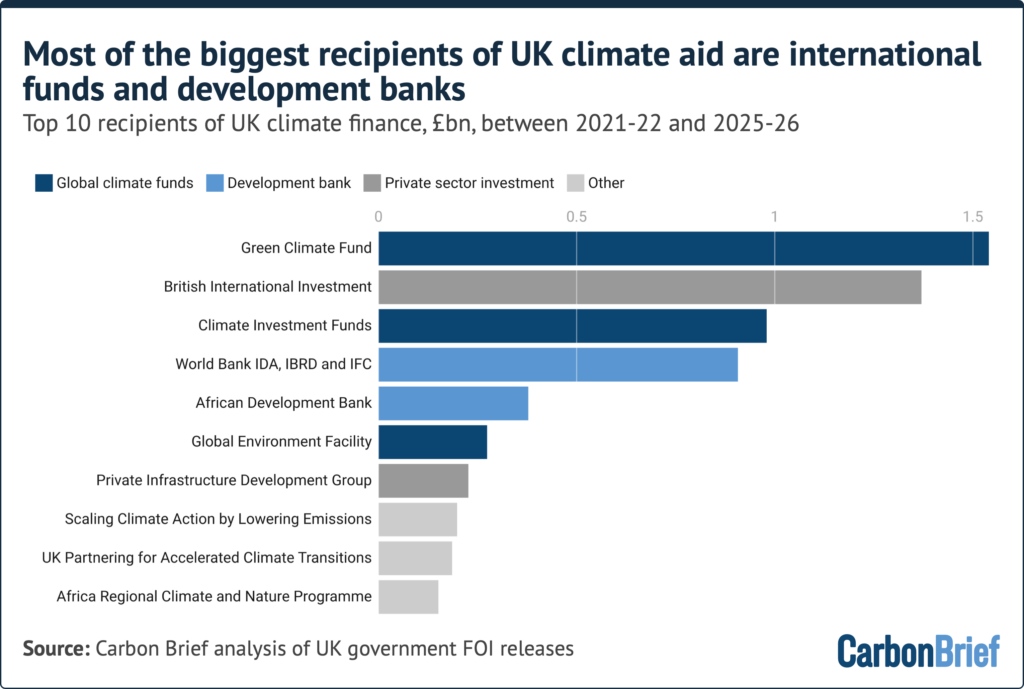
The distribution of UK climate finance reveals a heavy reliance on multilateral institutions. Over 80% of the funding is directed through international funds, development banks, and global initiatives rather than being sent directly to individual nation-states.
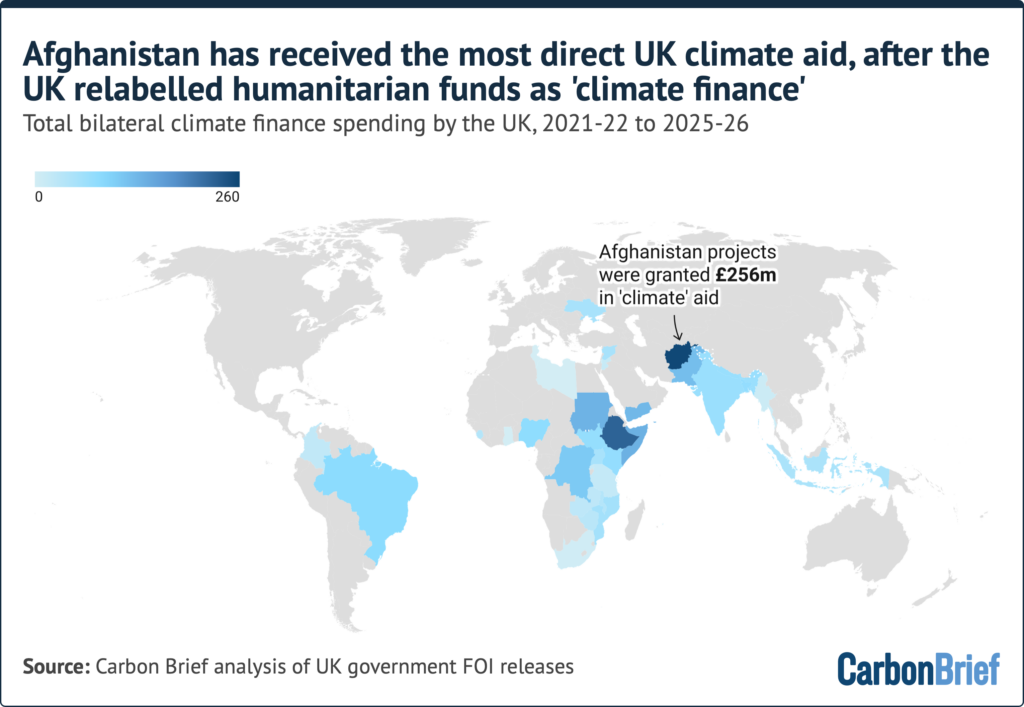
Among the bilateral aid that was delivered, the recipients are heavily skewed toward regions grappling with both conflict and climate instability. Afghanistan, for example, emerged as the top recipient of direct bilateral climate aid, receiving £256m. However, this figure is deceptive; it is not the result of a surge in green-energy projects, but rather the consequence of an internal policy to automatically classify 30% of all humanitarian aid provided to the country as "climate-related." Similar trends were observed in Somalia, Sudan, and Yemen. While these nations are undeniably on the front lines of climate-induced suffering, the blanket classification of emergency relief as climate finance remains a point of contention among development economists.
In contrast, projects in middle-income countries often focus on "mobilizing" private capital. The UK’s £198m investment in a World Bank-backed carbon-offsetting initiative in Colombia and Cambodia, as well as an £83m contribution to the Brazil-based Amazon Fund, exemplify this approach. These initiatives are designed to leverage public money to attract commercial investors, a strategy the UK government maintains is essential for filling the massive financing gap required to transition global energy markets.
The Role of Development Banks and Private Finance
The largest individual beneficiaries of UK climate aid are not local government bodies in developing nations, but rather large-scale financial institutions. The Green Climate Fund (GCF) received £1.5bn, while British International Investment (BII)—the UK’s development finance institution—was allocated £1.4bn.
The reliance on BII reflects a strategic decision to move away from traditional grant-based funding toward investment-led models. Proponents argue that BII’s pivot toward clean-energy projects in Africa and South Asia—such as solar farms in Uganda and sustainable aviation fuel facilities in Pakistan—demonstrates the potential of private capital to drive decarbonization. However, the institution has faced scrutiny over its historical ties to fossil fuel assets and the effectiveness of its for-profit model in reaching the poorest populations.
The government has also indicated that for the coming years, it will look outside the traditional aid budget to drive climate outcomes. The pledge to invest £6.7bn in export credits, guarantees, and private-sector partnerships represents a fundamental shift. While this provides a new mechanism for influence, it also moves the UK away from the unconditional grant model favored by many developing nations, potentially shifting the burden of repayment onto the recipient countries.
Implications and Future Outlook
The transition from a £11.6bn five-year target to a more conservative £6bn three-year spending plan, coupled with the reliance on "questionable" accounting, leaves the UK in a complex position ahead of future COP climate summits. The government’s move to diversify its toolkit by including non-aid budget investment is seen by some as a pragmatic response to fiscal constraints, but by others as a withdrawal from its moral obligations.
The implications for developing countries are significant. As the UK reduces its direct grant-based support, nations that lack the financial stability to attract private investment may see a decline in the support available for essential climate adaptation projects, such as flood defenses in Nepal or drought resilience programs in East Africa.
As it stands, the UK’s climate finance record is one of high-level ambition tempered by the realities of domestic fiscal pressure and the complexities of international accounting standards. With the data now fully in the public domain, the conversation is likely to shift from the total amount of money "committed" to the tangible, verified impact of the projects on the ground. For policymakers, the challenge will be to ensure that future climate finance is not only transparent and accounted for with greater rigor but also directed toward the communities most in need of a transition that is both green and equitable.