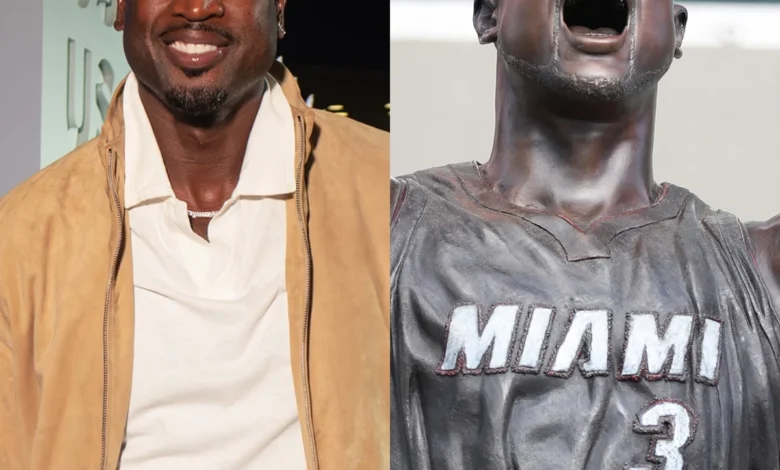
Basketball legend Dwyane Wade has embraced a humorous approach to a significant public makeover regarding his bronze tribute outside the Kaseya Center in Miami. Two years after the original sculpture commemorating his illustrious 15-season career with the Miami Heat sparked widespread online discourse and memes due to its likeness, the franchise unveiled a thoroughly revised version of the eight-foot artwork. Taking to social media on October 30, the 44-year-old retired shooting guard shared images of the refreshed headpiece and facial enhancements, quipping alongside the post, "Ok ok ok there’s nothing wrong with getting a little work done!"
The update marks a notable chapter in the public life of the three-time NBA champion, whose career has continually intersected with themes of legacy, family, and public scrutiny. Beyond the bronze monument outside his former team’s arena, Wade has consistently used his platform to reflect on personal growth, particularly highlighting the profound lessons he has learned from his children, including his 19-year-old daughter, Zaya.
The Evolution of a Monument: Chronology of the Miami Heat Tribute
The journey of Dwyane Wade’s statue began in October 2024, when the Miami Heat organization announced they would honor the franchise’s greatest player with the first-ever permanent statue outside their arena. The design captured Wade in his iconic 2009 "This is my house" celebration stance following a double-overtime victory against the Chicago Bulls.
While the historic nature of the tribute was widely celebrated by the sports community, the initial unveiling immediately drew intense scrutiny from fans and critics alike. Social media platforms were flooded with commentary questioning the accuracy of the facial features, transforming the sculpture into a viral meme. Despite the initial wave of mixed reactions, the organization and the athlete maintained a measured approach, eventually deciding to revisit the sculpture’s headpiece.
On October 30, the Miami Heat officially debuted the enhanced statue via social media channels, showcasing refined facial details designed to more accurately capture Wade’s likeness. The subtle yet impactful adjustments successfully shifted the public narrative, turning prior skepticism into widespread praise from the fanbase and the athlete himself.
A Deeper Meaning: Fan Connection and Community Pride
In a detailed essay published on Substack on October 30, Wade elaborated on the motivations behind the redesign, emphasizing that the artwork’s significance extends far beyond his personal achievements. He noted that as the first statue to grace the exterior of the Kaseya Center, the monument belongs as much to the city of Miami and its dedicated supporters as it does to him.
"Miami deserves to feel proud of it," Wade wrote in his essay. "The 305 deserves to look at that statue and feel the same energy it felt that night. And the fans deserve to see themselves in that moment because their noise, their belief and their love were part of what made it possible."
Wade expressed gratitude toward the franchise for listening to community feedback and returning to the workshop to refine the piece. By acknowledging the collective emotional investment of the fanbase, the former NBA star sought to reframe the monument not merely as an individual honor, but as a shared symbol of triumph and community endurance. "I hope when people see it now, they see a better likeness of me," he shared. "But more than that, I hope they see themselves. Because it may be my likeness, but it will always be our house."
A Foundation of Family: Parenthood, Advocacy, and Growth
While public monuments and athletic achievements often define a professional athlete’s legacy, Wade has frequently emphasized that his most important role is that of a father. He shares an extensive and diverse blended family with his wife, actress Gabrielle Union, and former partners. His children include Zaire, 24, and Zaya, 19, with ex-wife Siohvaughn Funches; son Xavier, 12, with ex Aja Metoyer; and daughter Kaavia, 7, whom he shares with Union.
Throughout his post-playing career, Wade has emerged as a prominent voice in modern parenting, particularly regarding unconditional support for LGBTQ+ youth. His advocacy journey has been deeply shaped by his relationship with his daughter Zaya, who came out as transgender. In past interviews, including a notable 2019 appearance on the All the Smoke podcast, Wade spoke candidly about the transformative impact his children have had on his worldview, noting that true leadership involves active listening and continuous learning within the home.
"First of all, if you want to talk about strength and courage, my 12-year-old has way more than I have," Wade shared at the time, reflecting on Zaya’s journey. "You can learn something from your kids. In my household, man, that’s all we talk about. We talk about making sure our kids are seen by each of us, me and my wife. We talk about making sure our kids understand the power in their voice."
This philosophy of familial solidarity has been publicly tested and consistently reinforced over the years. When the family has faced external criticism or online negativity regarding their personal lives and self-expression, both Wade and Union have maintained a unified front. Following public commentary on family photographs or milestones—such as Zaya’s attendance at her winter formal or her sixteenth birthday celebrations—Wade has consistently reiterated that his primary duty is to guide and protect his household with pride, love, and resilience.
Broader Implications of Athlete Tributes in Modern Sports
The journey of Dwyane Wade’s Miami Heat statue highlights a broader cultural shift in how professional sports franchises honor their legends. In the era of instantaneous digital feedback, public monuments are no longer immune to real-time critique. The decision by the Miami Heat to actively listen to fan sentiment and execute a physical modification to a major bronze sculpture is a rare and modern response in the realm of sports memorabilia and public art.
Traditionally, once a sports monument is cast in bronze, it remains a fixed historical marker, regardless of public consensus on its artistic execution. By opting to refine the sculpture, the Heat organization demonstrated an unprecedented level of responsiveness to the community that supported the player throughout his career. Sports analysts note that this collaborative approach between franchises, athletes, and fans may set a new precedent for how public art is evaluated and maintained in professional sports leagues.
Furthermore, Wade’s handling of the situation—blending self-deprecating humor with a profound message about community ownership—exemplifies the communication strategies of modern athletes in the digital age. By addressing the critique head-on with lightheartedness before pivoting to the deeper emotional significance of the monument, Wade effectively neutralized controversy and reinforced his enduring bond with the city of Miami.
As the refreshed statue now stands permanently outside the Kaseya Center, it serves as a multifaceted symbol: a testament to a legendary basketball career, a unique example of organizational adaptability to fan feedback, and a reflection of an athlete whose personal evolution off the court continues to resonate as deeply as his accomplishments on the hardwood.