NASA Technical Bulletin Clarifies Structural Testing Standards for Instrumented Hammer Impact Evaluations

Instrumented hammer impact testing remains a cornerstone of aerospace engineering, structural dynamics, and modal analysis. However, a widespread engineering misconception has long persisted regarding the necessity of achieving a pristine, idealized single half-sine waveform during impact testing. Recent technical guidance released by researchers at the NASA Langley Research Center seeks to correct this assumption, establishing that non-ideal force histories—such as those featuring crest ripples or separated contacts—do not inherently invalidate a test record. Provided that the complete force and structural response are measured with high precision, these complex waveforms represent fully known inputs that can yield accurate, actionable data for complex mechanical systems.
The clarification, detailed in a technical publication spearheaded by experts including Joel W. Sills, A. Majed, E. Henkel, V. Babuska, S. Yunis, D. Hamilton, J. Akers, and T. Kinney, emphasizes that test adequacy must be judged by measurement accuracy, system bandwidth, signal-to-noise ratio, and how effectively the test objectives are met, rather than the visual perfection of the input force trace.
Background: Understanding What the Instrumented Hammer Measures
In aerospace and mechanical engineering, instrumented hammer tests are routinely employed to support comprehensive modal analysis, helping engineers understand the natural frequencies, damping characteristics, and mode shapes of a structure. These tests frequently precede rigorous qualification procedures such as pyroshock testing, which simulates the high-frequency, high-amplitude transient environments experienced during spacecraft stage separation and pyrotechnic device firing.
Traditionally, technicians and test engineers have strived to produce a clean, textbook half-sine wave when striking a test article with an instrumented hammer. Real-world physics, however, rarely cooperate with ideal mathematical models. In practice, impacts often involve maintained-contact rippling or separated contacts, where the hammer tip bounces multiple times against the structure during a single impact event. During the zero-force interval of a separation, the structure continues to freely vibrate, and subsequent re-contact acts upon that ongoing structural motion.
According to foundational principles of structural dynamics and uniqueness theorems, if an exact analytical model and a physical test article receive identical force histories and initial conditions, bounded measured histories will yield identical responses. In reality, engineers work with approximate models, which manifest different predictive errors as varying force inputs excite different frequencies, amplitudes, or nonlinear states across the structure. Understanding the precise force history—regardless of its visual complexity—is therefore critical for accurate correlation between physical tests and finite element models.
Spectral Analysis: Dispelling the Half-Sine Perfection Myth
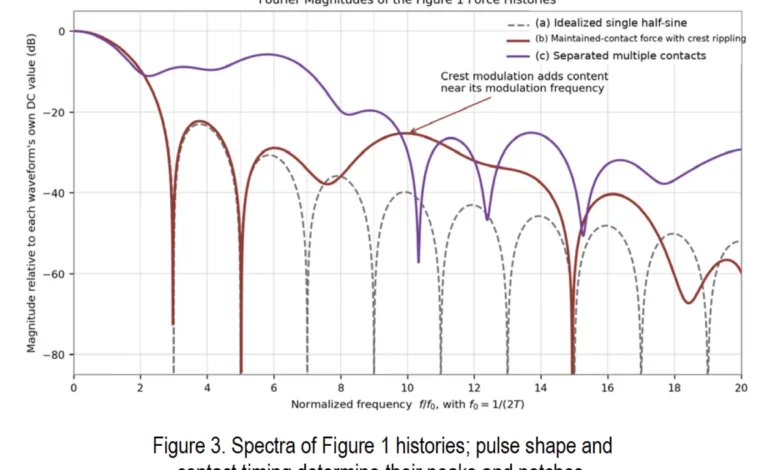
A finite half-sine pulse is inherently broadband, meaning it distributes energy across a wide range of frequencies. However, its spectral distribution is far from flat. Mathematical analysis reveals that a pure half-sine wave contains distinct spectral zeros—frequencies where the input energy drops to zero—located at odd integer multiples of $f/f_o = 3, 5, 7, dots$, where $f_o = 1/(2T)$ and $T$ represents the total pulse duration. Consequently, the visual appearance of a clean half-sine wave alone cannot establish that a structure has received adequate excitation across all frequencies of interest.
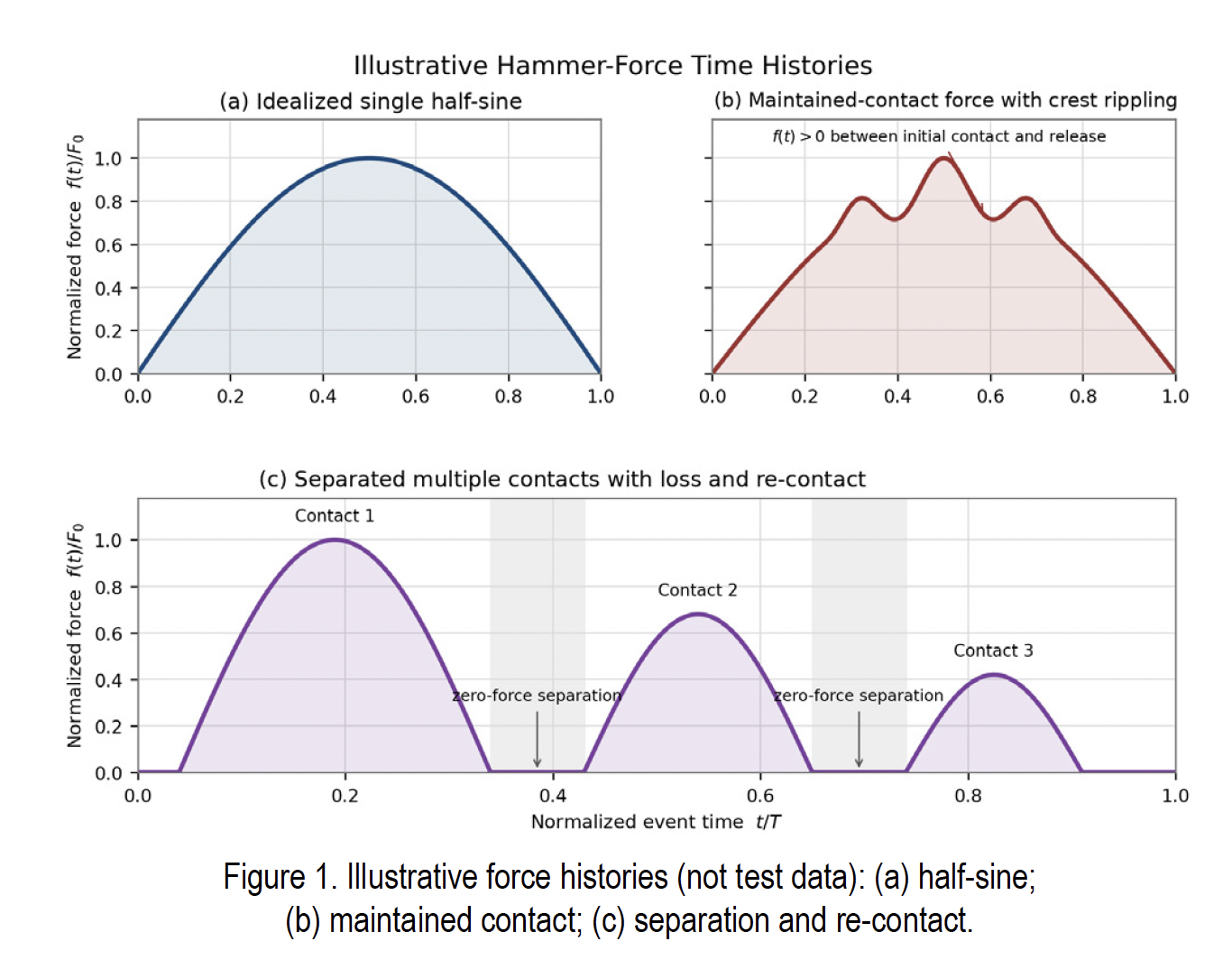
Furthermore, the spectral content of an impact is entirely determined by the actual measured force history rather than an assumed waveform shape. Crest rippling, which often appears as oscillations atop the force peak, actually adds beneficial spectral content that can help fill in the spectral notches characteristic of a pure half-sine wave. Similarly, the specific timing between separated contacts creates deterministic interference patterns. To properly evaluate test adequacy, engineers must inspect the unnormalized measured spectrum and verify the response signal-to-noise ratio, rather than relying on qualitative visual assessments of the force trace.
Chronology of Modern Structural Testing Standards
The evolution of impact testing standards spans decades of aerospace research, intersecting with the development of modal testing theory and advanced mechanical vibration standards.
- 1979: A. H. Nayfeh and D. T. Mook publish foundational work on Nonlinear Oscillations, establishing baseline mathematical frameworks for understanding complex structural responses that deviate from linear assumptions.
- 1999: NASA formalizes specific requirements for transient testing environments by releasing NASA-STD-7003, establishing rigorous criteria for pyroshock testing and structural survivability.
- 2000: D. J. Ewins releases the second edition of Modal Testing: Theory, Practice and Application, which becomes an industry standard for experimental dynamics and frequency response function measurements.
- 2008: K. G. McConnell and P. S. Varoto publish the second edition of Vibration Testing: Theory and Practice, further bridging the gap between theoretical dynamics and practical laboratory data acquisition.
- 2019: The International Organization for Standardization publishes ISO 7626-5:2019, detailing mechanical vibration and shock procedures for the experimental determination of mechanical mobility using impact excitation.
- September 2026: NASA Langley Research Center researchers publish a comprehensive technical evaluation titled Validity and Predictability of Measured Hammer Tap Inputs: Linear and Nonlinear Structural Systems, directly addressing the misconceptions surrounding non-ideal impact force profiles.
Recommended Engineering Practices for Test Evaluation
To align testing procedures with the latest NASA technical guidelines, aerospace and structural testing laboratories are encouraged to adopt a modernized framework focused on objective-driven validation rather than subjective visual criteria. The recommended protocol centers on four key pillars:
- Comprehensive Force Measurement: Ensure that the complete applied force is captured using instrumentation with adequate bandwidth, precise calibration, high dynamic range, and strict time synchronization between force and response channels.
- Response Verification: Verify that structural response measurements maintain sufficient bandwidth and high signal-to-noise ratios, ensuring data is free from artificial clipping, signal saturation, or analog-to-digital conversion errors.
- Objective Coverage Confirmation: Confirm that the actual excitation successfully covers the specific frequency spectrum, amplitude ranges, and nonlinear response regimes required by the intended test objective.
- Disciplined Rejection Criteria: Reject or repeat a hammer impact test exclusively based on identified measurement errors, hardware deficiencies, calibration faults, or inadequate frequency/amplitude coverage—never simply because the force trace failed to resemble an idealized half-sine wave.
Broader Implications for Aerospace and Mechanical Engineering
The clarification published by the Langley Research Center carries significant implications for flight hardware qualification, spacecraft development, and ground vibration testing across the aerospace industry. By shifting the evaluation paradigm away from subjective waveform aesthetics toward rigorous data integrity and spectral analysis, testing facilities can avoid unnecessary test repetitions and reduce schedule delays without compromising structural reliability.
In modern aerospace projects, where structural margins are tightly optimized and payloads are increasingly sensitive to high-frequency dynamics, obtaining accurate frequency response functions is vital. Misinterpreting a non-ideal hammer tap as invalid could lead to the rejection of otherwise pristine test data, forcing unnecessary retests that consume valuable program resources. Conversely, recognizing that complex contact mechanics and ripples are fully accountable inputs empowers engineers to build more robust finite element models and achieve higher-fidelity predictions for flight readiness.
For additional information regarding instrumented hammer test validation, researchers and industry practitioners may contact Joel W. Sills at the NASA Langley Research Center via email at [email protected] or consult the official technical documentation published through NASA’s standards portal.