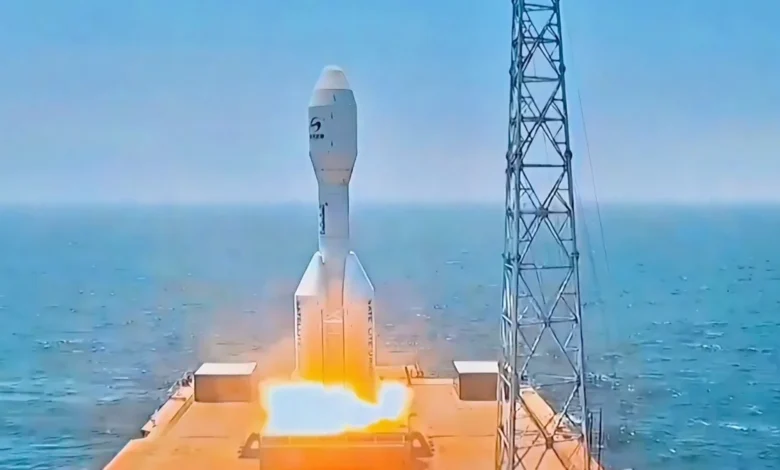
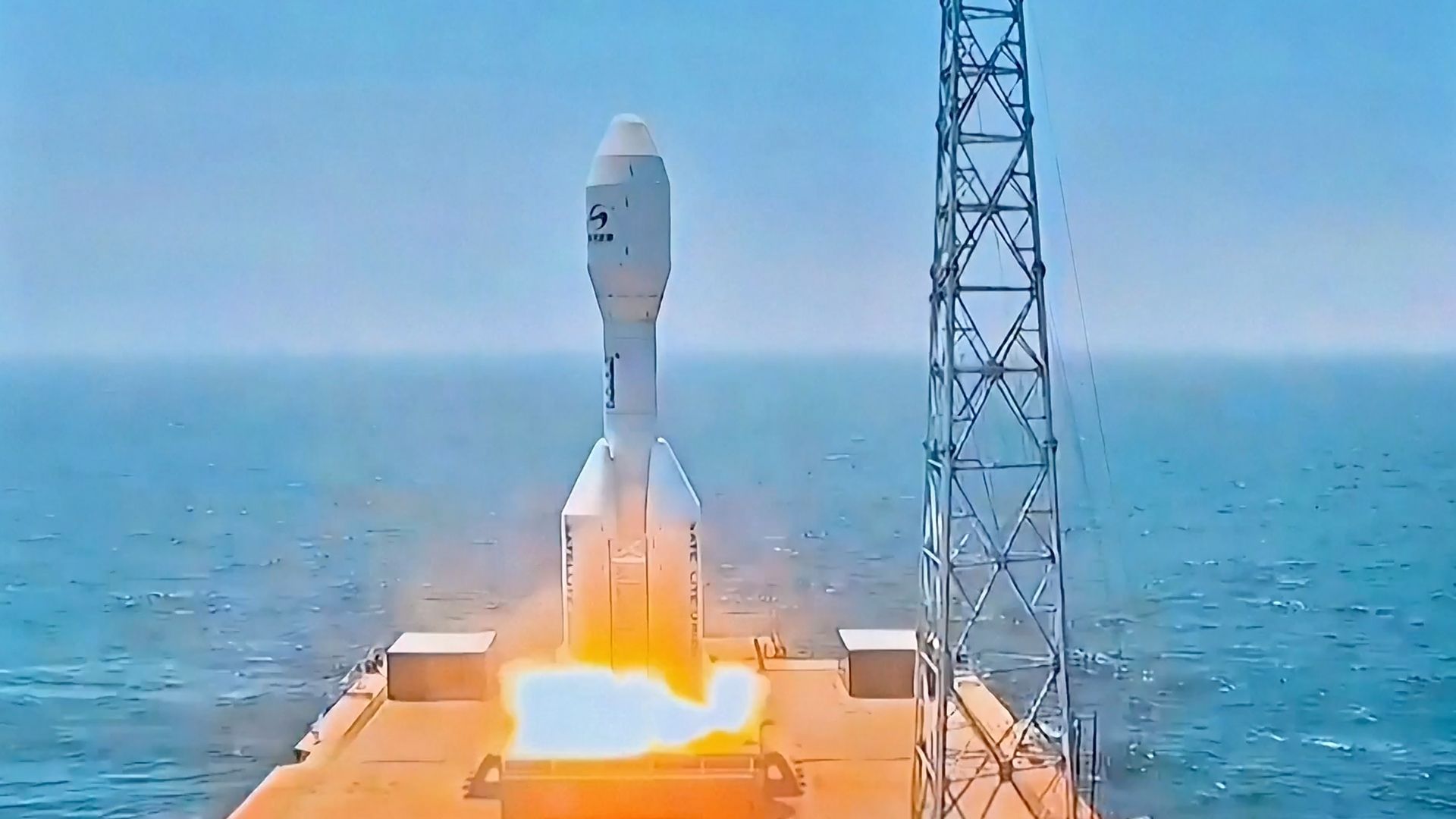
Orienspace’s Gravity-1, a distinctively squat and stubby rocket, successfully completed its third orbital mission on Tuesday night, July 21, 2026. Launching from a mobile platform at sea off the coast of Shanghai, the mission underscored the growing prowess and ambition of China’s commercial space sector. The successful deployment of nine satellites into their designated orbits marks another significant milestone for the young company and for solid-propellant rocket technology globally.
A Precision Launch from the High Seas
The launch sequence for Gravity-1 commenced precisely at 10:54 p.m. EDT on July 21 (0254 GMT on July 22, 10:54 a.m. Beijing time on July 22). The spectacle of the powerful solid-fuel rocket ascending from the deck of a specialized launch vessel captivated observers and marked the third consecutive flawless flight for the innovative launcher. State-run Chinese media outlet Xinhua confirmed the mission’s success, reporting that all nine onboard satellites achieved their intended orbits. While specific details regarding the satellites’ identities, purposes, or operators were not immediately disclosed, their successful deployment signifies Gravity-1’s reliability and its growing utility for various orbital missions.
The decision to launch from a ship at sea, rather than a traditional land-based launch pad, is a strategic choice that offers numerous advantages. Sea launches provide unparalleled flexibility in selecting optimal orbital inclinations, allowing rockets to avoid flying over populated areas and offering a wider range of launch azimuths. This flexibility is particularly crucial for deploying satellites into specific orbital planes, such as polar orbits or highly inclined orbits, which might be less accessible or more logistically challenging from fixed land sites. Furthermore, launching from sea significantly reduces the need for extensive ground infrastructure and simplifies safety protocols associated with rocket launches, which inherently involve hazardous operations. For a rapidly expanding space industry, this operational agility translates into faster launch cadences and potentially lower overall costs.
Gravity-1: A Technical Marvel in Solid Propulsion
Developed and operated by Orienspace, a private aerospace company based in the eastern Chinese province of Shandong, Gravity-1 stands as a testament to advancements in solid-fuel rocket technology. The rocket measures approximately 100 feet (30 meters) in height, a comparatively modest stature when placed alongside giants like SpaceX’s Falcon 9, which stands over twice as tall. However, its compact design belies its immense power within its class.
Gravity-1’s architecture is unique, comprising three core stages augmented by four strap-on boosters, all of which are powered by solid rocket motors. This configuration allows the launcher to deliver an impressive 14,300 pounds (6,500 kilograms) of payload to low Earth orbit (LEO), firmly establishing its position as the most powerful solid-fuel rocket currently operational in the world. To put this into perspective, while liquid-fueled rockets like the Falcon 9 can lift substantially heavier payloads—up to 50,265 pounds (22,800 kg) to LEO—solid-fuel rockets offer distinct advantages. They are inherently simpler in design, requiring fewer complex plumbing systems, turbopumps, and engine components. This simplicity contributes to their robust reliability, rapid assembly, and the ability to be stored for extended periods, making them ideal for missions requiring quick response times or for specific military and scientific applications where immediate readiness is paramount. The trade-off often lies in their inability to be throttled or shut down once ignited, and their lower specific impulse compared to advanced liquid-fueled engines. Nevertheless, Gravity-1’s payload capacity significantly expands the capabilities available for solid-propellant missions, enabling the deployment of larger constellations or more substantial individual satellites.
A Track Record of Success and Ambitious Future
The July 21, 2026, mission represents Gravity-1’s third successful flight since its debut. Its inaugural launch occurred in January 2024, followed by its second successful mission in October 2025. All three launches have originated from sea-based platforms, showcasing Orienspace’s mastery of this complex launch methodology and the inherent reliability of the Gravity-1 system. The flawless track record in such a short span of time is a strong indicator of the company’s engineering capabilities and operational efficiency.
Looking ahead, Orienspace has laid out an ambitious schedule for Gravity-1. The next mission is anticipated within the coming months, with plans to launch a batch of Chinese internet satellites. This upcoming deployment aligns with China’s broader national strategy to develop its own robust satellite internet constellation, often referred to as "Guowang" or "StarNet," designed to compete with global initiatives such as SpaceX’s Starlink and Amazon’s Project Kuiper. The consistent availability of reliable launch vehicles like Gravity-1 is crucial for building out such extensive orbital infrastructure rapidly.
Beyond Gravity-1, Orienspace is already deep into the development of its next-generation launch vehicles: Gravity-2 and Gravity-3. These rockets represent a significant leap in complexity and capability. Gravity-2, for instance, is designed to incorporate liquid-fueled core stages while retaining solid rocket boosters. This hybrid approach aims to combine the high thrust and reliability of solid boosters with the greater efficiency, throttleability, and potentially reusability benefits offered by liquid-fueled engines. According to reports from CGTN, Gravity-2 could be ready for its maiden flight by the end of 2026, marking an incredibly rapid development cycle. Like its predecessor, Gravity-2 is also expected to utilize ocean-based launch platforms, further solidifying Orienspace’s commitment to and expertise in maritime launch operations. Gravity-3, still further in the development pipeline, promises even greater capabilities, positioning Orienspace as a major contender in the increasingly competitive global heavy-lift launch market.
The Strategic Significance of Sea Launches and China’s Space Ambitions
The reliance on sea launches is a cornerstone of Orienspace’s strategy and holds significant implications for China’s overall space program. As Xu Guoguang, Gravity-1’s chief designer, stated, "Sea launch of solid-propellant rockets paves the way for future launch of liquid rockets at sea." This statement highlights a deliberate progression, demonstrating how mastering solid-fuel sea launches builds foundational knowledge and operational experience for the more complex task of launching larger, liquid-fueled vehicles from similar mobile platforms. This approach allows for the iterative development of technology and procedures, mitigating risks associated with advanced launch systems.
China’s space sector has witnessed an unprecedented surge in activity and innovation over the past decade, driven by both state-backed initiatives and a burgeoning private industry. The Chinese government’s decision in 2014 to open the space sector to private capital spurred the formation of numerous commercial space companies like Orienspace, LandSpace, i-Space, and Galactic Energy. These companies are not merely replicating state capabilities but are actively pushing the boundaries of technology, developing reusable rockets, advanced satellite constellations, and novel launch methodologies. Orienspace’s success with Gravity-1 is a prime example of this dynamism, demonstrating how private enterprises are complementing and accelerating China’s national space ambitions.
The development of a robust and diverse launch capability, encompassing both solid and liquid-fueled rockets, and utilizing both land and sea-based launch sites, enhances China’s strategic autonomy in space. It ensures redundancy, increases launch frequency, and allows for specialized missions. For instance, solid-fuel rockets, due to their simplicity and rapid deployment capabilities, are often favored for national security missions or for quickly replacing satellites in times of crisis. Their robust nature makes them less susceptible to the environmental variables that can affect liquid-fueled systems during storage and preparation.
Broader Implications for the Global Space Industry
Orienspace’s continued success with Gravity-1 and its ambitious roadmap for Gravity-2 and Gravity-3 carry significant implications for the global commercial launch market. The increasing number of reliable launch providers, particularly those offering innovative solutions like sea launches and powerful solid-fuel options, intensifies competition. This competition is generally beneficial for satellite operators, as it can drive down launch costs, offer more flexible scheduling, and provide a wider array of launch vehicle options tailored to specific payload requirements.
"The consistency and reliability demonstrated by Orienspace with Gravity-1 are remarkable," commented Dr. Anya Sharma, an independent space industry analyst. "Achieving three flawless missions in such a short period, especially with the added complexity of sea launches, establishes them as a serious contender. Their pivot towards larger, hybrid liquid-solid systems with Gravity-2 suggests they are not content to simply dominate the solid-fuel niche but are aiming for a broader share of the commercial launch market, including the lucrative constellation deployment sector."
The advancements also highlight a potential re-evaluation of solid-fuel rockets’ role in the modern space era. While liquid-fueled rockets have garnered significant attention for their reusability and heavy-lift capabilities, solid-fuel systems continue to hold their own in specific applications. Gravity-1’s capacity to launch 6,500 kg to LEO is substantial enough for many satellite constellation deployment scenarios, demonstrating that solid rockets are not merely for small payloads or niche military applications but can be workhorses for significant commercial ventures.
Furthermore, the expansion of sea launch capabilities, as pioneered by Orienspace and affirmed by the Gravity-1 program, signifies a growing trend in the global space industry. Companies worldwide are exploring mobile launch platforms to overcome geographical constraints, reduce environmental impact on land, and offer more versatile access to orbit. Orienspace’s expertise in this domain positions China at the forefront of this particular segment of launch technology.
As the demand for satellite services continues to grow—from global internet connectivity to Earth observation and scientific research—the need for diverse, reliable, and cost-effective launch solutions becomes ever more critical. Orienspace, with its proven Gravity-1 rocket and its ambitious plans for future launchers, is undoubtedly poised to play a pivotal role in shaping the future landscape of space access, both for China and for the international space community. The successful third mission of Gravity-1 is not just a triumph for a single company but a clear signal of the accelerating pace of innovation and competition that defines the new era of space exploration and utilization.