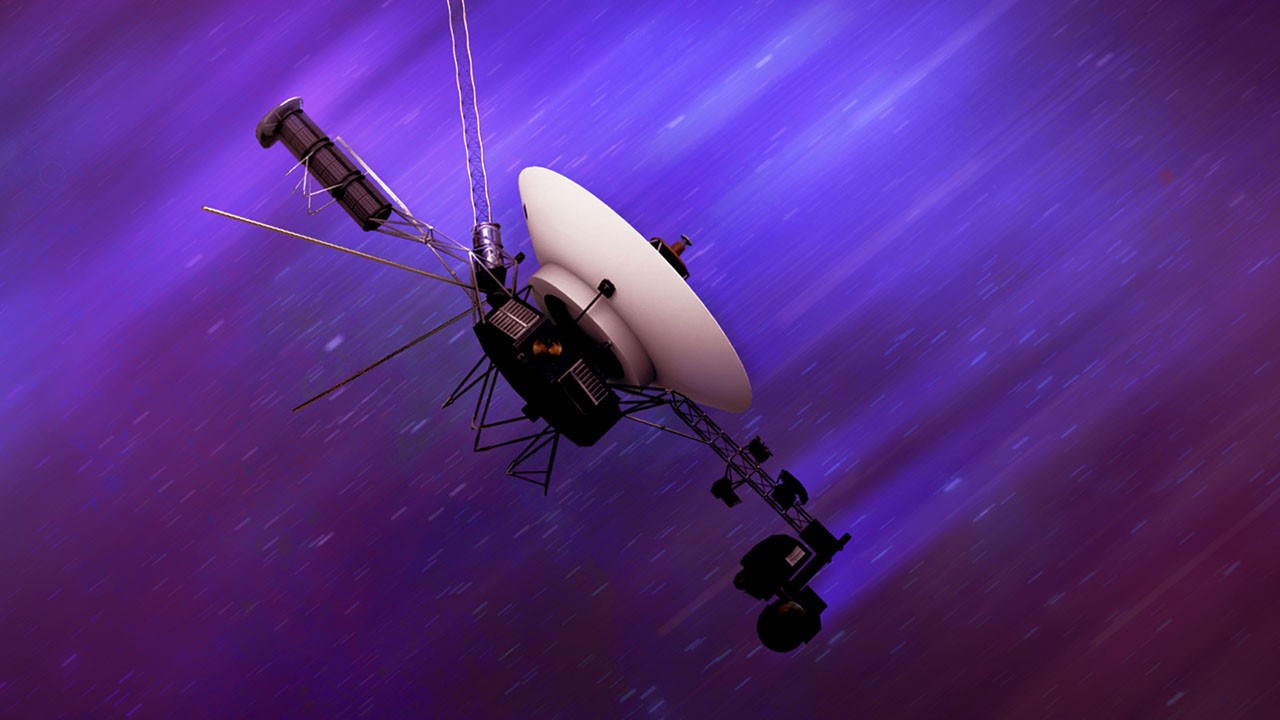
Nearly five decades after breaking free from Earth’s gravitational pull, NASA’s Voyager 1 spacecraft is on the verge of shattering yet another monumental distance record. On November 18, 2026, the venerable probe is projected to cross the staggering threshold of one light-day—equivalent to roughly 16.1 billion miles, or 25.9 billion kilometers—from our Sun. This milestone not only highlights the unprecedented longevity of 1970s engineering, but it also underscores humanity’s farthest reach into the cosmos.
Launched in September 1977, just weeks after its twin, Voyager 2, the mission was designed to take advantage of a rare geometric alignment of the solar system’s outer gas giants that occurs only once every 175 years. While originally intended to explore Jupiter and Saturn, the spacecraft’s trajectory was repeatedly optimized, allowing it to function long past its initial design life. Today, Voyager 1 and Voyager 2 stand as the only human-made objects operating in interstellar space, carrying the legacy of Earth into the uncharted depths of the Milky Way.
A Grand Tour and the Planetary Alignment of 1977
The genesis of the Voyager program lies in an astrodynamic opportunity of historic proportions. In the late 1960s and 1970s, orbital mechanics aligned Jupiter, Saturn, Uranus, and Neptune in a configuration that allowed a spacecraft to visit all four outer planets in a single mission using gravity-assist maneuvers. By skimming the gravitational fields of these massive bodies, the probes could be accelerated and redirected toward the next destination without expending massive amounts of onboard fuel.
NASA capitalized on this rare window by launching Voyager 2 on August 20, 1977, followed by Voyager 1 on September 5, 1977. Despite launching second, Voyager 1 was placed on a faster, shorter trajectory that allowed it to overtake its twin. It achieved close encounters with Jupiter in March 1979 and Saturn in November 1980.
These encounters revolutionized planetary science. Voyager 1 discovered active volcanism on Jupiter’s moon Io—the first time active volcanoes were observed on a body other than Earth—and revealed complex structures within Saturn’s ring system, alongside detailed atmospheric data of the gas giants.
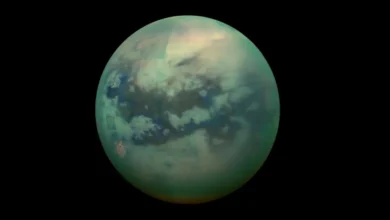
Following its encounter with Saturn and Saturn’s massive moon Titan, Voyager 1 was deflected northward out of the plane of the planets, setting it on a trajectory away from the solar system. Voyager 2, meanwhile, continued southward on its Grand Tour, going on to become the first and only spacecraft to visit Uranus (1986) and Neptune (1989).
By the time the planetary flybys concluded, both probes began their interstellar missions. Before Voyager 1 turned its cameras away from the inner solar system for the final time in 1990, it captured a famous 60-frame mosaic of the planets, including the iconic image of Earth as a "Pale Blue Dot"—a description famously coined by science communicator Carl Sagan, who played an instrumental role in shaping the messaging of the mission.
The Golden Record: A Message in a Bottle for the Cosmos
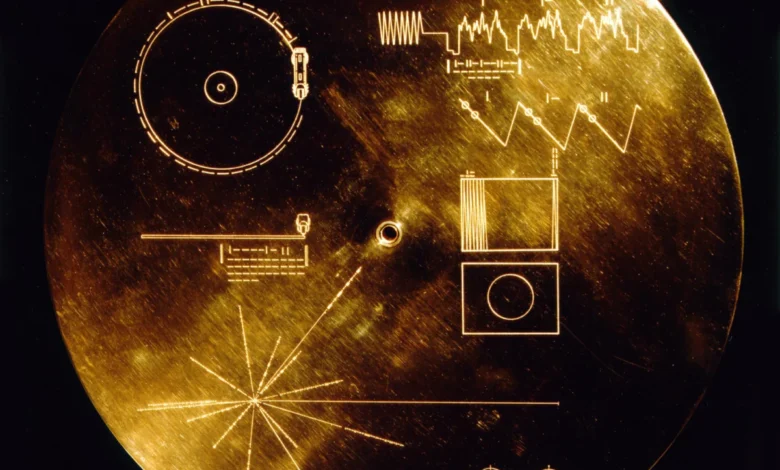
Pinned to the hull of each Voyager spacecraft is an ambassador for humanity: the Golden Record. Curated by a committee chaired by Carl Sagan, these 12-inch, gold-plated copper phonograph records were designed to communicate the story of our world to any intelligent extraterrestrial civilization that might intercept the probes billions of years in the future.
The content of the Golden Record is a comprehensive cross-section of Earth’s culture and natural environment. It features:
- Spoken greetings in 55 human languages, beginning with Sumerian, one of our oldest written tongues, and ending with a message from a modern child of Earth.
- Ninety minutes of musical selections spanning diverse eras, cultures, and genres, including works by Bach, Beethoven, and traditional global folk music.
- One hundred and sixteen digitized images encoded in analog form, depicting human anatomy, landscapes, cities, animals, and the structure of our DNA.
- Natural and technological sounds of Earth, such as whale songs, thunderstorms, the rumbling of a train, and the footsteps of a person walking.
To ensure the record could survive the harsh radiation environment of space for eons, it is housed in an aluminum protective cover. Etched onto this cover is a map of the solar system showing the Sun’s position relative to 14 distinct pulsars, allowing a finder to calculate both the location and the time of the launch.
Furthermore, the cover was electroplated with an ultra-pure sample of uranium-238. With a half-life of roughly 4.468 billion years, this radioactive isotope acts as an atomic clock, enabling any future discoverers to determine precisely how long the record has been traveling through space.
Crossing the Heliopause: Entering Interstellar Space
One of the defining achievements of the extended Voyager mission was crossing the heliopause—the invisible boundary where the solar wind, a stream of charged particles flowing outward from the Sun, is stopped by the pressurized interstellar medium, the thin soup of gas and dust that fills the space between stars.
Voyager 1 achieved this historic milestone in August 2012, when mission scientists observed a dramatic spike in galactic cosmic rays and a corresponding drop in solar-origin charged particles. Six years later, in November 2018, Voyager 2 crossed its own heliopause at a slightly different angle and distance.
These crossings provided humanity with its first direct measurements of the interstellar medium. Scientists learned that the boundary of our heliosphere is dynamic and compressed by the interstellar wind, and they gained critical data regarding how the magnetic fields of our Sun interact with the broader galactic environment.
Tracking these distant travelers is an ongoing challenge managed through NASA’s Deep Space Network (DSN)—a worldwide array of giant radio antennas located in California, Spain, and Australia. The DSN maintains continuous communication with both spacecraft, transmitting commands and receiving scientific telemetry. As of late 2026, the tracking station in Canberra, Australia, registers Voyager 1 at a distance exceeding 16 billion miles. Because radio waves travel at the speed of light, a single command sent to Voyager 1 takes more than 23 hours to reach it, and the return signal takes an equally long journey back to Earth.
Decoding Cosmic Distances: Light-Minutes to Light-Years
The upcoming milestone of one light-day brings abstract cosmic measurements into sharper focus for the general public. In astronomy, distances across interstellar space are routinely measured in light-years—the distance light travels in one Earth year, roughly 5.88 trillion miles (9.46 trillion kilometers).
However, within our solar system, measurements are often conceptualized in light-hours and light-minutes. For context, light from the Sun takes roughly 8 minutes and 20 seconds to reach Earth. When Voyager 1 crosses the one-light-day mark on November 18, 2026, it will mean that a photon of light leaving the Sun takes a full 24 hours to catch up with the spacecraft.
NASA and various educational institutions utilize milestones like this to bridge the gap between abstract astrophysics and public understanding. Educational programs, such as the Jet Propulsion Laboratory’s "Gravity Assist" podcast and interactive solar system applications, allow students and space enthusiasts to visualize the immense scale of the cosmos. By tracking the real-time positions of Voyager 1 and Voyager 2 via NASA’s official mission dashboards, observers can monitor the exact coordinates of humanity’s most distant emissaries.
Legacy, Longevity, and the Final Frontier
Operating hardware built in the mid-1970s presents profound technical hurdles. Both spacecraft rely on radioisotope thermoelectric generators (RTGs), which convert the heat generated by the natural decay of plutonium-238 into electricity. As the radioactive material decays over the decades, the power output of both probes steadily diminishes.
To conserve power, NASA engineers have systematically turned off non-essential science instruments, heaters, and attitude-control thruster systems over the years. Despite these power-saving measures, unexpected technical anomalies inevitably arise. In recent years, engineering teams have successfully diagnosed and resolved complex memory glitches and communication system errors across distances that baffle comprehension, showcasing the ingenuity of modern flight operations teams working with legacy architecture.
Even as power levels continue to wane—a trajectory that will likely force the final shutdown of all science instruments by the late 2020s or early 2030s—the physical journey of the spacecraft will continue indefinitely. Long after their electronic systems go silent, Voyager 1 and Voyager 2 will coast through the Milky Way as silent monuments to human curiosity.
Long after Earth has changed beyond recognition, the twins will drift past distant star systems. Voyager 1 is headed toward the constellation Ophiuchus and will pass within 1.7 light-years of the star AC+79 3888 in about 40,000 years. Voyager 2 is bound for the constellation of Andromeda and will make a close approach to the star Ross 248 in roughly 40,000 years as well.
As Voyager 1 prepares to log its historic one-light-day milestone, the mission remains a testament to what can be achieved through visionary scientific planning, international collaboration, and sheer perseverance. It stands as a physical manifestation of human ingenuity, carrying the sights, sounds, and stories of a tiny pale blue dot into the vast, silent theater of the stars.
Related posts: