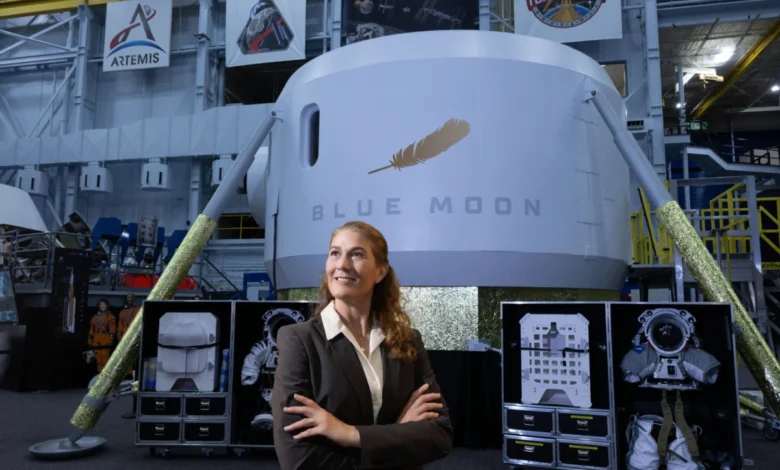
The path to human spaceflight is rarely linear, yet few careers mirror the extraordinary trajectory of Katie Spicer. Operating at the intersection of rigorous human-systems engineering and hands-on operational oversight, Spicer now serves as the NASA lander integration lead for Blue Origin’s Blue Moon Mark 2 lander. This vital vehicle stands as one of the commercially provided human landing systems central to NASA’s ambitious Artemis program, a multi-agency and commercial partnership designed to return humanity to the lunar surface for the first time in over half a century.
Stationed within the Flight Operations Directorate at NASA’s Johnson Space Center in Houston, Spicer carries the immense responsibility of evaluating, monitoring, and steering the design and development of the Blue Origin lander. As the architecture of the spacecraft rapidly evolves, Spicer and her team ensure that every mechanical nuance aligns seamlessly with the physiological and operational realities of spaceflight. From low Earth orbit rendezvous and docking milestones slated for upcoming Artemis missions to the fully functional, crewed lunar landing targeted for 2028, Spicer’s daily work leaves an indelible handprint on the future history of space exploration.
Bridging the Gap Between Engineering and Human Experience
Spicer’s core mandate at NASA is to examine the microscopic details of the macroscopic Artemis architecture. While aerospace engineering traditionally focuses on structural integrity, propulsion dynamics, and thermal protection systems, Spicer bridges the critical gap between raw hardware and human usability. Working in tandem with counterparts at both NASA and Blue Origin, she scrutinizes every surface, interface, and environment that astronauts will encounter during their lunar missions.
“I look at the design of everything Artemis crews will touch, work with, or interface with to ensure systems will function the way crews will need them to,” Spicer explains. This granular evaluation extends far beyond basic compliance with mission requirements. It involves deep ergonomic and operational analyses: How intuitively can a crew member grip handles or navigate handrails in bulky extravehicular activity (EVA) spacesuits? Can they reliably operate push-button displays and touchscreens in microgravity? Are the spacecraft’s waste management and hygiene systems optimized for user-friendliness within the heavily constrained volumetric budgets of a lunar lander? Furthermore, Spicer ensures that comprehensive procedures and training protocols accompany every hardware deployment to guarantee that astronauts can operate their life-support and mission-critical systems safely and effectively.
By championing the crew’s perspective throughout the design lifecycle, Spicer ensures that technical specifications do not compromise operational efficiency, thereby mitigating human error risks in high-stress, high-consequence environments.
An Unconventional Ascent: From Microbiology to Mission Control
What makes Spicer’s role as a premier integration lead particularly striking is her atypical academic and professional background. Unlike the vast majority of her engineering peers across the aerospace sector, Spicer did not follow a traditional aerospace or mechanical engineering pipeline.
Her professional journey began after she earned a bachelor’s degree in microbiology from the Pennsylvania State University in State College, Pennsylvania. Following her graduation, Spicer stepped away from the formal workforce for several years to serve as a full-time homemaker, raising three children. When she eventually re-entered the professional sphere, she secured a part-time position at NASA’s historic Life Sciences Laboratory—Building 37 at the Johnson Space Center.
Her initial duties were humble, ranging from washing laboratory glassware and cleaning specialized equipment to running baseline biological tests for staff scientists. Yet, this modest entry point placed her inside a facility rich with aerospace heritage. She found herself maintaining the very laboratories where Apollo astronauts were quarantined upon their return from the Moon and where pristine lunar rock samples were initially cataloged and analyzed.
“I went from tidying up and keeping my home running to maintaining the historic lab where the Apollo crews were quarantined when they came back from the Moon and the Moon rock samples were stored,” Spicer reflects.
Recognizing her organizational acumen and dedication, Spicer transitioned into working with active science payloads destined for the International Space Station (ISS). She began operating the Human Research Facility racks located within the ISS National Laboratory, collaborating directly with principal investigators and orbiting flight crews to ensure that complex in-flight biomedical protocols were flawlessly executed. Through this hands-on involvement, Spicer discovered an affinity for the high-tempo, dynamic nature of real-time space operations.
Mastering Mission Control Without an Engineering Degree
Driven by a passion for human spaceflight operations, Spicer set her sights on the pinnacle of mission support: becoming a flight controller inside NASA’s Mission Control Center in Houston. The barrier to entry for this role is notoriously rigorous, demanding an encyclopedic understanding of spacecraft systems, orbital mechanics, and contingency procedures.
For an individual without a formal engineering degree, the learning curve was steep and uncompromising. Undeterred by the educational deficit on paper, Spicer embarked on an intensive self-study regimen. Over five years of rigorous academic preparation, practical simulations, and grueling oral examination boards, she mastered complex aerospace engineering principles, fluid dynamics, and electrical systems.
In 2018, Spicer achieved her certification, officially stepping onto the floor of Mission Control as an Operations and Support Officer in the International Space Station’s flight control room—affectionately known within the aerospace community as the “front room.”
“Unlike most people I work with, I don’t have an engineering degree,” Spicer notes. “On my own, I studied engineering principles. I passed boards and certification tests. I learned to speak ‘engineer!’”
Her five-year tenure in the front room of Mission Control forged her reputation as a resilient, operationally astute problem solver capable of managing crisis situations under extreme time pressure. This operational foundation uniquely positioned her for her current responsibilities overseeing commercial human landing systems.
The Broader Context: The Artemis Program and Commercial Partnerships
Spicer’s transition to the Blue Origin integration lead role coincides with a transformative era in space exploration characterized by the maturation of commercial space partnerships. Under the Artemis program, NASA has fundamentally shifted its procurement and development strategy, moving away from traditional cost-plus government-built hardware toward fixed-price, commercial-partner models.
The Blue Origin Blue Moon Mark 2 lander represents a cornerstone of this strategy. Selected alongside SpaceX’s Human Landing System, Blue Origin’s lander is engineered to transport astronauts from lunar orbit down to the surface of the Moon and back. The development timeline includes crucial precursor milestones, such as a streamlined lander test article designed to validate rendezvous and docking capabilities during the Artemis III mission in low Earth orbit. This incremental testing philosophy allows NASA and its commercial partners to de-risk complex technologies before committing human lives to the lunar surface during subsequent landings, culminating in the fully crewed lunar landing mission targeted for 2028.
This public-private framework not only accelerates innovation but also distributes economic benefits across the aerospace industrial base while fostering a sustainable, competitive market for low Earth orbit and cislunar commerce.
Official Perspectives and the Legacy of Apollo
As NASA marches toward its goal of establishing a permanent human footprint on the Moon, leaders across the agency frequently emphasize the cultural and generational significance of the endeavor. The Artemis program seeks to build directly upon the technological foundation laid by the Apollo program while expanding horizons toward more challenging destinations, such as the permanently shadowed regions of the lunar South Pole, where water ice reserves could support in-situ resource utilization.
For Spicer, working on the vanguard of this new era evokes a profound sense of historical continuity and personal responsibility. When gazing up at the Moon in the night sky, she acknowledges the weight of her role in shaping the missions that will inspire the next generation of scientists, engineers, and explorers.
“I’m reminded of the great responsibility that NASA has in this endeavor, of the legacy of the courageous Apollo crews who went before, and inspiring the next generation of space explorers to keep going and reaching for the stars!” Spicer stated.
Strategic Implications for Future Deep Space Exploration
The integration of commercial landers into NASA’s architecture carries profound implications for the future of interplanetary travel. By proving that commercial entities can successfully design, build, and operate human-rated spacecraft under rigorous NASA oversight, the agency is validating a scalable model for deep space exploration.
The technologies perfected through the Artemis program—including advanced ECLSS (Environmental Control and Life Support Systems), precision autonomous landing algorithms, and ergonomic human-systems interfaces vetted by specialists like Spicer—will serve as the foundational stepping stones for humanity’s first crewed voyages to Mars.
As the timeline toward the 2028 crewed Blue Moon landing accelerates, the contributions of unconventional leaders like Katie Spicer demonstrate that diverse career paths, rooted in relentless curiosity and rigorous self-education, are vital to solving the complex challenges of the 21st-century space economy. Through meticulous attention to the human element within complex machine architecture, Spicer ensures that when the next boot touches the lunar regolith, humanity is fully prepared for the journey ahead.