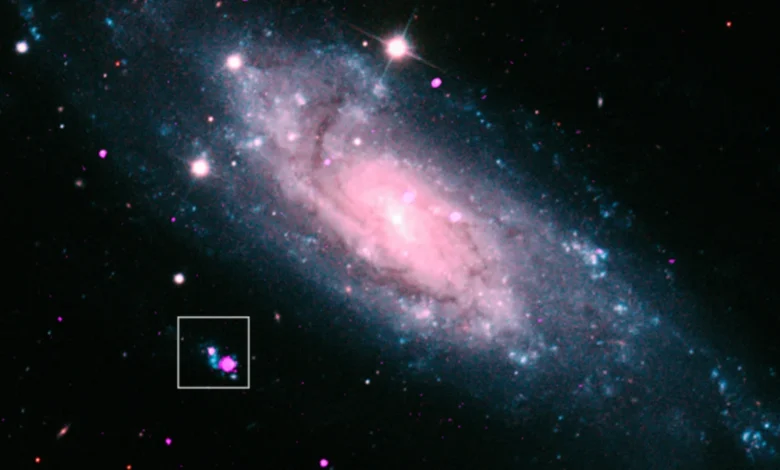
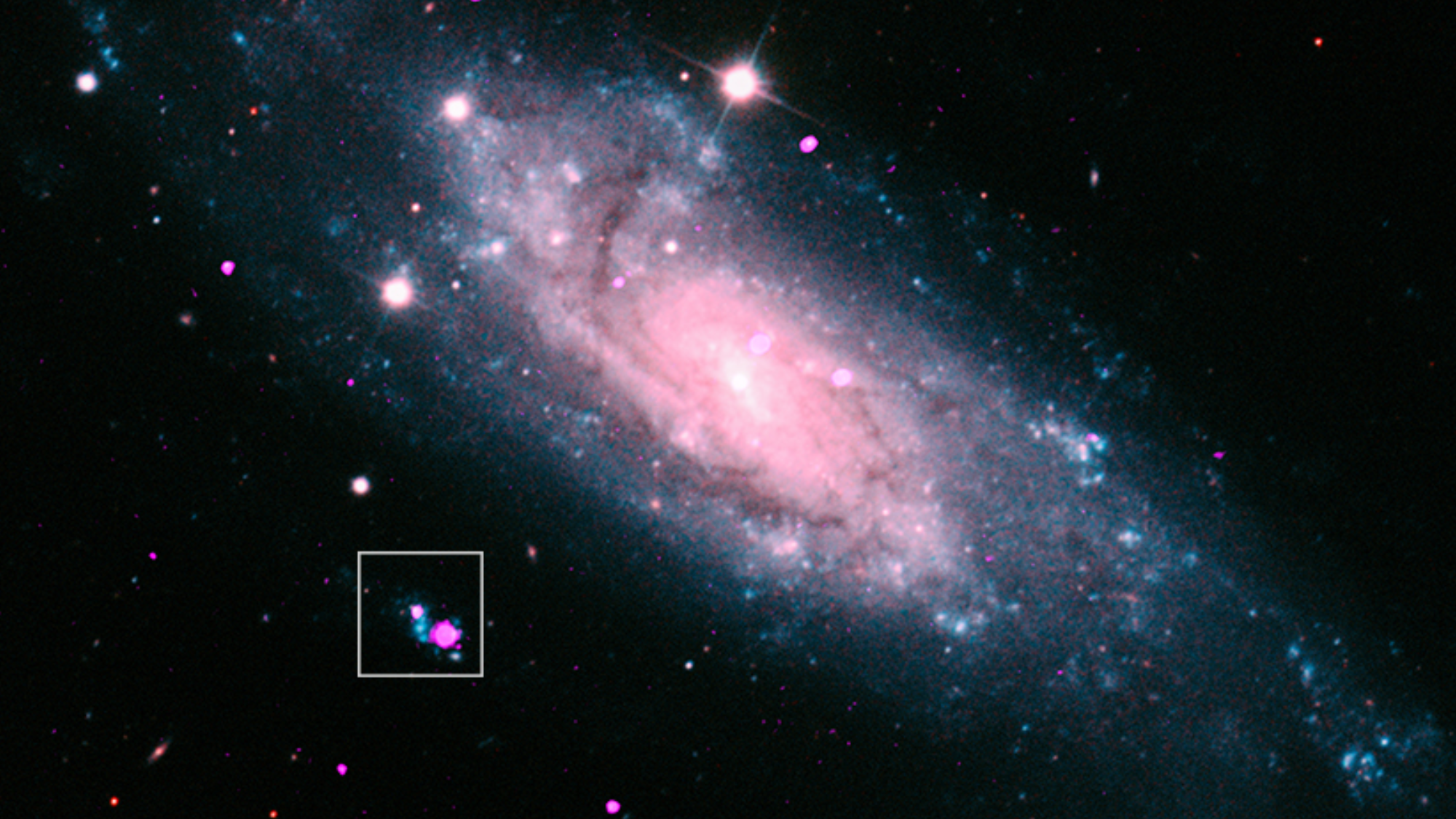
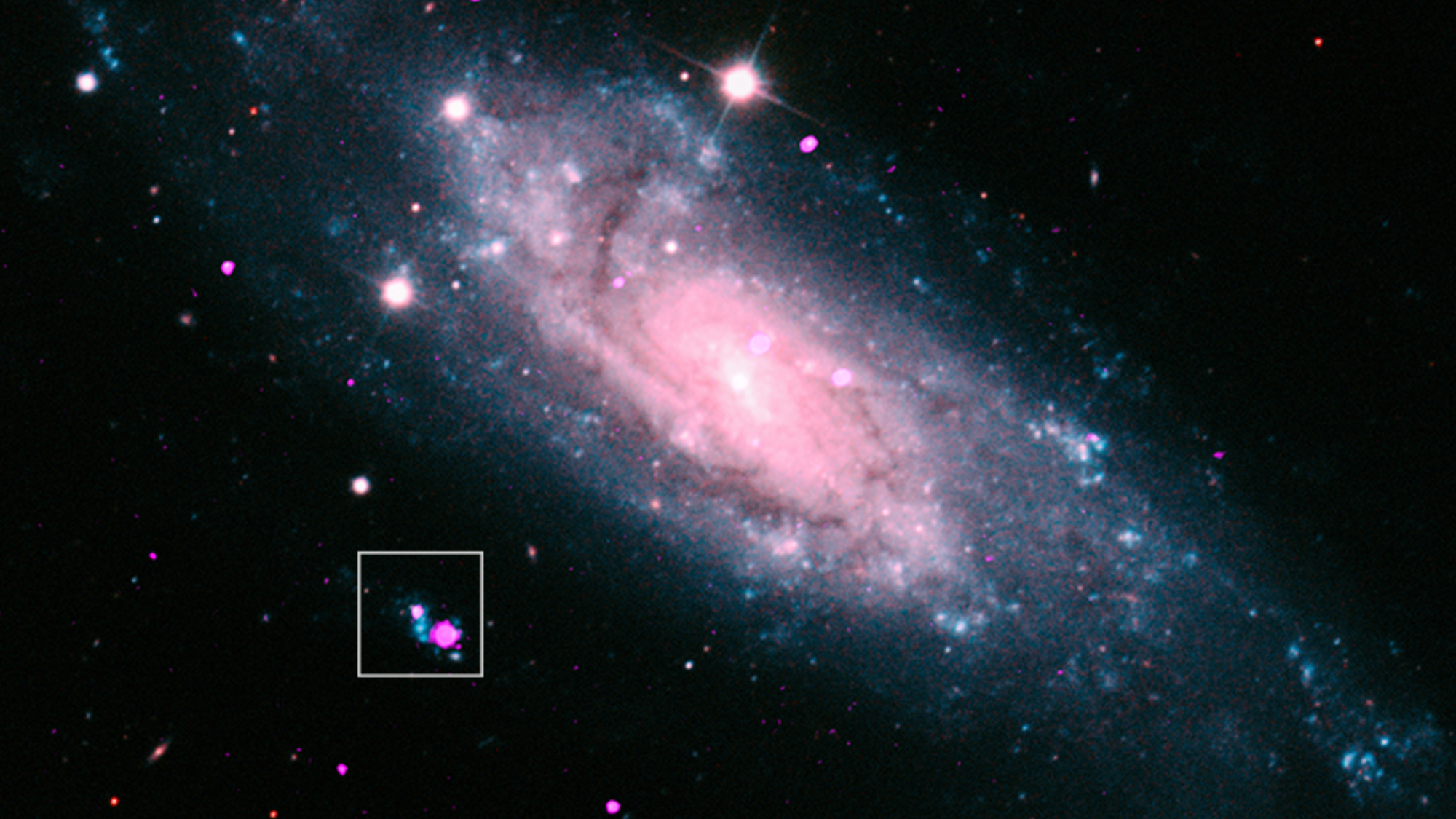
Astronomers have finally resolved the mystery of a persistent cosmic imposter, identified as AT 2016blu, which has repeatedly mimicked the catastrophic death throes of a supernova for over a decade. Located on the outskirts of the spiral galaxy NGC 4559, approximately 25 million light-years away in the constellation Coma Berenices, the object has been observed undergoing 27 distinct, bright outbursts since 2012. Data captured by NASA’s Chandra X-ray Observatory has now confirmed that these recurring flashes are not the result of a single star’s terminal explosion, but rather the violent, periodic feeding frenzy of a compact, vampiric companion—likely a black hole or a neutron star—stripping mass from a massive, unstable luminous blue variable (LBV) star.
The Anatomy of a Celestial Imposter
Luminous blue variables are among the most massive and unstable stars in the known universe. Characterized by their extreme luminosity and erratic mass-loss episodes, these stellar titans frequently eject significant quantities of material into their surrounding environments. However, the behavior of AT 2016blu defied standard models of stellar evolution. When astronomers first observed a bright event at this location on January 11, 2012, it exhibited the photometric hallmarks of a supernova—the cataclysmic destruction of a star that occurs when nuclear fusion ceases in its core.
The standard expectation was that the star would vanish or leave behind a remnant after the explosion. Instead, the object consistently dimmed after each burst, only to flare into brilliance again every 113 days. This cycle, which has persisted for over 15 years, led to the classification of AT 2016blu as a "supernova imposter." For years, the scientific community struggled to identify a mechanism that could trigger such precise, recurring energetic events without destroying the parent star. The breakthrough arrived in March 2026, when a team led by Mojgan Aghakhanloo of the University of Virginia secured targeted observation time with the Chandra X-ray Observatory during a known outburst phase.
Chronology of the Discovery
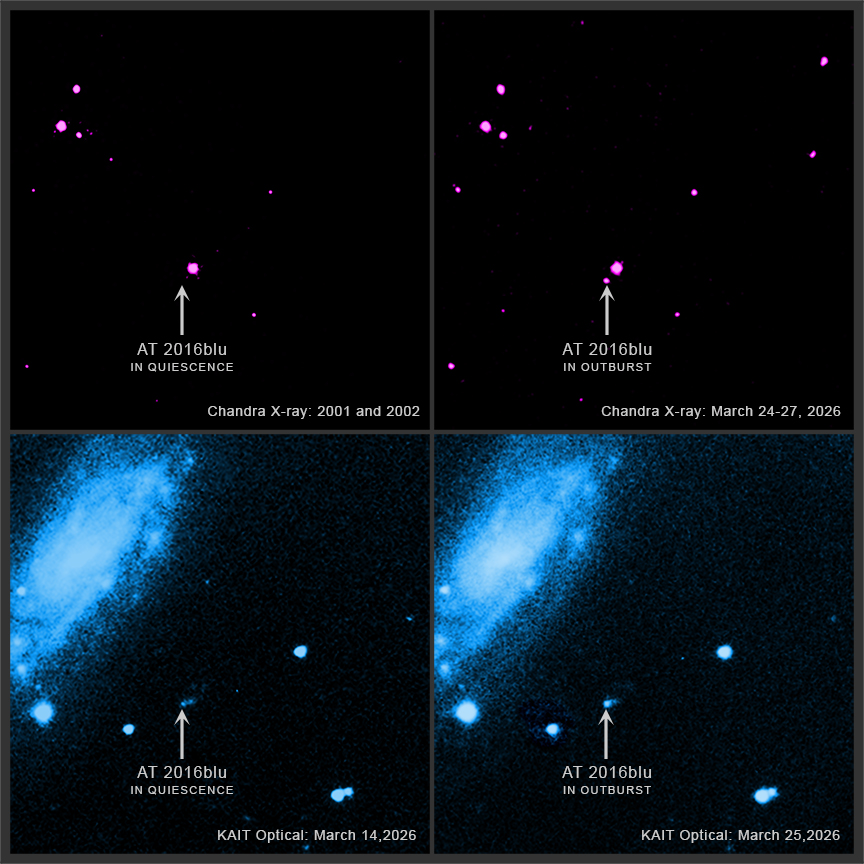
The investigation into AT 2016blu was bolstered by a stroke of archival luck. Chandra had incidentally imaged the region of NGC 4559 in 2001 and 2002. At that time, the system showed no unusual activity, providing a baseline of relative stability. The contrast between the archival silence and the high-energy signatures detected in 2026 provided the definitive evidence required to model the system.
Following the initial 2012 detection, follow-up observations using ground-based optical telescopes documented the 113-day periodicity. While the optical data confirmed the rhythm of the outbursts, it lacked the resolution to explain the underlying physics. The 2026 Chandra campaign revealed a intense blast of X-rays that perfectly aligned with the optical peak of the outburst. This correlation allowed the research team to construct a dynamic model: the massive LBV star is trapped in a binary system with a compact, high-gravity object.
As the compact companion—either a neutron star or a stellar-mass black hole—travels along an elliptical orbit, it approaches the LBV star every 113 days. At this periastron, the intense gravitational pull of the compact object strips away a significant portion of the LBV’s outer atmosphere.
Mechanisms of the Feeding Frenzy
The physics of this interaction is defined by extreme mass transfer. As the stolen material is pulled toward the companion, it does not fall directly into it; rather, it spirals inward, forming a hot, rapidly rotating accretion disk. The friction and gravitational energy within this disk heat the matter to millions of degrees, causing it to emit powerful X-rays.
The research team, which published their findings in The Astrophysical Journal on November 9, calculates that the compact object consumes a minimum of 440 billion trillion pounds of material during each encounter, though estimates suggest the actual intake could be up to 100 times greater. Despite this massive transfer, the LBV star, which possesses at least 33 times the mass of our sun, remains intact, though it is steadily losing mass to its parasitic partner.
The interaction also explains the optical "supernova" light. The high-energy X-ray blast from the accretion disk radiates outward, striking and ionizing the dense cloud of gas and dust that the LBV star has previously ejected into the surrounding space. This ionized gas glows intensely in the visible spectrum, creating the deceptive appearance of a supernova explosion for observers on Earth.
Scientific Implications and Broader Context
This discovery provides critical insight into the phenomenon of Ultra-Luminous X-ray sources (ULXs). ULXs are defined by their extraordinary X-ray brightness, often exceeding the Eddington limit—the theoretical maximum luminosity a star or accretion disk can achieve before the outward pressure of radiation overcomes the inward pull of gravity. Because AT 2016blu emits X-rays at such high levels, it functions as a surrogate for studying these mysterious objects.
"Until we were able to get Chandra data at the right time, we couldn’t figure out what was making this happen," stated Mojgan Aghakhanloo. The findings suggest that the binary nature of these systems—and the periodic "vampirism" of a compact companion—may be a common, yet under-observed, cause of periodic variability in massive star systems.
Nathan Smith, a co-author of the study from the University of Arizona, noted that the system serves as a potential "Rosetta Stone." While other supernova imposters have been studied, such as SN 2010da, the companion in that system is a red supergiant. AT 2016blu is distinct because its companion is a compact remnant, proving that even a dead star can dictate the life—and the apparent death—of its massive neighbor.
Future Research Directions
The identification of a compact companion in the AT 2016blu system shifts the focus toward understanding the evolution of binary systems containing massive stars. Astronomers are now tasked with determining how common these "vampiric" binary systems are throughout the universe. If these systems are more frequent than currently estimated, they may account for a significant percentage of observed transients that were previously misidentified as supernovae.
Furthermore, the 113-day cycle offers a unique laboratory for studying accretion physics. With the timing of the outbursts now predictable, future multi-wavelength campaigns—using not only X-ray observatories like Chandra but also infrared and radio telescopes—will be able to map the spatial distribution of the ejected gas and the precise geometry of the accretion disk.
The study of AT 2016blu serves as a reminder of the complex, often counter-intuitive nature of stellar evolution. What appeared to be a singular, violent death of a star has been revealed as a long-term, cyclical dance between two objects. This discovery not only resolves a decade-long puzzle but also refines our understanding of how high-mass binary systems evolve and eventually influence the chemical and energetic landscape of their host galaxies. As instruments become more sensitive, the "cosmic imposters" of the past may continue to yield secrets about the hidden dynamics of the stars that populate our universe.