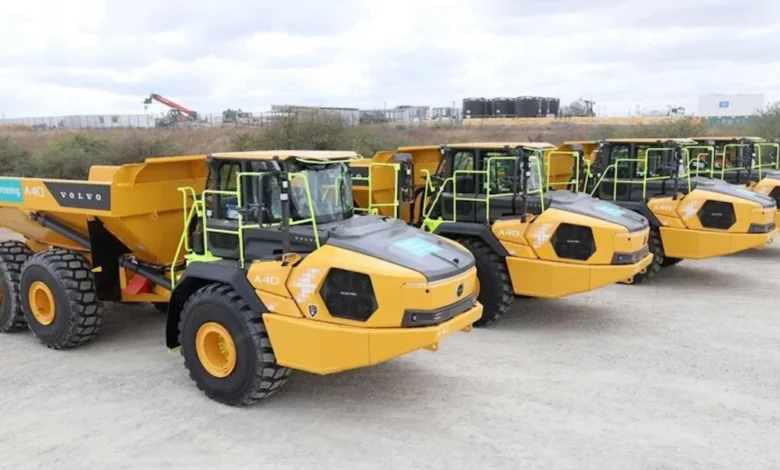
The global transition toward sustainable heavy industry has reached a significant operational milestone as Volvo Construction Equipment (Volvo CE) delivers its first customer-ready A40 Electric articulated haul trucks to the United Kingdom. Purchased by BMJV—a major joint venture comprising Bouygues Travaux Publics and J Murphy & Sons—four of these 39-tonne heavy-duty battery-electric vehicles have been deployed directly onto the expansive Lower Thames Crossing project. This deployment establishes the Lower Thames Crossing as the world’s first major infrastructure initiative to systematically integrate the Volvo A40 Electric into its core material-handling workflows, signaling a decisive shift away from traditional diesel-dependent earthmoving equipment on large-scale construction sites.
The arrival of the A40 Electric units in the UK underlines the rapid evolution of commercial electric mobility within the heavy construction sector. Originally unveiled to the global market earlier in the year as the world’s first series-produced all-electric 40-ton class articulated hauler, the vehicle bridges the gap between environmental responsibility and high-capacity industrial performance. By introducing these machines to a multi-billion-pound transport scheme, Volvo CE and its project partners are attempting to prove that zero-emission alternatives are capable of matching, and in some aspects exceeding, the rigorous operational demands of contemporary civil engineering.
Historical Context and Evolution of the Articulated Hauler
To understand the magnitude of this deployment, it is necessary to examine the lineage of the articulated hauler itself. More than sixty years ago, Volvo revolutionized earthmoving operations by introducing the concept of the articulated hauler, famously embodied by the historical prototype known as "Gravel Charlie." This engineering breakthrough allowed heavy materials to be transported across unstable, muddy, and steeply graded terrain where conventional rigid-frame trucks routinely failed.
For decades, the standard formula for these machines relied exclusively on high-torque diesel internal combustion engines. While these powerplants delivered the necessary tractive effort for grueling excavation and civil works, they also contributed heavily to carbon emissions, particulate pollution, and high ambient noise levels on active job sites. The transition to battery-electric propulsion represents the most profound mechanical overhaul in the history of the articulated hauler. By substituting the internal combustion engine with advanced battery systems and electric motors, manufacturers like Volvo CE are addressing the dual pressures of stringent global emissions regulations and corporate sustainability targets without sacrificing the core utility that made the platform an industry standard.

Project Profile: The Lower Thames Crossing
The operational proving ground for the new Volvo haulers is the Lower Thames Crossing, a landmark infrastructure project commissioned to alleviate chronic traffic congestion at the Dartford Crossing and improve transit connectivity across southeast England. Spanning approximately 14.3 miles, the new route incorporates more than 2.5 miles of twin-bored tunnels running beneath the River Thames, making it one of the most ambitious tunneling and highway construction undertakings in recent British history.
Once completed, the crossing will connect the road networks of Kent and Essex, effectively doubling the vehicular capacity across the eastern approaches to London. Beyond its regional economic importance, the program has established a pioneering environmental mandate. The Lower Thames Crossing is targeted to become the first major infrastructure project in the United Kingdom delivered through entirely carbon-neutral construction practices. Achieving this ambitious benchmark requires a total reimagining of site logistics, supply chains, and heavy machinery fleets, placing advanced battery-electric machinery like the Volvo A40 Electric at the very center of the operational strategy.
Overcoming Infrastructure Challenges: Green Hydrogen Generation On-Site
A primary obstacle facing the deployment of heavy-duty electric construction machinery is the lack of robust electrical grid infrastructure in remote or newly established job sites. Heavy excavation often occurs miles ahead of permanent electrical connections, complicating the logistics of keeping high-capacity battery systems charged.
To overcome this hurdle at the Lower Thames Crossing, BMJV has implemented an innovative off-grid charging solution. Because conventional grid power is unavailable across large portions of the alignment, the joint venture is utilizing specialized fuel cell generators powered by British-manufactured green hydrogen. These hydrogen fuel cell systems generate zero exhaust emissions during operation and run with significantly reduced noise output compared to traditional diesel generator sets. This closed-loop approach ensures that the charging ecosystem for the electric haulers remains entirely carbon-neutral, while simultaneously improving air quality and acoustic comfort for both construction personnel and local residents living adjacent to the work zones.
Technical Specifications and Performance Metrics of the Volvo A40 Electric
The engineering specifications of the Volvo A40 Electric reveal a machine built explicitly to endure punishing industrial environments. The designation "40" corresponds to its maximum rated payload capacity of 40 tons (39 metric tonnes), allowing it to move massive volumes of earth, rock, and aggregate on par with its diesel-powered predecessors.

Propulsion is supplied by a robust 350-kilowatt electric motor—roughly equivalent to 470 horsepower—which channels energy through a torque-amplifying gear reduction transmission. This arrangement generates immense wheel-end torque, translating to hundreds of thousands of foot-pounds of twisting force at the point of contact with the ground. This immense torque delivery ensures seamless acceleration under heavy loads, even when navigating steep inclines or soft, unpaved haul roads.
Energy is stored onboard within a massive 540-kilowatt-hour lithium-ion battery pack. Under normal continuous operation, the battery provides up to six hours of working time. However, real-world productivity is substantially extended by the vehicle’s sophisticated regenerative braking system. As the fully laden truck descends loaded ramps or decelerates, the electric motors operate in reverse, capturing kinetic energy that would otherwise be lost as heat and routing it back into the battery array. Through intelligent energy recycling, the A40 Electric is capable of sustaining a full standard work shift on a single charging cycle.
When replenishment is required, the machine supports high-power direct current (DC) fast charging. Utilizing compatible commercial high-output chargers, operators can charge the 540 kWh battery from 10% to 90% capacity in approximately one hour, minimizing equipment downtime and keeping fleet utilization rates high.
Official Perspectives and Industry Reactions
Industry stakeholders have voiced strong optimism regarding the long-term implications of adopting zero-emission heavy machinery. Shaun Pidcock, Lower Thames Crossing Programme Director at BMJV, emphasized that the transition to electric fleets transcends mere compliance with environmental standards, noting that it delivers tangible operational advantages.
"Going electric today is no longer about compromise, it’s about the benefits," Pidcock stated. "These remarkable machines show that even the heaviest jobs can be done cleanly, and in a way that is better for those working on or living near our sites."

Elaborating on the strategic vision of the project, Pidcock added, "By using the next generation of construction machinery to make the Lower Thames Crossing Britain’s greenest road today, we are helping the industry set a new standard for tomorrow and make diesel-powered sites a thing of the past."
This sentiment is shared by representatives from Volvo CE, who view the deployment as validation of years of research, development, and rigorous field testing. By moving beyond controlled test environments and into active, high-pressure infrastructure projects, Volvo aims to accelerate market acceptance of heavy commercial electrification.
Broader Industry Implications and Future Outlook
The integration of the Volvo A40 Electric into the Lower Thames Crossing project serves as a bellwether for the global construction and mining sectors. For decades, heavy transport and earthmoving have been categorized as hard-to-abate sectors due to the sheer energy density required to move massive payloads across degraded terrain. The successful deployment of 39-tonne electric haulers demonstrates that battery technology has matured sufficiently to handle heavy commercial workloads.
As governments worldwide tighten carbon budgets and mandate sustainable practices for public procurement, contractors face mounting pressure to decarbonize their fleets. The successful execution of the Lower Thames Crossing using carbon-neutral construction methods will likely establish a regulatory and operational precedent for future civil engineering projects across Europe and international markets.
Furthermore, the successful pairing of battery-electric machinery with hydrogen fuel cell generators highlights an emerging paradigm in site energy management. As green hydrogen supply chains mature and high-capacity mobile charging solutions become more widely available, the logistical barriers to electrifying remote industrial sites will continue to diminish.

Ultimately, the deployment of the Volvo A40 Electric fleet by BMJV marks a critical inflection point. It moves electric construction equipment out of the realm of theoretical experimentation and firmly into the domain of standard commercial practice, offering a clear blueprint for how major civil engineering projects can achieve zero-emission operations at scale.