Earth Overshoot Day 2025 Falls on July 24 Marking the Earliest Date in Human History for Ecological Deficit

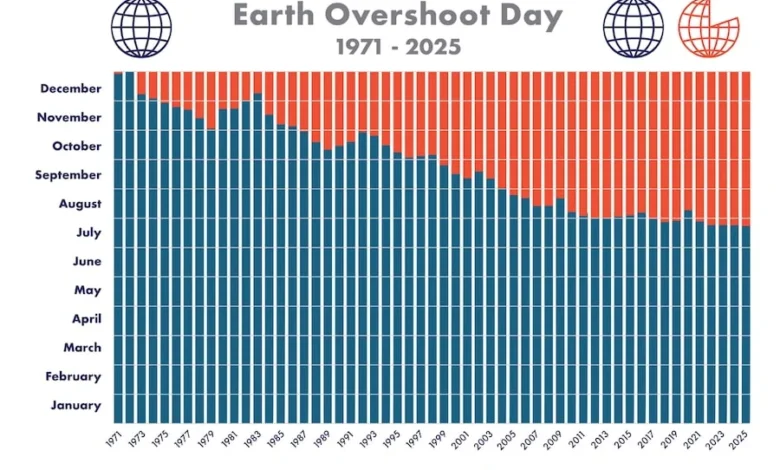
July 24, 2025, marks a somber milestone in the history of human civilization and environmental science as the Global Footprint Network officially declares it Earth Overshoot Day. This date represents the specific point in the calendar year when humanity’s collective demand for ecological resources and services exceeds what the Earth can regenerate within that same year. For the remainder of 2025, the global population will be operating in an ecological deficit, maintaining its resource consumption by liquidating stocks of natural capital and accumulating waste, most notably carbon dioxide in the atmosphere.
The arrival of Earth Overshoot Day on July 24 is the earliest such date recorded since the metric was first calculated and publicized in 2006. It signals a continuing and accelerating trend of overconsumption that threatens the long-term viability of the planet’s biological systems. According to the Global Footprint Network, an international research organization that tracks humanity’s use of natural resources, the world is currently consuming ecological services at a rate 1.8 times faster than the Earth’s ecosystems can replenish them. In simpler terms, humanity is living as if it had 1.8 planet Earths at its disposal.
The Evolution of Ecological Debt: A Historical Chronology
The concept of Earth Overshoot Day was first conceived by Andrew Simms of the UK think tank New Economics Foundation. In 2006, Simms collaborated with the Global Footprint Network to launch the first official campaign to bring attention to the growing gap between human demand and biological supply. While the formal announcement began in the mid-2000s, researchers have since applied modern data sets to historical records to provide a retrospective look at how humanity’s footprint has expanded over the last five decades.
In the early 1970s, the global economy was nearly in balance with the planet’s regenerative capacity. In 1971, Earth Overshoot Day fell on December 25, meaning humanity used only a few days’ worth of "extra" resources. However, as industrialization accelerated and the global population grew, the date began a steady march backward through the calendar. By 1979, the date had moved to November 3. Throughout the 1980s, the date fluctuated but generally trended earlier, reaching October 12 by 1989.
The 1990s and 2000s saw a rapid escalation of resource demand. By 1999, the overshoot occurred on September 25. When the first official announcement was made in 2006, the recalculated date fell on August 22. The trend continued unabated until 2018, when the date reached July for the first time, landing on July 29. A brief and temporary reprieve occurred in 2020, when the global lockdowns associated with the COVID-19 pandemic caused a sudden, sharp contraction in resource use and carbon emissions, pushing the date back to August 16. However, this shift was short-lived, as economic recovery in 2021 and 2022 saw the date return to late July. The 2025 date of July 24 surpasses the previous records of July 25 set in both 2022 and 2023, confirming that the brief pandemic-era dip did not translate into long-term systemic change.
Understanding the Methodology: Biocapacity vs. Ecological Footprint
The calculation of Earth Overshoot Day is based on two primary metrics: Biocapacity and the Ecological Footprint. Biocapacity represents the amount of biologically productive land and sea area available to provide the resources we use and to absorb our waste, including carbon emissions. This includes cropland, grazing land, forest land, fishing grounds, and built-up land.

The Ecological Footprint, conversely, measures the population’s demand for those same resources. It tracks how much area is required to produce the food, fiber, and timber that humanity consumes, the space needed for infrastructure, and the forest area required to sequester the carbon dioxide emissions resulting from the burning of fossil fuels.
When the Ecological Footprint exceeds Biocapacity, the system enters "overshoot." The consequences of this deficit are not immediately felt as a total collapse but rather as a gradual degradation of the environment. This manifests as deforestation, soil erosion, biodiversity loss, the depletion of freshwater aquifers, and the accumulation of greenhouse gases in the atmosphere, which drives global climate change.
The Cumulative Impact of Resource Depletion
The danger of Earth Overshoot Day lies not just in the annual deficit, but in the cumulative debt being passed to future generations. As of 2025, the Global Footprint Network estimates that humanity has accumulated an ecological debt equivalent to 22 years of the planet’s total regenerative capacity. This means that even if the world were to achieve an immediate balance today, it would take more than two decades for the Earth to recover from the damage already sustained.
Lewis Akenji, a board member of the Global Footprint Network, emphasized the gravity of this situation in a recent press release. "We are stretching the limits of how much ecological damage we can get away with," Akenji stated. "It is now a quarter into the 21st century and we owe the planet at least 22 years of ecological regeneration, even if we stop any further damage now. If we still want to call this planet home, this level of overshoot calls for a scale of ambition in adaptation and mitigation that should dwarf any previous historical investments we have made."
The depletion of resources is particularly evident in three critical areas: carbon sequestration, food systems, and freshwater management. Carbon emissions currently make up 60% of humanity’s total Ecological Footprint. The Earth’s forests and oceans simply cannot absorb the volume of CO2 being pumped into the atmosphere, leading to ocean acidification and rising global temperatures. Furthermore, the global food system is responsible for a significant portion of biocapacity use, yet nearly one-third of all food produced for human consumption is lost or wasted, effectively throwing away the ecological resources used to create it.
Regional Disparities and the "Country Overshoot" Factor
While Earth Overshoot Day is a global average, it masks significant disparities between nations. The Global Footprint Network also calculates "Country Overshoot Days," which represent when the date would fall if the entire world lived like the citizens of a specific nation.
High-income countries typically reach their overshoot days much earlier in the year. For instance, if everyone lived like the residents of the United States or the United Arab Emirates, Earth Overshoot Day would occur in early to mid-March. Conversely, many developing nations in Africa and Southeast Asia have footprints that fall within the regenerative limits of the planet, though this is often a byproduct of poverty rather than sustainable design. This disparity highlights the ethical and economic challenges of addressing overshoot: high-consumption nations bear the greatest responsibility for the deficit, while low-income nations are often the most vulnerable to the resulting environmental degradation.

The Path Forward: The Power of Possibility
Despite the alarming trend, experts insist that the date is not fixed and can be moved back through deliberate policy and behavioral shifts. The Global Footprint Network has outlined a framework called the "Power of Possibility," which identifies key interventions that could significantly delay Earth Overshoot Day.
One of the most impactful changes would be a drastic reduction in carbon emissions. According to GFN data, reducing the carbon component of the global Ecological Footprint by 50% would move Earth Overshoot Day by 93 days, or roughly three months. This would require a massive transition to renewable energy sources. Currently, generating 75% of the world’s electricity from renewables could move the date by 26 days.
Food system reform offers another significant opportunity. Halving global food waste would push the date back by 13 days. Furthermore, implementing a "Green New Deal" on a global scale—focusing on reforestation, sustainable agriculture, and circular economy principles—could move the date by as much as 42 days.
Mathis Wackernagel, co-founder of the Global Footprint Network, warns that the current trajectory is unsustainable by the laws of physics. "Overshoot cannot last," Wackernagel noted. "It will end either by deliberate design or dumped-on disaster. It should not be too hard to choose which one is preferable, particularly in light of so many possible choices."
Conclusion and Implications for Global Policy
The announcement of July 24 as Earth Overshoot Day 2025 serves as a scientific warning to policymakers and the private sector. It arrives at a time when the world is already struggling to stay within "planetary boundaries." A study published in 2023 indicated that humanity has already breached six of the nine planetary boundaries—including climate change, biodiversity loss, and land-system change—that keep the Earth stable and habitable.
The economic implications are equally profound. Just as financial debt can lead to bankruptcy, ecological debt leads to "ecosystem bankruptcy." This manifests as supply chain disruptions, rising costs for raw materials, and increased insurance premiums due to climate-related disasters. For businesses and governments, moving the date is no longer just an environmental imperative but a strategy for long-term economic resilience.
As the world moves into the second half of 2025, the focus of international climate summits and economic forums will likely shift toward these metrics. The goal of "moving the date" provides a clear, measurable target for global sustainability efforts. Whether the 2026 date will continue the trend toward the beginning of the year or finally begin to retreat depends on the speed at which global society can transition from resource exploitation to resource stewardship.