Probiotic treatment of Montastraea cavernosa colonies using a whole-colony bagging technique.

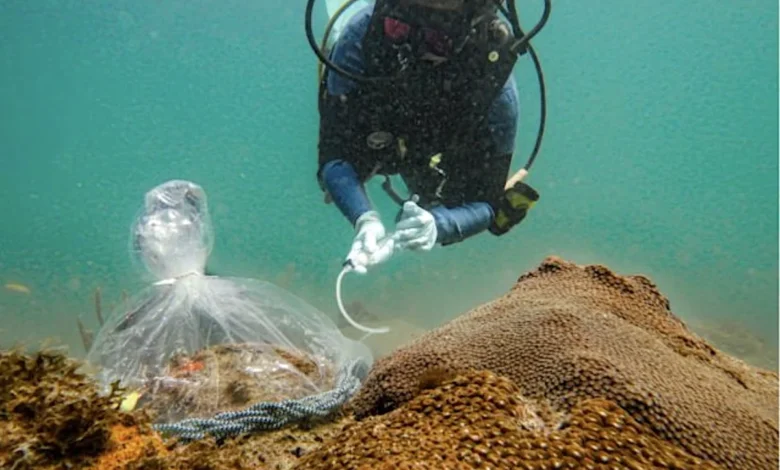
In a landmark development for marine conservation, researchers have identified a promising probiotic treatment that significantly slows the progression of Stony Coral Tissue Loss Disease (SCTLD), a lethal condition that has decimated reef ecosystems across the Florida Reef Tract and the wider Caribbean. The study, led by scientists at the Smithsonian Marine Station and published in the journal Frontiers in Marine Science, highlights the efficacy of a specific bacterial strain, MCH1-7, when administered through a specialized "whole-colony bagging" method. This approach offers a potential alternative or supplement to traditional antibiotic treatments, which have raised concerns regarding long-term environmental impacts and the development of bacterial resistance.
The Crisis of Stony Coral Tissue Loss Disease
To understand the significance of this probiotic breakthrough, it is essential to contextualize the threat posed by Stony Coral Tissue Loss Disease. First identified off the coast of Miami-Dade County in 2014, SCTLD is arguably the most lethal coral disease ever recorded. Unlike many other coral ailments that affect a single species or progress slowly, SCTLD is characterized by its rapid transmission, high mortality rates, and its ability to infect more than 20 species of reef-building corals, including the ecologically vital great star coral (Montastraea cavernosa).
The disease manifests as white lesions that expand across the coral colony, liquefying the living tissue and leaving behind a stark white skeleton. Once infected, a colony can lose its entire tissue cover in a matter of weeks or months. Since its emergence, SCTLD has spread throughout the Florida Reef Tract—the third-largest barrier reef system in the world—and has reached nearly every corner of the Caribbean, from Mexico to the US Virgin Islands. The loss of these corals threatens not only marine biodiversity but also the coastal protection, tourism, and fisheries that human communities depend on.
The Discovery of a Natural Shield: MCH1-7
The search for a solution led researchers to the Smithsonian Marine Station, where, in 2018, scientists began investigating "survivor" corals—colonies that remained healthy even while surrounding corals succumbed to the disease. From these resilient specimens, they isolated a beneficial bacterial strain known as MCH1-7.
MCH1-7 is a naturally occurring probiotic that produces a potent antimicrobial compound called tetrabromopyrrole (TBP). Preliminary laboratory tests indicated that this strain could inhibit the growth of the pathogens suspected of causing SCTLD. However, translating laboratory success into an effective field treatment required a robust delivery mechanism that could withstand the dynamic conditions of the open ocean.
Experimental Methodology: Bagging vs. Paste
The recently published study sought to determine the most effective way to apply this probiotic to wild coral colonies. The research team focused on Montastraea cavernosa, a hardy and common species that serves as a primary framework builder for Caribbean reefs. The scientists tested two primary delivery methods:
- Whole-Colony Bagging: This technique involves divers placing a large, weighted plastic bag over an entire coral colony. The MCH1-7 probiotic is then injected into the seawater trapped inside the bag. This creates a concentrated "probiotic bath," allowing the beneficial bacteria to saturate the coral’s surface and the surrounding water column for several hours before the bag is removed.
- Direct Paste Application: In this more targeted approach, the probiotic is mixed into a specialized paste and applied directly to the active disease lesions on the coral. This method is similar to how amoxicillin (an antibiotic) is currently administered to corals in the field.
The experiment was conducted in situ, with researchers monitoring treated and untreated (control) colonies over a period of 2.5 years. This longitudinal approach was critical, as many coral treatments show initial success but fail to provide long-lasting protection.
Quantitative Results and Long-Term Success
The results of the study were striking. Corals treated with the whole-colony bagging method demonstrated a significant increase in survival and tissue retention compared to untreated colonies. On average, the bagging-treated corals lost only 7% of their tissue to SCTLD over the course of the study. In contrast, the untreated control colonies lost an average of 35% of their tissue, with many experiencing total mortality.
Crucially, the protective effects of the whole-colony bagging treatment persisted for 2.5 years. This suggests that the MCH1-7 strain does not just provide a temporary shield but may actually integrate into the coral’s microbiome, bolstering its long-term immunity against the disease.
Interestingly, the paste application method proved to be significantly less effective than bagging. While the paste targeted individual lesions, it failed to protect the rest of the colony from developing new infections. The researchers concluded that the bagging method’s success lies in its ability to treat the "whole colony," addressing both visible lesions and asymptomatic areas that may already be harboring pathogens.

The Role of Tetrabromopyrrole (TBP)
A key finding of the research involves the chemical compound produced by MCH1-7: tetrabromopyrrole (TBP). Beyond its antimicrobial properties, TBP plays a fascinating role in coral ecology. It is known to act as a "settlement cue" for coral larvae, signaling that a particular surface is healthy and suitable for growth.
Jennifer Sneed, a biologist at the Smithsonian Marine Station, noted the evolutionary logic of this mechanism. If a bacterium produces a compound that both protects the coral and attracts new larvae, it creates a virtuous cycle of reef health. Larvae that settle in areas rich in TBP are more likely to survive to adulthood because they are inherently protected by the probiotic-producing bacteria. This dual function makes MCH1-7 an exceptionally powerful tool for reef restoration, as it could potentially help newly settled corals survive in disease-impacted environments.
Chronology of Probiotic Research and SCTLD Management
The journey from the emergence of SCTLD to the current probiotic breakthrough follows a decade-long timeline of scientific urgency:
- 2014: SCTLD is first detected near Miami, Florida.
- 2015–2017: The disease spreads rapidly across the Florida Reef Tract; scientists struggle to identify the pathogen.
- 2018: Researchers at the Smithsonian Marine Station isolate the MCH1-7 strain from a resistant coral colony.
- 2019–2021: Initial laboratory and small-scale field trials are conducted to test the safety and efficacy of MCH1-7.
- 2022–2024: Long-term monitoring of the bagging vs. paste methods is carried out in Florida waters.
- 2025: The findings are published in Frontiers in Marine Science, establishing the whole-colony bagging method as a superior delivery system for probiotics.
Logistics, Scalability, and the Future of Reef Diving
While the whole-colony bagging method has proven effective, researchers acknowledge the logistical challenges it presents. The process is labor-intensive, requiring scuba divers to transport heavy bags and weights to reef sites, deploy them carefully to avoid damaging the coral, and return hours later for retrieval.
However, the study’s authors argue that the long-term benefits outweigh these operational costs. Unlike antibiotic treatments, which often require repeated applications and can lead to the emergence of resistant bacteria, the probiotic treatment offers a more sustainable, "nature-based" solution. Furthermore, the researchers confirmed that the MCH1-7 strain does not negatively impact other healthy Caribbean coral species, making it safe for broader ecological use.
Expert Reactions and Scientific Analysis
The marine science community has reacted with cautious optimism to these findings. Kelly Pitts, the lead author of the study and a researcher at the Smithsonian Marine Station, emphasized that while the results are encouraging, the probiotic is not a "silver bullet."
"It’s important to understand that this is the very beginning," Pitts stated. "This is definitely not a cure-all, but we’re moving in the right direction."
The scientific consensus suggests that a multi-pronged approach will be necessary to save the world’s coral reefs. Probiotics like MCH1-7 could be used in tandem with other strategies, such as:
- Genetic Selection: Breeding corals that show natural resistance to SCTLD and rising sea temperatures.
- Land-Based Nurseries: Raising healthy coral fragments in controlled environments to be outplanted onto reefs.
- Water Quality Management: Reducing land-based pollution and runoff that can stress corals and make them more susceptible to disease.
Broader Implications for Marine Conservation
The success of the MCH1-7 probiotic represents a paradigm shift in how we manage marine diseases. Traditionally, wildlife disease management has focused on reactive measures—treating symptoms once they appear. The move toward "proactive probiotics" mirrors advances in human and agricultural medicine, where the focus is on strengthening the host’s natural microbiome to prevent disease before it takes hold.
Moreover, the implications of this study extend beyond Florida. Coral reefs globally are under siege from a combination of local stressors and global climate change. As ocean temperatures rise, corals become more susceptible to bleaching and disease. Developing a toolkit of effective, long-lasting treatments like the whole-colony bagging method is essential if we are to preserve these ecosystems for future generations.
The Smithsonian team plans to continue their research by exploring ways to streamline the bagging process and testing whether MCH1-7 can be used to treat other coral species or even other types of marine diseases. As the fight against Stony Coral Tissue Loss Disease continues, the humble MCH1-7 bacterium stands as a testament to the power of nature-based solutions in the face of unprecedented environmental challenges.