Global Climate Crisis Intensifies as Wildfires Ravage Northern Hemisphere and Extreme Weather Becomes the New Normal


The convergence of record-breaking temperatures and prolonged drought conditions has triggered a series of catastrophic wildfires across Europe and North America, signaling what meteorologists and climate scientists are increasingly describing as a permanent shift in the global climate landscape. This week, emergency services across several continents struggled to contain a phenomenon dubbed the "firewave," a period of intense, sustained heat that has turned vast tracts of forest and grassland into tinderboxes. In France, the scale of the crisis necessitated the deployment of specialized water-dumping aircraft, which were forced to collect water directly from the Seine River to combat a massive blaze in the Fontainebleau forest, located on the outskirts of Paris. This operation highlighted the proximity of the climate threat to major metropolitan centers and the logistical strain placed on national infrastructure.
Across the English Channel, the United Kingdom has experienced an unprecedented streak of high temperatures. According to data analyzed by the Financial Times, the country has recorded 25 non-consecutive days with temperatures exceeding 30°C, including nine days where the mercury climbed above 34°C. This persistent heat has not only impacted public health but has also placed the UK’s emergency services under extreme pressure as they contend with a surge in grass fires and heat-related incidents. Meanwhile, in North America, the remnants of massive Canadian wildfires have cast an "orange haze" over Ontario and several northern U.S. states, according to BBC News reports. The smoke, which traveled hundreds of miles, prompted air quality alerts for millions of residents, serving as a visceral reminder of the transboundary nature of climate-induced disasters.
The Met Office and the UK’s Shifting Climate Baseline
The UK Met Office recently published a comprehensive report on the state of the nation’s climate, concluding that weather patterns previously categorized as "extreme" are rapidly becoming the "new normal." While 2023 stood as the hottest year on record for the United Kingdom, meteorological models suggest that this record is likely to be surpassed within the next few years. This assessment reflects a broader global trend where the baseline for "average" weather is shifting upward at an accelerating rate.
Liz Bentley, the head of the Royal Meteorological Society, emphasized that the theoretical predictions made by climate scientists for decades are now manifesting as lived experiences for the general population. The transition from scientific modeling to daily reality is being felt in homes and communities across the UK, where infrastructure designed for a temperate climate is increasingly failing to cope with Mediterranean-level heat. The Met Office report underscores that the frequency of these heatwaves is not an anomaly but a direct consequence of historical and ongoing greenhouse gas emissions.
Significant Progress in Amazon Conservation Efforts
Despite the grim news from the Northern Hemisphere, there have been notable successes in conservation efforts in the Southern Hemisphere. New data indicates a 38% drop in deforestation within the Brazilian Amazon during the first half of 2026 compared to the same period in the previous year. This decline, reported by Al Jazeera, represents the lowest level of forest loss in a decade and is widely attributed to the aggressive environmental policies implemented by the administration of President Luiz Inácio Lula da Silva.
The reduction in deforestation is a critical development for global climate goals, as the Amazon rainforest serves as one of the world’s most vital carbon sinks. Under the previous administration, deforestation rates had surged, leading to international condemnation and concerns that the rainforest was approaching a "tipping point" beyond which it would transition into a dry savanna. The current 38% reduction suggests that targeted law enforcement, the reinstatement of environmental protections, and the empowerment of Indigenous communities can effectively slow the destruction of critical ecosystems. However, experts warn that these gains remain fragile and require sustained political will and international financial support to be maintained.
Attribution Science and the Human Cost of Heat
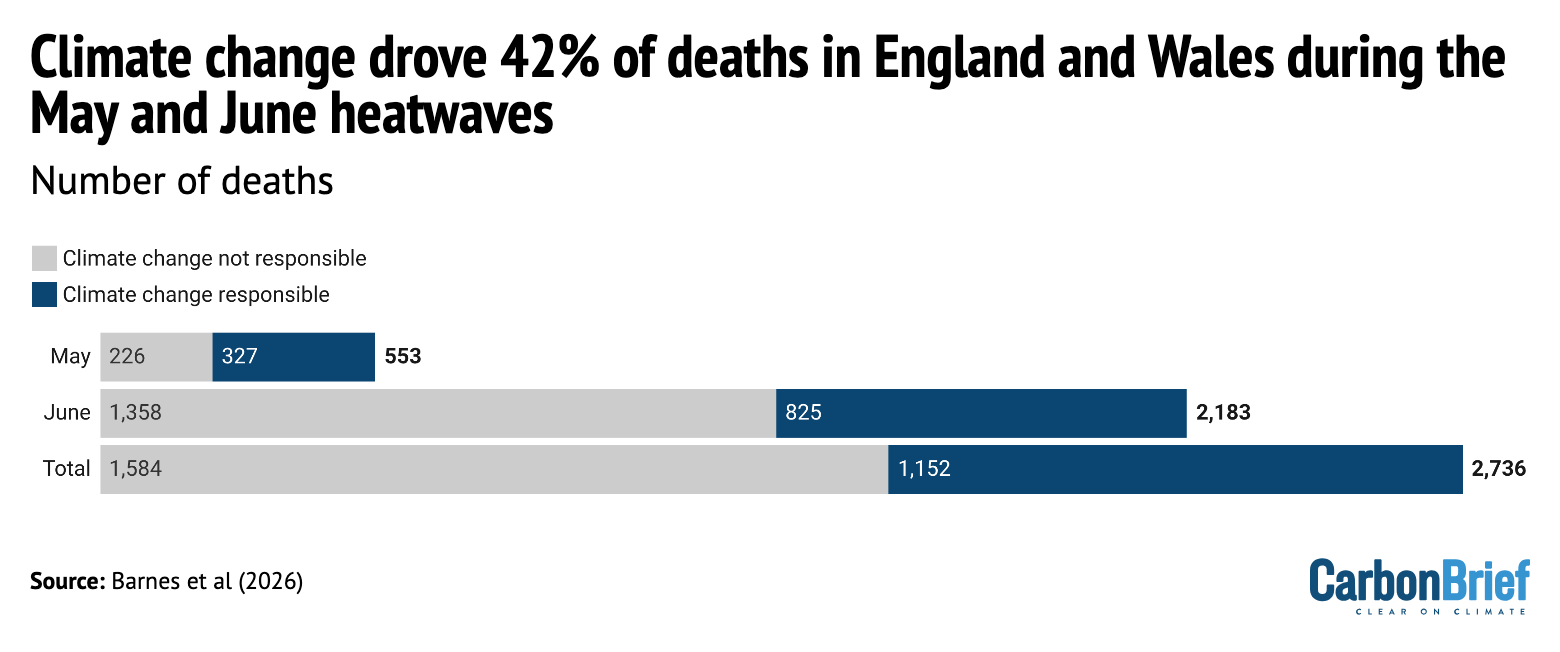
A pivotal study recently highlighted by Carbon Brief has provided a stark quantification of the human toll associated with rising temperatures. The research found that more than 1,000 heat-related deaths in England and Wales during the months of May and June were directly attributable to climate change. This figure accounts for approximately 42% of all heat-related fatalities during that period. By using "attribution science"—a field that compares observed weather events with models of a world without human-induced warming—researchers can now determine the specific role played by climate change in individual weather events and their subsequent health impacts.
The implications of this data are profound. It shifts the conversation from viewing heat-related deaths as unfortunate natural occurrences to recognizing them as preventable consequences of policy and industrial choices. The study also unpacked the various methodologies used globally to estimate heat deaths, noting that different regions utilize different metrics, which can often lead to an underestimation of the true mortality rate. As heatwaves become more frequent and severe, the need for robust public health interventions and urban cooling strategies becomes a matter of life and death.
The Role of Cultural Institutions in Climate Advocacy
As the physical impacts of climate change become more apparent, cultural institutions are taking on a more prominent role in public education and advocacy. London’s Natural History Museum (NHM) recently launched its first permanent climate-themed exhibition, titled "Fixing Our Broken Planet." Meaghan Macdonald, the senior project and programme manager for the museum, explained that the exhibition aims to position the museum as a "convener of conversations" regarding the planetary emergency.
In an interview with Carbon Brief, Macdonald highlighted the importance of engaging visitors who may not have previously sought out information on climate change. By integrating scientific data with a sense of "hope and empowerment," the museum seeks to move beyond the disheartening nature of the subject matter. The exhibition features "conversation starters," such as digital screens asking visitors complex ethical questions about the green economy—for example, whether deep-sea mining should be permitted to source minerals for renewable energy technologies.
The NHM’s broader strategy is to "create advocates for the planet." This involves not only educating the public but also bringing together policymakers, industry leaders, and scientists to find collaborative solutions. The museum has expanded its reach through initiatives like "Generation Hope" and the "National Education Nature Park," a project in partnership with the Department for Education designed to engage students in biodiversity and climate action.
Historical Awareness and the Path Forward
The urgency of the current crisis is further underscored by recent investigative research into the history of climate knowledge. A report by the Center for International Environmental Law (CIEL), published via Climate Home News, revealed that major emitting countries were aware of the risks of climate change decades earlier than they have previously admitted. This research suggests that the delay in global climate action was not due to a lack of scientific understanding but was influenced by political and economic interests.
As the world grapples with the current "firewaves" and record temperatures, the discourse among the scientific community is also evolving. Professor Peter Stott, a prominent climate scientist, recently argued in The Conversation that researchers must be more transparent and vocal about "worst-case scenarios." Stott suggests that while maintaining hope is essential, a clear-eyed understanding of the potential for catastrophic outcomes is necessary to spur the level of radical action required to mitigate the worst effects of global warming.
The intersection of extreme weather, public health crises, and the historical accountability of nations creates a complex landscape for future policy. With the potential for a "Godzilla" El Niño event on the horizon—a phenomenon characterized by exceptionally warm sea surface temperatures in the Pacific—meteorologists warn that the records set in 2023 and 2024 may soon be eclipsed. The current events in France, the UK, Canada, and Brazil serve as disparate but deeply interconnected pieces of a global puzzle, illustrating that while some progress is being made in conservation, the overall trajectory of the climate remains one of escalating volatility. The transition into this "new normal" demands a fundamental reassessment of how societies prepare for, respond to, and attempt to prevent the further degradation of the global environment.