CN Rail Train Surrounded by Northern Ontario Wildfires as Union Questions Safety Protocols Amidst Regional Evacuations

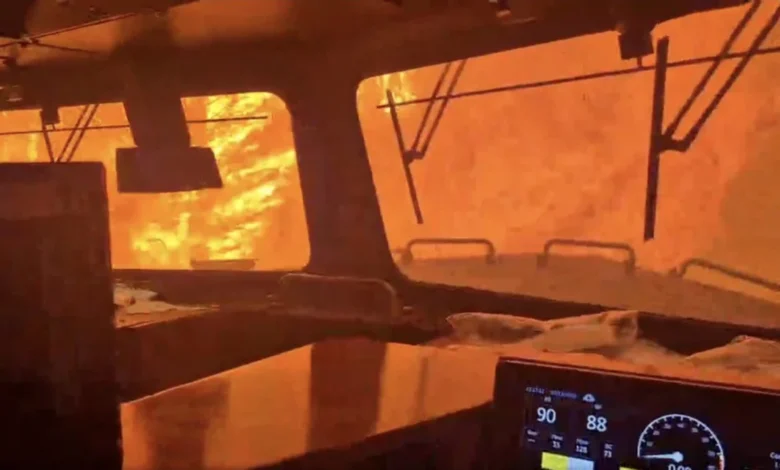
A harrowing scene unfolded this week in the remote wilderness of Northern Ontario as a Canadian National (CN) Rail crew found their locomotive engulfed by a fast-moving wildfire. The incident, captured in dramatic video footage by a crew member, has sparked a national conversation regarding the safety of rail operations during extreme weather events and the adequacy of corporate protocols when transporting goods through active fire zones. As at least 134 wildfires continue to burn across the province’s northwest, the narrow escape of this train crew serves as a stark reminder of the escalating dangers posed by a record-breaking fire season.
The footage, which quickly circulated across social media and news outlets, shows a CN locomotive stopped on a section of track near Armstrong, Ontario. The train appears to have been held in a siding or a specific section of the main line to allow an oncoming train to pass. As the crew waits, the landscape on the left side of the tracks is transformed into an inferno. Thick, charcoal-colored smoke chokes the air, and orange flames lick at the side of the engine. In the video, a crew member can be heard describing the deteriorating situation with a mixture of professional calm and mounting urgency. "This could potentially overtake us here. This has gotten a little scary," the employee remarks as the fire advances toward the front of the train.
A Terrifying Encounter on the Tracks
As the fire intensity increased, the crew’s communication with dispatch and other nearby rail traffic became more frantic. "OK, y’all need to hurry up here, like, seriously. We’re encased in flames now," the crew member stated over the radio. The visual evidence confirms the severity of the situation; the heat from the blaze was likely immense, yet the heavy steel construction of the locomotive and its internal air filtration and conditioning systems provided a critical barrier between the workers and the lethal environment outside.
The oncoming train eventually passed the stationary locomotive, appearing briefly through the haze of smoke. Shortly after the passing maneuver was completed, the crew was able to move their train out of the immediate danger zone. While no injuries were reported among the crew members involved in this specific encounter, the incident has raised significant questions about why the train was permitted to enter an area where fire activity was so volatile.
In response to the incident, a spokesperson for CN Rail confirmed that the company eventually took drastic measures to ensure the safety of its personnel. "CN has temporarily suspended rail operations near Armstrong, Ontario, as a precaution due to wildfire activity in the area," the company stated in an official release. "As a safety measure, CN employees in the area and residents of the Town of Armstrong were evacuated overnight Monday." The company further emphasized that it remains in close contact with the Ontario Ministry of Natural Resources and local authorities to monitor the evolving situation.
The Union Response: A Question of Forethought
The Teamsters Canada Rail Conference, which represents thousands of rail workers across the country, was quick to voice its concerns over the incident. Paul Boucher, president of the conference, issued a stern statement commending the crew’s professionalism while simultaneously lambasting CN’s decision-making process.
"We commend the courage and professionalism of our members, who kept their composure in a terrifying situation. We are relieved that nobody was hurt," Boucher said. However, he transitioned into a critique of the company’s operational choices: "But make no mistake, this incident should never have happened. CN should never have sent a train down those lines. The company knows exactly how bad the situation is in that region. That fire has been raging for five weeks."
The union’s primary contention is that the presence of a known, long-standing fire should have triggered a more proactive suspension of service or a rerouting of traffic long before the crew was placed in a life-threatening scenario. The criticism highlights a recurring tension between the logistical demands of maintaining transcontinental supply chains and the safety of the frontline workers tasked with operating them under increasingly hostile environmental conditions.
Broader Regional Impact and Community Displacement
The wildfire that nearly overtook the CN train is part of a much larger crisis currently gripping Northern Ontario. With over 130 active fires, the provincial resources are being pushed to their limits. While the Armstrong incident involved a crew that was fortunately able to escape, other communities have not been as lucky.
Approximately 20 miles west of Armstrong, near the Namaygoosisagagun First Nation (also known as Collins), the situation reached a tragic peak. According to reports from the Ontario Provincial Police (OPP) and CBC News, three other trains carrying combustible and flammable materials were stranded in the vicinity of the First Nation community due to the encroaching flames. The proximity of highly flammable cargo to active fire zones created a secondary hazard for both the rail workers and the local population.
The community of Namaygoosisagagun suffered a devastating blow as the fire swept through the area. Residents were forced to flee with little more than what they could carry, using boats to escape across Collins Lake as the community reportedly burned to the ground. The loss of infrastructure and personal property in these remote regions presents a long-term recovery challenge, as many of these communities rely on seasonal rail and air access for essential supplies.
Environmental and Health Consequences Across the Continent
The impact of the Northern Ontario wildfires is not confined to the immediate vicinity of the flames. Meteorological patterns have carried the resulting smoke thousands of miles, affecting air quality for millions of people. This week, Toronto, Canada’s most populous city, recorded air quality levels that were ranked among the worst in the world. The particulate matter from the fires created a thick, yellowish haze over the city, prompting health officials to issue warnings for residents to stay indoors, particularly those with respiratory conditions.
The smoke has also crossed the international border, blanketing parts of the north-central and northeast United States. Residents in states as far south as Pennsylvania and New York have reported hazy skies and the smell of woodsmoke, illustrating the transboundary nature of wildfire smoke. This phenomenon has reignited debates over climate change and the increasing frequency of "mega-fires" in the Canadian boreal forest.
Environmental analysts point to the accumulation of greenhouse gases as a primary driver of the hotter, drier conditions that allow these fires to ignite and spread with such ferocity. The 2024 fire season follows a record-shattering 2023 season, suggesting a "new normal" for the Canadian wilderness. The rail industry, which is a backbone of the Canadian economy, must now grapple with how to navigate a landscape that is becoming seasonally impassable.
Analysis of Rail Safety and Dangerous Goods
The incident near Armstrong and the stranding of trains carrying combustible materials near Collins highlight a critical vulnerability in the North American rail network. Rail lines in Canada often pass through vast, unpopulated forested areas where fire suppression is difficult. When a train carrying dangerous goods—such as petroleum products or chemicals—is caught in a wildfire, the risk of a catastrophic explosion or environmental spill increases exponentially.
Current safety protocols for rail operators involve monitoring fire maps provided by provincial agencies and maintaining communication with fire towers and aerial reconnaissance teams. However, as seen in the Armstrong video, wildfires can be unpredictable, shifting direction or increasing in intensity within minutes due to localized wind patterns created by the fire itself.
The Transportation Safety Board of Canada (TSB) often reviews incidents where rail safety is compromised by environmental factors. While no formal investigation into the Armstrong incident has been announced as of this writing, the public pressure from the Teamsters and the dramatic nature of the footage may prompt a review of the "trigger points" used by rail companies to suspend service. The question remains: at what point does the risk to human life and the environment outweigh the economic necessity of keeping the trains moving?
Conclusion and Future Outlook
The CN Rail crew’s narrow escape is a story of survival, but it is also a warning. As the 134 wildfires continue to burn across Northern Ontario, the focus remains on containment and the protection of life. The evacuation of Armstrong and the destruction of Namaygoosisagagun serve as somber milestones in a summer that has already seen unprecedented environmental stress.
For CN Rail and other major carriers, the incident necessitates a re-evaluation of emergency procedures. The transition from "business as usual" to emergency evacuation must be seamless to prevent a repeat of the "encased in flames" scenario. Meanwhile, for the residents of Northern Ontario, the focus is on rebuilding and hoping for the rainfall needed to quell the flames that have redefined their landscape.
As the smoke clears over Toronto and the United States, the long-term implications of these fires will continue to be studied. From the immediate safety of rail workers to the global impact of carbon emissions from burning forests, the events of this week in Northern Ontario are a microcosmic look at the challenges of the 21st century. The courage of the train crew is undeniable, but the consensus among union leaders and environmental advocates is clear: such courage should never have been tested under these avoidable circumstances.