The absence of American representation at the pinnacle of international motorsport is a phenomenon that has persisted for three decades, marking a stark departure from the mid-20th-century era when drivers like Mario Andretti, Phil Hill, and Dan Gurney were household names across the globe. Today, the landscape of Formula 1, the World Rally Championship (WRC), and endurance racing prototypes is dominated by European, South American, and Asian talent. For a nation that functions as a global superpower and a massive automotive market, the inability to consistently place American drivers in the winners’ circles of the FIA-sanctioned world stage represents a complex failure of infrastructure, economic accessibility, and cultural focus.
The Historical Divergence: A Chronological Decline
To understand the current void, one must examine the timeline of American success in international racing. The 1960s and 1970s served as a golden era. Phil Hill secured the Formula 1 World Drivers’ Championship in 1961, and Mario Andretti followed suit in 1978. In endurance racing, American teams and drivers were integral to the dominance of the Ford GT40 at Le Mans. However, as the 1980s progressed, the professionalization of European motorsport began to accelerate.
By the time Mario Andretti stepped away from F1, the "American Pipeline"—the traditional route for domestic drivers to reach Europe—had effectively evaporated. Since the mid-1990s, the number of American drivers to even secure a full-time seat in Formula 1 can be counted on one hand. The last time an American won an F1 race was the 1978 Dutch Grand Prix. In endurance racing, the drought is similarly profound; while American teams often compete, the last overall victory for an American driver at the 24 Hours of Le Mans occurred in 1996, when Davy Jones reached the top step of the podium.

The NASCAR Hegemony and the Talent Funnel
A significant factor in this decline is the internal gravitation toward NASCAR. In the mid-1990s, the American open-wheel scene suffered a catastrophic fracture known as "The Split," where the Indy Racing League (IRL) and CART became warring factions. This internal conflict decimated budgets, confused sponsorship streams, and eroded the quality of the domestic open-wheel ladder.
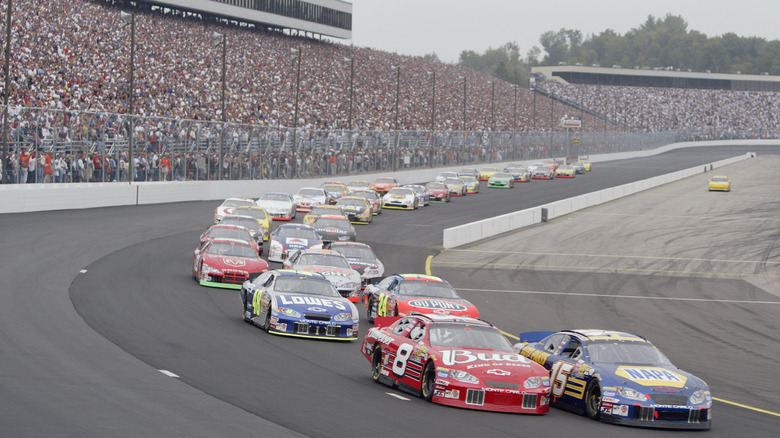
As open-wheel racing struggled for air, NASCAR capitalized on the vacuum. By the early 2000s, NASCAR had transformed from a regional Southern sport into a national powerhouse. It offered something that the fragmented open-wheel world could not: a stable, lucrative, and highly accessible career path. The "NASCAR Funnel" became the default trajectory for young, talented American drivers. Local dirt tracks and asphalt ovals across the country fed into a clearly defined hierarchy—from ARCA to the Truck Series, then the Xfinity Series, and finally the Cup Series.
The economic incentive was overwhelming. A talented driver could earn a multi-million-dollar salary in NASCAR without ever having to navigate the expensive, grueling, and politically complex landscape of European junior formulas. This phenomenon is best illustrated by the career path of modern prospects like Connor Zilisch. Despite showing early potential and success in international-style sports car racing—such as the MX-5 Cup and endurance outings at Daytona—the gravitational pull of the NASCAR system proved irresistible, culminating in a long-term development deal with Hendrick Motorsports.
Economic Barriers and the Cost of Global Entry
The financial barrier to entry for international racing is perhaps the most rigid obstacle facing American youth today. In Europe, the ladder to Formula 1 is highly structured, starting with karting and moving through FIA-certified Formula 4, Formula 3, and Formula 2. This path requires a sustained, multi-year financial investment that often reaches seven figures before a driver even touches a Formula 1 car.
For an American family, the cost of moving to Europe to compete in these series is prohibitively high, compounded by the lack of institutional support. While a young driver in the United States can find local sponsors and affordable regional series, the "European-style" open-wheel racing lacks a comparable domestic ecosystem. Consequently, young Americans are rarely exposed to the high-downforce, high-speed, and tire-management-intensive racing that defines the global circuit.
Furthermore, the International Motor Sports Association (IMSA) serves as a robust domestic sports car series, but it has not functioned as a reliable bridge to the international stage. Data from the 2025 and 2026 seasons shows that American drivers are increasingly overshadowed by international imports even on home soil. When an American driver does achieve success, it is often an isolated incident rather than a trend, highlighting the gap in training and competitive exposure.
Cultural Implications and Soft Power
The decline of American representation in global racing has broader implications for the nation’s soft power. Motorsport is a multi-billion-dollar global industry that serves as a high-visibility venue for international diplomacy, technological exchange, and brand marketing. When a nation consistently produces champions, it creates a "halo effect" that bolsters the global prestige of its automotive and engineering sectors.
Industry analysts note that when countries like Spain witnessed the rise of Fernando Alonso, the national interest in motorsport—and the resulting tourism and economic investment—surged. The current absence of an American flag on the podium at events like the World Rally Championship or the F1 World Championship suggests a missed opportunity for cultural connection with key global allies.
Analysis of the Future Landscape
Industry experts and team principals have long suggested that a revival of American talent requires a fundamental shift in how the country scouts and nurtures its youth. There is a growing consensus that the U.S. needs a dedicated, FIA-aligned ladder system that prepares drivers for the unique demands of international circuits. Without such a mechanism, American racing will likely remain a bifurcated ecosystem: a thriving domestic industry built on oval-track traditions and a distant, infrequent participant in the world’s most prestigious endurance and open-wheel championships.
The irony remains that while America is arguably the birthplace of modern automotive consumer culture, it has effectively outsourced its competitive representation to Europe. Until there is a structural overhaul that makes the path to the global stage as accessible and supported as the path to the NASCAR Cup Series, the "American drought" in international racing is likely to persist for the foreseeable future. The talent is undoubtedly present, but the roadmap remains missing, leaving the next generation of American legends to seek their fortunes in familiar, domestic circles rather than on the world’s most storied tracks.
Related posts: