WHO and African Union Forge New Health Pact to Combat Aid Cuts and Drive Continental Self-Reliance

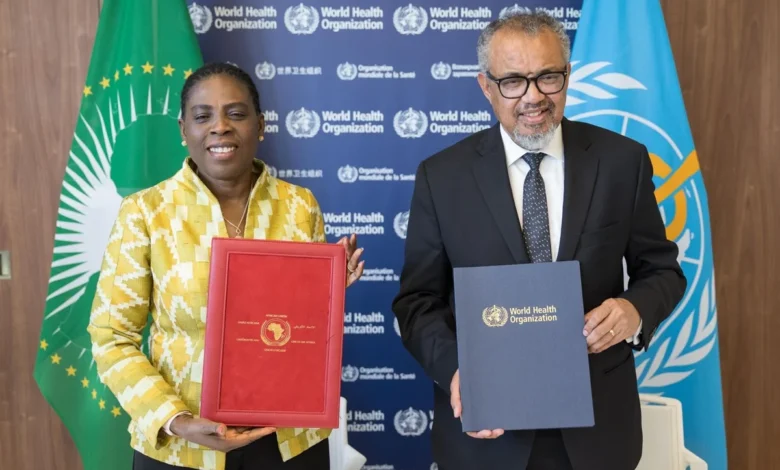
GENEVA — In a definitive move to safeguard public health amidst severe global financial headwinds, the World Health Organization (WHO) and the African Union (AU) Commission formally renewed their longstanding strategic partnership on the sidelines of the 78th World Health Assembly. The signing of an updated Memorandum of Understanding (MoU) marks a critical evolution in multilateral cooperation, underscoring a joint commitment to advancing health security, achieving universal health coverage (UHC), and driving sustainable development across the African continent.
Against a backdrop of unprecedented financial challenges in the international development landscape—marked notably by steep reductions in bilateral foreign aid—the agreement serves as a resolute statement of intent. It repositions African health governance around the pillars of regional resilience, collective action, and inclusive partnerships. Central to this renewed framework is the Department of Health, Humanitarian Affairs, and Social Development of the AU Commission, which will act as the principal engine for implementing robust health policies across member states.
The high-level accord was formally executed by Her Excellency Ambassador Amma Adomaa Twum-Amoah, Commissioner for Health, Humanitarian Affairs, and Social Development, representing His Excellency Mahmoud Ali Youssouf, Chairperson of the African Union Commission, alongside Dr. Tedros Adhanom Ghebreyesus, Director-General of the World Health Organization. By strengthening institutional ties, the agreement sets a clear trajectory for transforming primary healthcare delivery and laying the groundwork for long-term health sovereignty throughout Africa.
Strategic Imperatives and the Shift Toward Health Sovereignty
The timing of this updated pact is far from coincidental. Global health financing is undergoing a profound structural shift. For decades, many African nations have relied heavily on external bilateral aid and donor-driven programs to finance their public health infrastructures. However, recent economic pressures, shifting geopolitical priorities, and domestic budget constraints in traditional donor nations have triggered a wave of foreign aid cuts. These reductions threaten to derail decades of progress made against major infectious diseases, maternal mortality, and fragile health systems.
Recognizing these vulnerabilities, the leadership of both the AU and the WHO framed the new MoU not merely as a diplomatic formality, but as a strategic survival tool and a roadmap toward independence.
"This Agreement marks a new chapter in AU-WHO cooperation," stated Commissioner Amma Adomaa Twum-Amoah during the signing ceremony. "By working together more closely, we can better respond to the health needs of our populations and ensure that no one is left behind. The African Union values WHO’s central and leading role in global health and looks forward to deepening this strategic partnership in support of our shared goals. We need to move from budgeting for survival to planning for health sovereignty."
This philosophy of "health sovereignty" addresses a fundamental flaw in historical public health interventions: the cyclical vulnerability of African health systems to external macroeconomic shocks. By coordinating technical guidance, pooling resources, and streamlining regulatory frameworks, the renewed MoU aims to empower African nations to build domestic manufacturing capacities for vaccines, pharmaceuticals, and essential medical supplies, thereby reducing reliance on global supply chains that have historically proven fragile during international crises.
Building on a Solid Foundation: Chronology of the AU-WHO Partnership
To fully understand the weight of the updated MoU, it is necessary to examine the historical trajectory of collaboration between the two continental and global bodies. The partnership has evolved significantly over the past two decades, maturing from ad-hoc emergency responses into a structured, institutionalized alliance.
- Early 2000s: Cooperation was largely reactionary, focusing on emergency responses to severe epidemics such as HIV/AIDS, tuberculosis, and malaria, alongside ad-hoc responses to localized outbreaks of viral hemorrhagic fevers like Ebola in West Africa.
- 2017–2018: The establishment of the Africa Centres for Disease Control and Prevention (Africa CDC) as a specialized technical institution of the African Union provided a new institutional anchor. This development necessitated a more formalized, structured relationship between the WHO and the AU to avoid duplication of efforts and maximize technical synergy.
- February 2019: The signing of the landmark 2019 Memorandum of Understanding. This earlier agreement laid the foundational framework for cooperation, establishing joint mechanisms to address health emergencies, build resilient health systems, and tackle the dual burden of communicable and non-communicable diseases.
- 2020–2022 (The COVID-19 Pandemic): The global pandemic tested the limits of international cooperation. While initial vaccine nationalism exposed severe global inequities—leaving many African nations at the back of the queue for life-saving immunizations—the crisis ultimately galvanized African leadership. Initiatives such as the Africa Vaccine Acquisition Trust (AVAT) and the Partnership for African Vaccine Manufacturing (PAVM) demonstrated the continent’s capacity for collective mobilization.
- Late 2023: The African Union achieved permanent membership in the G20, substantially elevating the continent’s geopolitical voice in global economic and financial governance, including health financing architecture.
- May 2025 (Present Day): The formal updating and signing of the MoU at the 78th World Health Assembly in Geneva, cementing a modern framework designed to navigate the post-pandemic financial reality and the looming threat of bilateral aid reductions.
Key Pillars of the Updated Framework
The newly minted agreement builds comprehensively upon the 2019 MoU while introducing streamlined mechanisms designed to eliminate bureaucratic friction and accelerate operational delivery. The updated pact aligns institutional efforts around Africa’s specific health priorities and reasserts the WHO’s vital technical and normative leadership role in supporting the AU and its specialized agencies in achieving the health-related Sustainable Development Goals (SDGs).
While the comprehensive administrative details encompass a wide spectrum of public health disciplines, the collaboration is anchored by key operational focus areas:
- Strengthening Health Security and Emergency Preparedness: Enhancing early warning systems, cross-border surveillance, and joint rapid response capabilities to contain emerging zoonotic diseases and epidemic-prone pathogens before they escalate into continental or global crises.
- Accelerating Universal Health Coverage (UHC) and Primary Health Care: Fostering policies that expand financial risk protection, reduce out-of-pocket health expenditures for vulnerable populations, and strengthen community-level health service delivery.
- Enhancing Local Manufacturing and Supply Chain Resilience: Supporting strategic initiatives—such as the regional production of vaccines, diagnostics, and therapeutics—to secure self-reliance and insulate African markets from international supply shocks.
- Tackling the Double Burden of Disease: Coordinated strategies addressing both persistent infectious diseases (such as HIV, TB, malaria, and neglected tropical diseases) and the rapidly rising prevalence of non-communicable diseases (NCDs) like cardiovascular disorders, diabetes, and cancers.
- Institutional Capacity Building and Workforce Development: Bolstering the administrative, technical, and regulatory capabilities of national health authorities and regional bodies, including the Africa CDC and the AU Department of Health, Humanitarian Affairs, and Social Development.
Dr. Tedros Adhanom Ghebreyesus emphasized the urgency of these pillars in the face of shifting international aid dynamics.
"This renewed agreement comes at a critical time, as cuts to bilateral aid imperil the health of millions in Africa," Dr. Tedros remarked. "It reflects our determination to translate our partnership into tangible results for the people of Africa, and support countries to leave behind the era of aid dependency and transition to sustainable self-reliance. We are proud to stand with the African Union in driving forward the health priorities of the continent."
Broader Implications and Global Governance Context
The formalization of this agreement carries profound implications for global health governance. For decades, international health agendas were largely drafted in Geneva, Washington, and European capitals, with African nations frequently cast in the role of passive recipients rather than active architects of policy.
The political landscape of 2025 presents a markedly different reality. Bolstered by its historic inclusion in the G20, the African Union now commands a direct platform to shape global macroeconomic policy, debt relief structures, and international development financing frameworks. This institutional elevation empowers the AU to negotiate on equal footing with traditional donor nations and multilateral financial institutions, demanding investments that align with indigenous priorities rather than external donor whims.
Furthermore, the WHO’s proactive alignment with the AU signals a pragmatic acknowledgment within the global health community: sustainable health outcomes cannot be imposed from the outside. They must be anchored in regional leadership, robust local institutions, and domestic resource mobilization.
From an economic perspective, the transition from aid dependency to sustainable self-reliance is projected to yield high dividends. Public health experts have long argued that investments in resilient primary healthcare systems and local pharmaceutical manufacturing do not merely save lives; they generate robust economic growth, create high-skilled employment, and shield nations from the catastrophic financial fallout of future pandemics.
Moving Forward: Implementation and Oversight
With the ink dry on the updated Memorandum of Understanding, attention now shifts from the ceremonial halls of Geneva back to the operational frontlines across Africa. The success of the renewed pact will ultimately be measured not by the comprehensiveness of its text, but by its tangible impact on health indicators at the community level.
To ensure accountability and sustained momentum, the implementation will be jointly overseen by the AU Department of Health, Humanitarian Affairs, and Social Development, alongside specialized WHO technical divisions. Regular monitoring frameworks will track progress against set milestones, focusing specifically on local manufacturing output, primary healthcare coverage expansion, and regional emergency response readiness.
As the international community navigates an era of fiscal tightening and complex geopolitical friction, the renewed AU-WHO partnership offers a compelling model for multilateral solidarity—one rooted in mutual respect, institutional empowerment, and an unyielding vision of health equity and self-determination for the African continent.
For Further Media and Institutional Inquiries:
- Professor Julio Rakotonirina | Director | Department of Health, Humanitarian Affairs and Social Development | African Union Commission | Email: [email protected]
- Ms. Stéphanie Seydoux | Director | DG Envoy for Multilateral Affairs | World Health Organization | Email: [email protected]
- WHO Media Team | World Health Organization
- Mr. King David Cartey | African Union Commission