US Politics Live: Trump Announces Air Force One Upgrades Amid Scrutiny, ‘Alien Terrorist’ Court Activated, and Maine Democrats Rally for Senate Battle

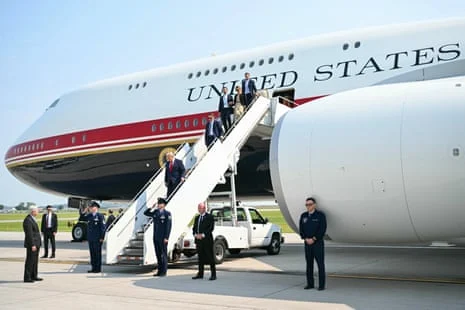
Washington D.C. – President Donald Trump announced plans on Monday to send the Boeing luxury jet, gifted by the Qatari government, for “maxed out” security upgrades, addressing growing concerns over its defensive capabilities. This development comes amidst a flurry of significant domestic and international news, including the unprecedented activation of a secretive "alien terrorist" removal court by the Trump administration, a pivotal shift in the Maine Senate race, and a sharp increase in national gasoline prices driven by escalating US-Iran hostilities.
The President’s Fleet and Foreign Gifts: Security Upgrades for a $400 Million Jet
President Trump confirmed that the Qatari-donated Boeing luxury jet, intended to serve as a secondary Air Force One, will undergo comprehensive security enhancements. Speaking to reporters on Sunday after returning from the World Cup final in New Jersey, the President stated, "Well, it has – it has a lot, and you know it has a lot of capability, but as I understand it, in about a month or so, they’re going to send it to have it be maxed out. So they’re going to be sending it, and they’ll have it be maxed out. It’ll take about a month." This announcement directly follows heightened scrutiny and public questions regarding the aircraft’s defensive features.
The approximately $400 million Boeing aircraft was accepted by the Trump administration as an "unconditional" gift from the Qatari government last year, with President Trump making his first flight aboard it on July 1, 2026. While the acquisition was framed as a diplomatic gesture, questions about its suitability for presidential travel, particularly its security infrastructure, have lingered. These concerns were sharply brought into focus earlier this month during a presidential trip. After attending the NATO summit in Ankara, Turkey, President Trump unexpectedly chose to fly to England aboard the older, traditional Air Force One aircraft (a modified Boeing VC-25A) rather than the newly acquired Qatari jet. This change in travel plans immediately sparked speculation among political observers and security analysts about potential deficiencies in the newer plane’s defensive systems.
Air Force One, the iconic call sign for any U.S. Air Force aircraft carrying the President, is far more than a luxury liner. The existing presidential aircraft, two highly customized Boeing 747-200B series aircraft designated VC-25A, are renowned for their extensive modifications. These include hardened fuselage protection, advanced secure communications systems capable of operating during a nuclear attack, sophisticated electronic countermeasures, and robust anti-missile defense systems designed to deflect or intercept incoming threats. The planes also feature mid-air refueling capabilities, allowing for virtually unlimited range, and onboard medical facilities. The standard for presidential travel mandates an unparalleled level of security, reflecting the paramount importance of protecting the Commander-in-Chief.
The New York Times reported earlier this month, citing anonymous sources, that the Qatari-gifted jet indeed "lacks the same defensive countermeasures as the older model, including antimissile capabilities." This revelation underscored the reason behind the President’s sudden switch to the older aircraft during his European trip. The report’s publication triggered a swift and aggressive response from the Trump administration, which initiated a leak investigation and issued subpoenas to several New York Times journalists. These subpoenas, some delivered directly to reporters’ homes, demanded their testimony before a federal grand jury in Manhattan. This move was widely condemned by press freedom organizations and civil liberties advocates as a blatant attempt to punish the outlet for its reporting and to intimidate independent media. In response, The New York Times has since filed a motion to quash the subpoenas, asserting its First Amendment rights and the importance of protecting journalistic sources.
The decision to accept a $400 million aircraft from a foreign government, even an ally like Qatar, has also raised ethical and diplomatic questions. Qatar is a strategic partner to the U.S., hosting the largest American military base in the Middle East, Al Udeid Air Base. The gift could be seen as a gesture of goodwill and a strengthening of ties, particularly given Qatar’s efforts to enhance its global standing and influence. However, it also introduces a layer of dependency or potential obligation that typically is avoided in matters of presidential transport, traditionally managed and procured through rigorous domestic channels and national defense budgets. The forthcoming "maxed out" upgrades, while essential for presidential security, will likely incur substantial additional costs, further adding to the total expenditure on an aircraft initially presented as a "gift." This situation highlights the complex interplay of international diplomacy, national security, and domestic political optics.
Activating the Dormant ‘Alien Terrorist’ Court: A New Chapter in US National Security Law

In another unprecedented move, the Trump administration has filed the first-ever petition to the secretive and long-dormant Alien Terrorist Removal Court (ATRC). Established 30 years ago in 1996, the ATRC was designed to consider government requests to deport non-citizens deemed "alien terrorists" from the United States using classified evidence that might not be admissible in open court. Its activation marks a significant development in U.S. national security and immigration policy, raising immediate concerns among legal and civil liberties groups.
The ATRC was created as part of the Antiterrorism and Effective Death Penalty Act of 1996, enacted in the wake of the Oklahoma City bombing and other terrorist attacks of the era. The legislation aimed to enhance the government’s ability to combat terrorism, particularly by addressing the perceived limitations of traditional immigration courts in handling cases involving classified intelligence. The court’s five judges, selected from federal district court judges, are tasked with determining if there is "probable cause" to believe an individual is an "alien terrorist" and if their removal is in the national interest. Crucially, the court operates with provisions allowing for the use of classified information, which may not be fully disclosed to the individual or their legal counsel, thus departing from conventional due process standards.
Despite its establishment, the ATRC had never received a petition until Wednesday, July 16, 2026. For three decades, successive administrations, both Republican and Democratic, opted to use other legal avenues, such as standard immigration courts or criminal prosecutions, for national security-related deportations. This dormancy was often attributed to the court’s controversial nature, particularly its potential to infringe on due process rights by allowing "secret evidence," and the high evidentiary bar required to initiate proceedings. Many legal experts and civil liberties advocates have long viewed the ATRC with suspicion, fearing it could become a tool for government overreach and erode fundamental protections for non-citizens.
The U.S. Justice Department filed the application seeking the removal of an unnamed individual. The single-page document posted on the court’s website conspicuously omits the respondent’s name, a common practice in sensitive national security cases. Joan Ericksen, the chief judge of the five-member court and a federal judge in Minnesota, issued a written response to the petition. She confirmed that a hearing was held on Thursday, July 17, during which the court raised "questions about the nexus that the government alleges between the actions of the respondent and the specific sections and subsections it invokes with respect to those actions." Judge Ericksen elaborated, "The answers persuaded the court that the government could benefit from the opportunity for more thoughtful consideration." She has directed the Justice Department to provide more comprehensive information by Wednesday, July 23.
This activation immediately prompted strong reactions from civil liberties organizations. The American Civil Liberties Union (ACLU), for instance, swiftly condemned the move, stating that the court’s procedures undermine fundamental due process rights by potentially relying on secret evidence that the accused cannot fully challenge. Critics argue that even if an individual is a genuine threat, they should still be afforded a fair hearing with full disclosure of the evidence against them, as is standard in the U.S. judicial system. The administration’s decision signals a potential shift towards a more aggressive and less transparent approach to national security deportations, testing the boundaries of judicial oversight and individual rights in the face of perceived threats. The outcome of this first petition could set a powerful legal precedent, influencing how future administrations handle cases involving non-citizen terrorism suspects and shaping the ongoing debate between national security imperatives and civil liberties.
Maine’s Pivotal Senate Race Takes a Turn: Democrats Rally Around Troy Jackson
In a significant realignment for the crucial Maine Senate race, former state legislator Troy Jackson has rapidly emerged as the presumptive Democratic candidate. His ascent follows a dramatic weekend wherein several of his primary opponents withdrew their candidacies and consolidated their support behind him, aiming to unify the party against the long-serving Republican incumbent, Senator Susan Collins, in the November midterm elections.
The Democratic race in Maine had been thrown into disarray earlier this month when the party’s initial nominee, Graham Platner, suspended his campaign. Platner’s withdrawal came after a series of damaging scandals, most notably an accusation of sexual assault by a woman, an allegation he vehemently denies. His departure left a vacuum, and Democrats, acutely aware of Maine’s critical role in their national strategy to regain control of the Senate, scrambled to find a unifying replacement. Control of the Senate often hinges on a few key races, and Maine, with its history of split-ticket voting and a strong independent streak, is consistently viewed as a must-win state for Democrats hoping to flip the chamber.
Over the weekend, a clear consensus began to form around Troy Jackson. On Sunday morning, Maine’s Secretary of State, Shenna Bellows, announced her withdrawal, emphasizing the urgent need for party unity. "Democrats don’t have a day to waste in unifying around the goal of defeating Senator Susan Collins," Bellows stated, throwing her endorsement to Jackson. Later that evening, Nirav Shah, former director of Maine’s Centers for Disease Control and Prevention and a respected public health figure, also dropped out and endorsed Jackson. They were swiftly followed by Dan Kleban, co-founder of the popular Maine Beer Company, and Jordan Wood, a progressive political operative who previously served as chief of staff to former California Representative Katie Porter. Both Kleban and Wood also publicly backed Jackson, creating a powerful wave of unified support.
Troy Jackson, 58, brings a distinct profile to the race. A fifth-generation logger from northern Maine, he has deep roots in the state’s working-class communities. He was first elected to the state legislature in 2002 and steadily rose through the ranks, eventually serving as President of the Maine Senate before being term-limited out of office in 2024. Earlier this year, Jackson made an unsuccessful bid for the Democratic gubernatorial nomination, an effort that had received backing from the now-withdrawn Graham Platner. His political platform typically centers on economic populism, support for labor unions, and advocating for rural communities.
The rapid consolidation of support for Jackson was evident at county-level party meetings held over the weekend. These committees began selecting delegates for a statewide nominating convention scheduled for July 25 in Bangor, where the new candidate will officially be chosen. According to POLITICO, while not legally binding, more than two-thirds of the 601 delegates have already committed to voting for Jackson at the upcoming convention, making his nomination virtually certain.
The path ahead for Jackson, however, is challenging. He will need to effectively unite both the traditional Democratic base and the progressive wing, some of whom might have preferred Wood or other candidates. More critically, he faces the formidable task of unseating Senator Susan Collins, a moderate Republican known for her ability to attract cross-party support and her long-standing political resilience. Collins’s campaign is expected to highlight Jackson’s more progressive stances on national issues and portray him as out of touch with Maine’s broader electorate, while also capitalizing on any lingering negative sentiment from the Platner scandal. The stakes are incredibly high, as the outcome in Maine could very well determine the balance of power in the U.S. Senate for the next Congress.
Economic Fallout: Gas Prices Surge Amid Intensifying US-Iran Conflict
As geopolitical tensions continue to escalate in the Middle East, with the United States and Israel launching further attacks on Iran, American consumers are once again feeling the pinch at the pump. On Monday, the national average price for a gallon of regular gasoline surged back to $4, marking a significant increase and underscoring the direct economic consequences of international instability. This price point represents nearly an entire dollar more than the average price recorded a year ago, which stood at $3.14 per gallon, according to data from the motor club federation AAA.
The resurgence in gasoline prices is directly linked to the intensifying conflict in the Middle East. The initial outbreak of hostilities at the end of March saw average gas prices climb above the $4 mark. However, a period of relative calm and an "interim deal" between the US and Iran in mid-June had offered some relief, causing prices to dip and continue a downward trend for several weeks. The nature of this "interim deal" was largely focused on de-escalation measures and discussions around maritime security in the Strait of Hormuz, a critical chokepoint for global oil shipments. Its recent breakdown, coupled with renewed military actions, has reignited fears of supply disruptions and sent shockwaves through the global oil markets.
Iran has repeatedly threatened to disrupt or block oil and gas shipments through the Strait of Hormuz, a vital waterway through which roughly one-fifth of the world’s total petroleum liquids pass. Any perceived threat to this route, or actual disruptions, immediately impacts crude oil futures prices, which then trickle down to retail gasoline prices. The ongoing military engagements and the uncertainty surrounding the conflict’s trajectory have created a risk premium on oil, driving up costs for refiners and, consequently, for consumers.
For American households, the rising cost of gasoline translates into higher transportation expenses, impacting daily commutes, supply chain costs, and overall consumer spending. This inflationary pressure adds another layer of economic challenge at a time when many are already grappling with broader cost-of-living increases. Politically, surging gas prices often become a potent issue, drawing public criticism and placing pressure on the incumbent administration to address economic hardships. The interwoven dynamics of international conflict, energy markets, and domestic economics present a complex challenge for the White House, with the stability of oil supplies and consumer affordability remaining key concerns.
Related posts: