The 2026 Belgian Grand Prix has amplified the challenges facing the Haas Formula 1 team, as they recorded their fourth consecutive race without scoring a single point. This downturn follows an early-season period that had hinted at greater potential, but recent races have underscored a significant development gap between the American outfit and its rivals. Teams such as Racing Bulls and Audi, previously considered to be in a similar performance bracket, have now visibly outpaced Haas and are actively competing for points, alongside Alpine, further diminishing Haas’s prospects.
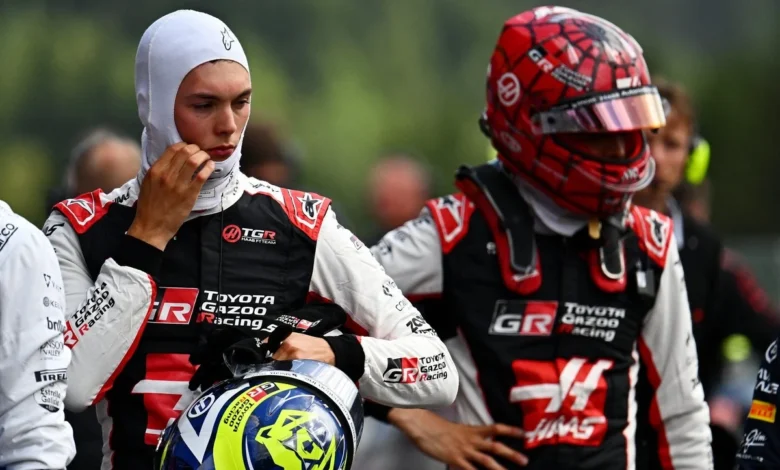
The atmosphere within the Haas camp entering the iconic Spa-Francorchamps circuit was already subdued. Hopes for a strong performance were not particularly high, especially given the persistent performance issues that have plagued Esteban Ocon’s VF-26 throughout the season. However, the situation was exacerbated on the opening lap when an on-track incident involving both Haas drivers, Esteban Ocon and Nico Hülkenberg, resulted in significant damage. Ocon was forced off-track, and both drivers suffered punctures, effectively ending any chance of a competitive race. This collision has intensified scrutiny on the team’s internal dynamics and driver conduct.
A Pattern of Incidents and Team Principal’s Stance
Incidents involving Haas drivers have unfortunately become a recurring theme in recent Formula 1 seasons. For Team Principal Ayao Komatsu, the latest collision, regardless of the specific circumstances, represents a critical juncture. He has emphasized the immediate need to establish a clear directive to prevent future occurrences. Speaking to the media, including Motorsport.com, on Thursday in Budapest, Komatsu stated, "We just have to make sure it doesn’t happen again." He detailed a thorough process of addressing the incident, involving discussions with both drivers and sharing his own perspective. "As always, even on a Sunday after the race, I just wanted to hear points of view from both sides, and then I put my points of view, and then we spoke about it, and then days after as well, so it’s all fine," he explained.

When pressed for his personal assessment of the on-track incident, Komatsu adopted a measured approach, opting not to share specific details publicly. His primary concern remains the team’s operational integrity and performance. "I don’t think I need to share that here," he responded. "My interest is of course, whatever the reason, it just cannot happen again. Full stop. So, we just got to have a clear rule of engagement." This firm stance signals Komatsu’s intent to instill a stronger sense of discipline and collective responsibility within the driver pairing.
Ocon’s Perspective: An Unfortunate Circumstance, Not a Battle
Esteban Ocon, whose own future with Haas remains a subject of speculation amidst his challenging season, characterized the Belgian Grand Prix opening lap incident as an unfortunate confluence of events rather than a deliberate aggressive maneuver gone awry. "For sure, it was not ideal," Ocon told the press. "It’s not something that we want to happen because we’re already struggling to be exactly on pace to be in the point scoring zone."
He corroborated Komatsu’s account of post-race discussions, noting a direct and constructive conversation with Komatsu and his teammate. "We had a discussion with Ayao, Ollie and myself straight away after the race. A very straightforward conversation. I’m sure we’ll come out stronger out of that as well. Ayao said what he wanted to say to us. It must not happen for sure. It’s not like we’re fighting for the World Championship." This comment highlights the team’s current performance level, where internal collisions are seen as a significant detriment, not a necessary consequence of championship battles.
Ocon elaborated on the sequence of events leading to the collision, emphasizing the chaotic nature of the opening lap and the drivers’ attempts to navigate traffic. "It was unfortunate really," he continued. "It was not even a real fight to be honest. Ollie had his issues with his gear out of the corner. We were three wide because we were trying to avoid him. He was a slow moving object. I was on the inside, Nico [Hülkenberg] was here." He further detailed the positioning: "Ollie was slightly in the back actually. I brake early to let Nico go. I was on the inside there. Last second I saw Ollie coming there and we collided. It’s quite unfortunate really. Of course we don’t want to waste time with that. Hopefully it will not happen again." Ocon’s description paints a picture of a complex, multi-car situation where split-second decisions and unforeseen circumstances led to the contact, rather than a direct confrontation between the two Haas drivers.

Haas’s Season in Numbers: A Stark Reality
The 2026 season has presented a particularly difficult challenge for Haas. After a promising start, where the team showed flashes of competitiveness, their development trajectory has faltered. In the first five races, Haas secured a total of 8 points, with Hülkenberg scoring 5 and Magnussen adding 3. This initial performance gave rise to cautious optimism. However, the subsequent races have seen a significant drop-off.
Prior to the Belgian Grand Prix, the team had endured three consecutive races without points: Imola, Monaco, and Canada. The Spanish Grand Prix also yielded no points, marking a string of four races without a points finish before the Belgian event. This trend is a direct reflection of the team’s struggle to keep pace with the development of their competitors. The gap to midfield teams has widened, making it increasingly difficult for Haas to challenge for the top ten positions.
The Shifting Midfield Landscape
The competitive landscape of the 2026 Formula 1 season has seen significant shifts, particularly in the midfield. Teams like Racing Bulls and Audi, which have historically been in a similar performance category to Haas, have demonstrated marked improvements. Their aerodynamic updates and strategic developments have yielded tangible results, allowing them to consistently fight for points. Audi, in particular, has been investing heavily in its F1 program, signaling a long-term ambition to contend at the front. Racing Bulls, benefiting from the Red Bull technology transfer, has also shown a surprising turn of pace.
This development has pushed teams like Alpine, which has also faced its own set of challenges, into a more competitive position. Alpine has managed to score points in recent races, further intensifying the battle for the lower midfield positions. For Haas, this means that the fight for points is no longer just against a few direct competitors but against a larger, more dynamic group of teams that have successfully upgraded their machinery and strategies.
Analysis: Development Slump and Strategic Imperatives
Haas’s current predicament can be attributed to several factors. Firstly, their car development program appears to have stalled or, at best, has been outpaced by rivals. In Formula 1, a continuous development cycle is crucial. Any team that fails to bring effective upgrades risks falling behind. The VF-26, while showing promise early on, seems to have reached its development ceiling, or its upgrades have not been as impactful as those introduced by other teams.
Secondly, the team’s reliance on driver performance, particularly in a car that is not inherently quick, becomes more pronounced. When drivers collide, especially on the first lap of a race, it not only eliminates their chance of scoring points but also incurs costs in terms of car repairs and potential penalties. For a team like Haas, operating with a more constrained budget compared to the top manufacturers, these setbacks are particularly significant.
The clear directive from Ayao Komatsu regarding driver conduct is a strategic imperative. While the team is struggling with performance, internal harmony and disciplined execution are non-negotiable. The focus must now shift to ensuring that both drivers work cohesively, maximizing the limited opportunities the car provides. This includes avoiding unnecessary risks and prioritizing the team’s overall objective of scoring points, even if it means sacrificing individual battles.

Broader Implications for Haas and Ocon
The continued lack of points and the internal incident at Spa have significant implications for Haas. Financially, points are crucial as they contribute to a team’s share of the sport’s revenue. Performance on track directly impacts sponsorship appeal and long-term investment. For the team’s leadership, the challenge is immense: to reignite the development of the VF-26, improve operational efficiency, and foster a more disciplined environment.
For Esteban Ocon, the situation is particularly precarious. His performance has not consistently met expectations, and the incident at Spa, though he downplays its severity, adds to a narrative of on-track issues. With his future at Haas uncertain, and with the team struggling to provide a competitive car, his options for 2027 and beyond may become increasingly limited. The pressure on both Ocon and Hülkenberg to deliver results and maintain team discipline will be intense for the remainder of the season.
The coming races will be a critical test for Haas. The team needs to demonstrate a clear path forward, both in terms of technical development and driver management, if they are to salvage their 2026 season and lay a foundation for future competitiveness. The journey from the promise of early season form to the current reality of struggling to score points is a stark reminder of the unforgiving nature of Formula 1, where even the smallest missteps can have significant consequences.