Two sides of the Mercedes garage: Toto Wolff addresses the stark contrast between Antonelli and Russell at the United States Grand Prix

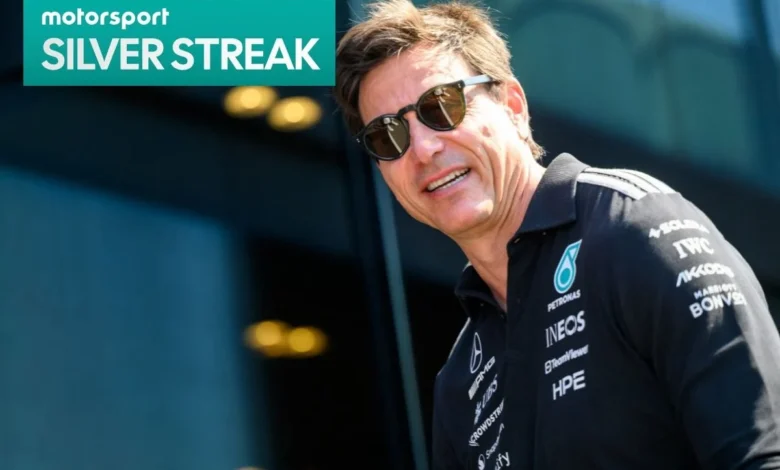
The United States Grand Prix at the Circuit of the Americas (COTA) served as a microcosm of the current volatility within the Mercedes-AMG PETRONAS Formula One Team. On one side of the garage, the narrative was one of ascension and brilliance; Andrea Kimi Antonelli secured a dominant race victory that cemented his status as the sport’s most promising young talent. Conversely, the other side of the garage was marked by profound frustration, as George Russell endured a dismal outing characterized by a restrictive five-second time penalty and a fundamental lack of mechanical grip that left him struggling for pace throughout the afternoon.
The disparity between the two Mercedes drivers has become a focal point of the season, prompting team principal Toto Wolff to offer a candid assessment of the team’s current technical trajectory and their failure to provide a consistent platform for a driver of Russell’s caliber.
A Weekend of Polarized Fortunes
The Sunday race in Austin began with high expectations for the Mercedes outfit, which has been steadily clawing back performance from its rivals. However, the optimism quickly evaporated for Russell. During the frantic opening lap, the British driver found himself embroiled in a multi-car scuffle. While maneuvering through the technical first sector, Russell went off-track, an incident that the FIA stewards deemed worthy of a five-second time penalty for gaining a lasting advantage.
The decision was met with immediate skepticism from the paddock, including former Formula One driver David Coulthard, who was covering the event for broadcast. During a post-race interaction, Coulthard highlighted the absurdity of the penalty, noting that it was, at its core, the nature of racing during the opening lap of a Grand Prix. Wolff, adopting a sardonic tone that belied his underlying irritation, remarked that perhaps the stewards were under the influence of something unconventional, a nod to the local culture in Texas. Beyond the jest, however, lay a deeper concern regarding the officiating consistency that often plagues the sport.
Chronology of the Struggle
The timeline of Russell’s race was a series of compounding technical difficulties. Following the early penalty, the Mercedes W15 appeared to lose its competitive edge. Telemetry data suggested that while the sister car, piloted by Antonelli, was able to navigate the high-speed corners of COTA with precision, Russell’s car exhibited erratic behavior in the mid-corner phase.
The struggle to extract pace was not merely a matter of driver error; it was a symptom of a broader engineering issue. By lap 15, the gap between the two Mercedes machines had widened to an extent that suggested they were running different specifications or experiencing drastically different tire degradation profiles. Despite the team’s efforts to adjust the car’s balance via front-wing flaps and engine mapping, Russell remained unable to find the grip required to challenge the midfield, ultimately finishing well outside the positions expected of a front-running team.
The Engineering Crisis: A Narrow Window
The root cause of the performance delta lies in the latest aerodynamic upgrade package introduced by the Mercedes factory in Brackley. Andrew Shovlin, the team’s trackside engineering director, has been transparent about the challenges these updates have created. The current W15, while possessing high theoretical downforce, operates within an extremely narrow "set-up window."
When the car is placed exactly within this window, it is capable of challenging for podiums and wins, as evidenced by Antonelli’s performance. When it falls outside this window—even by a few millimeters of ride height or a fraction of a degree in wing angle—the car becomes notoriously difficult to drive, suffering from unpredictable aerodynamic stalls and a lack of thermal management in the tires. This "knife-edge" characteristic has disproportionately affected Russell, who has struggled to adapt his driving style to the car’s fluctuating behavior.
Wolff’s Defense of a Championship-Calibre Asset
In the aftermath of the race, Toto Wolff assumed full responsibility for the performance gap. Rather than criticizing Russell’s technical feedback or race craft, the team principal framed the situation as an institutional failure.
"We have a champion in George," Wolff stated. "We have someone that has it all, but he is currently not clicking with the machine. It is not satisfying for the team to see a driver with his immense ability unable to extract the performance that the car is clearly capable of producing."
Wolff’s decision to fall on his own sword is a strategic move to preserve the morale of his driver. By shifting the burden of failure onto the engineers and the team leadership, Wolff is attempting to prevent a spiral of confidence in a driver who is widely considered a future World Champion. The implications are clear: Mercedes must either widen the car’s operating window or provide a more forgiving platform that allows both drivers to maximize their potential regardless of their individual driving nuances.

Statistical Context and Driver Performance
Data from the 2024 season shows that while Russell remains a formidable qualifier, his race-day consistency has been hampered by these technical fluctuations. In sectors where the car is stable, his sector times are often among the fastest on the grid. However, the variance in his lap times—often exceeding 0.3 seconds per lap compared to his teammate—highlights the lack of confidence he currently has in the W15’s rear-end stability.
Furthermore, the impact of penalties on a car that lacks a wide performance buffer is catastrophic. In modern Formula One, where the field is separated by mere tenths, a five-second penalty essentially mandates a two-stop strategy that may not be optimal for tire life. For Russell, the penalty at COTA effectively ended his race before it had truly begun, forcing him into a defensive driving posture that further exacerbated the car’s lack of pace.
Future Implications for the Brackley Factory
The failure at the United States Grand Prix serves as a warning for the remainder of the season. With the championship hunt intensifying, Mercedes cannot afford to have one car performing at a championship level while the other struggles to score points. The upcoming race calendar includes several tracks that, like COTA, require high aerodynamic efficiency and mechanical grip.
If the engineering department fails to solve the narrow set-up window issue, the team risks not only the Constructors’ Championship standings but also the long-term relationship with their drivers. The internal pressure is mounting, and the focus has now shifted entirely to the factory in Brackley. The objective for the next two weeks is to analyze the data collected from both sides of the garage to determine why the car behaves so differently under identical environmental conditions.
The team will likely run extensive simulator sessions to correlate the track data with the wind tunnel models. Shovlin and his team are under immense pressure to deliver a solution that makes the W15 a "driveable" car again. For Russell, the task is to maintain his focus while the team navigates these technical hurdles. For Wolff, the task is to balance the celebration of Antonelli’s breakthrough with the urgent need to stabilize the veteran side of the team.
The United States Grand Prix will be remembered as a turning point—either as the moment the team fell apart under the pressure of their own technical ambitions, or as the moment they identified the fundamental flaws that were preventing them from achieving parity. In the high-stakes environment of Formula One, the difference between a podium and a struggle is often found in the details of the set-up, and for Mercedes, those details have never been more critical. As the circus moves to the next venue, all eyes will be on the Brackley team to see if they can reconcile the two sides of their garage and return to the dominant form that the sport expects from the Silver Arrows.