The Silicon Shadow: How America’s AI Boom is Igniting a Grassroots Environmental Rebellion Against Data Centers

The rapid, unyielding expansion of artificial intelligence infrastructure is colliding with a powerful wave of community resistance across the United States. As tech conglomerates and utility companies race to secure real estate for massive data centers, they routinely pitch these multi-billion-dollar developments as economic engines promising local employment and tax revenue. Yet, according to recent polling data from Gallup, a decisive majority of Americans remain skeptical, opposing data center construction in their local neighborhoods over mounting concerns regarding energy consumption, strain on municipal resources, and environmental degradation.
For community leaders and environmental justice advocates, these anxieties are far from hypothetical. Across the nation, residents living in the long shadow of historical industrialization are mobilizing with unprecedented speed. In cities ranging from Denver and Indianapolis to Asheville, Charlotte, and Reno, local governments have implemented temporary construction moratoriums. Meanwhile, major state-level interventions, such as an executive order signed by New York Governor Kathy Hochul halting the approval of new permits for large-scale data centers, signal that the political cost of unchecked digital infrastructure expansion is rising rapidly.
The epicenter of this burgeoning anti-data-center movement can be found in communities bearing the generational scars of heavy industry, where the promise of technological progress is viewed through a lens of hard-earned suspicion.
The Grays Ferry Precedent: Living in the Wake of Heavy Industry
To understand why opposition to new industrial-scale facilities is so fierce in neighborhoods like Grays Ferry in Southwest Philadelphia, one must examine the area’s toxic past. For generations, residents lived directly adjacent to the Philadelphia Energy Solutions (PES) oil refinery, a sprawling industrial complex that once operated as the largest petroleum processing facility on the East Coast, handling up to 335,000 barrels of crude oil daily.
For Shawmar Pitts, a lifelong resident and managing co-director of the local environmental justice group Philly Thrive, the health crises plaguing his family and neighbors were long accepted as an inexplicable fact of urban life. Friends, relatives, and neighbors suffered from chronic respiratory issues, rare cancers, and systemic illnesses. It was not until 2018, when Philly Thrive members set up an informational table in the neighborhood to protest a proposed refinery expansion, that Pitts connected the dots between heavy industry and community pathology.

“I read the information they had on the table about how living near the refinery affects you, and I’m looking at all the sicknesses on this paper, and I’m like, ‘My mother has this, my sister has that, my next-door neighbor suffers from this’ — every house, someone has something on that list,” Pitts recalled. “From that point, I was all the way in.”
The stakes of industrial pollution were brought into tragic focus for Sonya Sanders, the board president of Philly Thrive. Sanders lost her husband in 2020 to a rare bone cancer. A lifelong Grays Ferry resident who neither smoked nor drank, her husband’s premature death is, in her view, a direct consequence of decades of toxic emissions released by the nearby refinery.
“In my eyes, they killed him,” Sanders stated during a recent community rally. “The pollution killed him. I believe he would be here today if he wasn’t silently murdered, because it was the pursuit of profit that killed him.”
Although the PES refinery was permanently shuttered following a catastrophic series of explosions in June 2019, the psychological and physical toll on the community remains fresh. Consequently, when city officials in Philadelphia recently identified two potential locations for future data center development—including one site in Northeast Philadelphia and another in Grays Ferry—the response from residents was swift and unyielding.
The ‘No Data Centers in Philly’ Campaign
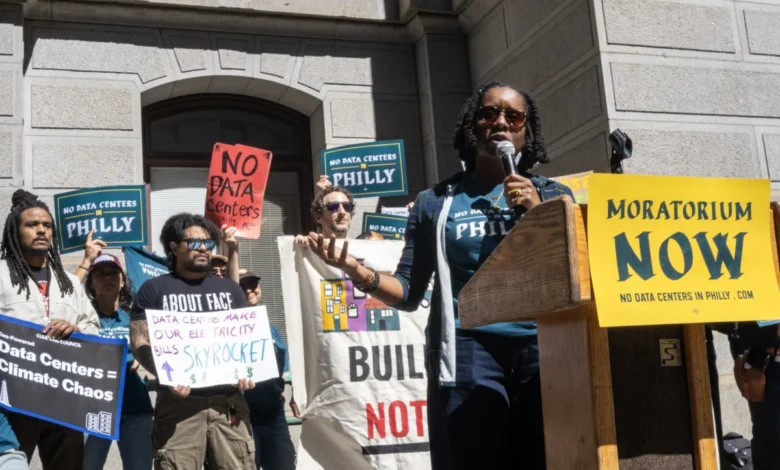
On a Monday morning outside Philadelphia’s City Hall, more than 100 residents gathered for the kick-off rally of the “No Data Centers in Philly” campaign. Chanting slogans and carrying placards, the coalition demanded that city council members institute an immediate moratorium on data center construction.
Although city officials have not yet formally approved construction plans for the sites, the mere possibility of hosting massive computing hubs has galvanized local activism.

“We don’t want data centers,” Sanders told the assembled crowd, raising her voice over the din of drums and megaphones. “We don’t want the pollution, we don’t want the noise, and we know they’re not going to bring us more jobs.”
Legal and environmental advocates note that while data centers do not emit petroleum byproducts in the manner of an oil refinery, their operational footprint is uniquely demanding on modern municipal grids and regional ecosystems. Annie Fox, an attorney with the Clean Air Council, explained the hidden environmental costs during the City Hall demonstration.
“A typical data center planned in Pennsylvania has hundreds of diesel engines that spew air pollution, and even if they’re supposedly reserved for emergencies, the government has already said that the data center should use those rather than drawing from an overstressed electrical grid during some heat waves,” Fox said. “We can expect that to get more frequent… Fossil fuel-hungry data centers will worsen climate change, making those heatwaves more frequent and severe.”
The Global AI Race and the Looming Energy Crisis
The local resistance in Philadelphia reflects a broader national panic regarding the resource intensity of generative artificial intelligence. The international race among tech giants—including Microsoft, Google, Amazon, and Meta—to build, train, and deploy increasingly complex large language models has triggered a compounding demand for electricity and computational power that far outpaces current renewable energy production capabilities.
According to a comprehensive forecast published by BloombergNEF, U.S. data centers are projected to consume more natural gas than Germany and Japan combined by the year 2035. This staggering projection nearly doubles the firm’s own estimates published just nine months prior, illustrating the breakneck acceleration of infrastructure planning within the tech sector.
While natural gas is frequently marketed as a cleaner transition fuel compared to coal or heavy crude oil, its extraction and combustion carry severe environmental consequences. Burning a single cubic foot of natural gas releases approximately 60 grams of carbon dioxide equivalent. Industry analysts estimate that the surging electricity demands of forthcoming data centers will generate an additional one million metric tons of greenhouse gas emissions daily—accounting for roughly 12% of all contemporary U.S. greenhouse gas output.

This projected surge in fossil-fuel reliance carries profound public health implications. A landmark 2021 study led by researchers at Harvard University found that particulate matter air pollution generated by the burning of fossil fuels was responsible for one in five deaths globally. Public health advocates warn that the expansion of gas-fired power generation to support AI infrastructure threatens to reverse decades of marginal improvements in American air quality.
Beyond air pollution, local residents harbor deep anxieties regarding water usage and grid reliability. Modern data centers require millions of gallons of water daily for cooling server racks, placing severe stress on municipal water tables. Furthermore, because these facilities operate 24 hours a day, seven days a week, they demand continuous baseload power, frequently leading utility operators to delay the retirement of aging coal and gas plants or to construct dedicated fossil-fuel generators on-site.
A National Wave of Municipal Moratoriums
Philadelphia is far from an isolated battleground. Across the United States, local municipalities and state governments are pushing back against aggressive corporate land acquisition by enacting temporary freezes on new digital infrastructure.
In July, New York Governor Kathy Hochul signed an executive order placing a temporary halt on state permit approvals for massive data center projects, highlighting the strain placed on local utilities. “Progress shouldn’t arrive with a higher utility bill, deleted water supply, or noise pollution,” Hochul stated at a press conference announcing the measure. “These data centers can only be built, should only be built in places that want them.”
Similarly, municipal governments have utilized zoning codes and temporary moratoriums to regain control over urban planning. Cities such as Denver, Indianapolis, Asheville, Charlotte, and Reno have instituted pause periods ranging from six months to a full year. These legislative interventions are designed to give urban planners and elected officials breathing room to study the long-term fiscal, environmental, and infrastructure impacts of data centers before committing municipal land to corporate buyers.
For residents like Donna Greenberg, who attended the Philadelphia rally to voice her opposition, the issues extend beyond environmental health to encompass digital privacy and resource equity.

“I’m worried about pollution,” Greenberg said. “I’m worried about surveillance and the fact that they’re going to have access to information they have no business knowing, and I’m concerned that they’re going to be using water and electricity that takes away from the people and the neighborhoods who need it.”
The Road Ahead for Tech and Communities
As the artificial intelligence boom matures, the tension between digital innovation and physical community preservation is reaching a critical inflection point. Tech companies accustomed to sweeping into municipalities with promises of economic revitalization are discovering that post-industrial communities are no longer willing to trade their public health for speculative corporate gains.
For grassroots leaders like Shawmar Pitts, the campaign against data centers is an extension of a lifelong struggle for bodily autonomy and environmental justice. Reflecting on the turnout at the City Hall demonstration, Pitts expressed cautious optimism about the power of organized resistance.
“I just think that our community standing up and fighting back is tremendous,” Pitts said. “It takes a lot of effort and a lot of people.”
Whether city councils and state legislatures will heed the warnings of grassroots coalitions remains to be seen. However, as the energy demands of the AI revolution continue to scale upward, the battle lines drawn in neighborhoods like Grays Ferry suggest that the true cost of the digital age will be heavily contested block by block, city by city, across the American landscape.
Related posts: