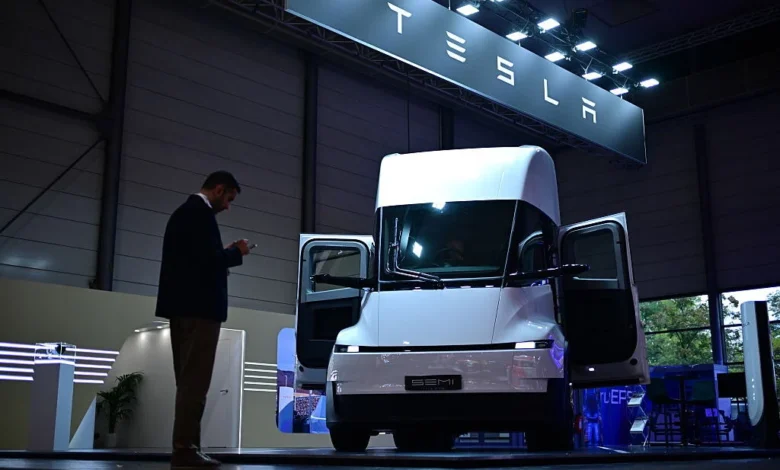
The transportation and logistics sector is currently navigating a period of profound volatility, characterized by surging energy costs, geopolitical instability, and a complex regulatory environment. Despite the Trump administration’s decision to roll back federal subsidies for electric vehicles (EVs) and move to loosen fuel economy standards for heavy-duty trucking, the market for electric commercial vehicles is experiencing a notable surge in demand. This trend is anchored by a historic procurement deal: a coalition of major corporate shippers, including technology giant Microsoft and consumer goods leader PepsiCo, has placed a record-setting order for 2,500 Tesla Semis. Scheduled for delivery over the next 18 months, this order represents a critical inflection point for the heavy-duty electric vehicle market in the United States.
The Economic Catalyst: Volatility in Global Energy Markets
The economic rationale for the shift toward electric trucking is increasingly driven by the instability of the global oil market. With the ongoing conflict involving Iran disrupting shipping routes and oil production, diesel prices in the United States have reached record highs, effectively doubling in cost compared to this time last year. For logistics operators, who typically run on thin profit margins, fuel accounts for a significant portion of total operational expenditure.
In a pre-taped address regarding the Tesla Semi, Elon Musk emphasized the comparative advantage of electric powertrains in this environment. "The truck is going to make a ton of sense economically because the cost of electricity is much less than the cost of diesel, especially in these crazy times," Musk noted. This statement highlights the growing disconnect between the federal government’s current energy policy—which historically favored fossil fuel-reliant freight—and the pragmatic bottom-line calculations of the private sector. By moving away from diesel, shippers are not only pursuing sustainability goals but are also hedging against the extreme price volatility that has become a hallmark of current global energy markets.
Regulatory Tensions and Industry Divergence
The current policy environment is marked by a stark contrast between the executive branch’s stance and the trajectory of the private market. Last year, the Trump administration and its GOP allies—a political bloc that Musk previously supported with significant campaign donations—moved to slash billions in federal incentives for EV adoption. Furthermore, the administration’s efforts to relax fuel economy standards for truck engines have sought to lower the barrier for traditional combustion-engine manufacturers to remain in compliance with climate regulations.
Heavy-duty trucking is a major contributor to national carbon output, with these vehicles accounting for approximately 7 percent of total U.S. greenhouse gas emissions. While the administration’s regulatory rollbacks aim to provide immediate relief to traditional manufacturers, many analysts argue these policies may create long-term competitiveness issues for U.S. firms. As global markets, particularly in Europe and parts of Asia, accelerate the transition to zero-emission standards, domestic companies that fail to adopt electric infrastructure risk falling behind in the global export market.
A Landmark Procurement: The 2,500-Unit Deal
The agreement involving Microsoft and PepsiCo represents one of the largest single-order commitments for electric heavy-duty vehicles in American history. According to data from the nonprofit Smart Freight Centre, this singular procurement has the potential to nearly double the total number of battery-electric heavy-duty trucks currently operating on U.S. roadways.
Meena Bibra, a spokesperson for the Smart Freight Centre, noted that the decision-making process for these carriers was rigorous. The alliance prioritized criteria such as "price, performance, production capability, and service support." The strategy of pooling demand among multiple carriers proved vital, as it provided the economies of scale necessary to drive down per-unit costs, making the adoption of electric technology more financially palatable for large-scale fleets.
While Tesla secured this specific contract, the broader market remains competitive. Carriers are maintaining a diversified approach, with companies like Kenworth, Volvo, and startup Ride continuing to vie for market share. These legacy manufacturers offer distinct advantages, including established service networks and decades of experience in commercial vehicle engineering, which remain critical for companies whose business models depend on the 24/7 uptime of their fleets.
The Evolution of the Tesla Semi: From Promise to Production
The journey of the Tesla Semi has been characterized by significant delays and ambitious pivots. First unveiled in 2017, the truck was initially touted with features that set industry expectations high. However, the rollout has faced numerous setbacks, including challenges in scaling production and the refinement of battery technology required to move heavy loads over long distances efficiently.
A central point of discussion among industry experts remains the implementation of advanced driver assistance systems. Tesla’s "Full Self-Driving" (Supervised) feature, which has been a staple of the company’s consumer vehicle narrative, is not yet available for the Semi. During his recent address, Musk indicated that the technology would be integrated in "the very near future," though critics note that the technology’s predecessor, Enhanced Autopilot, was promised as early as the 2017 launch. For the logistics industry, the value of such systems lies not just in novelty but in potential efficiency gains and safety improvements, provided the technology can meet the rigorous requirements of commercial freight.
Fact-Based Analysis: Implications for the Freight Industry
The shift toward electric heavy-duty trucking has profound implications for the U.S. energy grid and infrastructure. Widespread adoption of electric semis will necessitate a massive build-out of high-capacity charging stations along major freight corridors. Unlike consumer EVs, which can often charge overnight in residential settings, commercial trucks require high-speed "megawatt charging" to maintain efficiency schedules.
Furthermore, the "economic sense" argument presented by Musk relies on the assumption that electricity prices will remain relatively stable compared to the volatile price of diesel. However, as the demand for electricity grows—driven by both the electrification of the transport sector and the rising energy requirements of data centers and artificial intelligence—utilities may face significant strain. This creates a circular dependency: the transition to electric trucking requires a modernized, resilient power grid, while the adoption of these trucks provides the base-load demand that could, in theory, help fund and justify such grid investments.
Looking Ahead: The Sustainability Mandate
For companies like PepsiCo and Microsoft, the transition to electric trucks is as much about meeting Environmental, Social, and Governance (ESG) targets as it is about economic hedging. These organizations are under increasing pressure from shareholders and consumers to reduce their Scope 3 emissions—the emissions resulting from the indirect activities in their value chain, such as transportation and distribution.
As the industry moves through the next 18 months of delivery, the performance of these 2,500 Tesla Semis will be closely monitored. If the trucks demonstrate the operational reliability required for high-volume supply chains, it could serve as a catalyst for a broader, industry-wide shift. Conversely, any technical or service-related shortcomings could provide an opening for legacy manufacturers to reclaim dominance by offering more robust support infrastructures.
In summary, the logistics landscape is currently in a state of transition where corporate sustainability goals and the necessity of navigating energy price shocks are overriding the influence of federal policy. The success of this record-breaking order will likely dictate the pace of electrification for the rest of the decade, signaling whether the heavy-duty sector is truly ready to decouple its operations from the volatility of global fossil fuel markets. While political winds may shift in Washington, the economic reality on the ground—defined by the cost-per-mile calculation—is increasingly pointing toward an electric future for the American trucking industry.