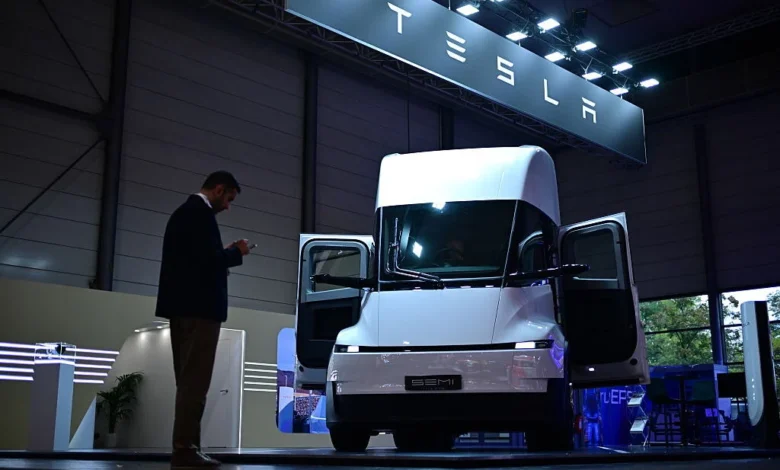
The electric vehicle industry is currently navigating a period of profound contradiction, characterized by aggressive political retrenchment at the federal level and an increasingly urgent economic mandate for electrification within the logistics sector. Despite the Trump administration’s decision to slash billions in federal subsidies for electric vehicles (EVs) and its active efforts to roll back fuel economy standards for heavy-duty truck engines—a move that challenges existing climate goals—the market for zero-emission commercial transport is experiencing a period of unexpected acceleration. This dichotomy is perhaps best exemplified by the recent record-setting procurement of 2,500 Tesla Semis by a consortium of major corporate shippers, including Microsoft and PepsiCo, signaling that market forces and fuel volatility are currently outweighing political headwinds.
A Regulatory Paradox: Federal Policy vs. Industrial Reality
The current federal stance represents a significant pivot from the previous administration’s efforts to incentivize the transition to green energy. Last year, the Trump administration and a supportive GOP legislative bloc moved to dismantle substantial federal support structures for the EV sector. Beyond the reduction in financial incentives, the administration has intensified its focus on weakening emissions mandates for Class 8 trucks. This is a critical regulatory area, as heavy-duty vehicles represent roughly 7 percent of total greenhouse gas emissions in the United States. By lowering fuel economy standards, the administration seeks to alleviate short-term manufacturing costs for traditional automotive giants, though environmental advocates argue that such policies will leave the American logistics industry ill-prepared for a global economy that is rapidly transitioning toward carbon neutrality.
Ironically, these policy shifts arrive at a moment when Elon Musk, who contributed millions to the successful election campaigns of those same political figures, finds himself championing a product that relies on the very market viability his political allies are attempting to suppress. In a pre-taped address delivered this week, Musk acknowledged the tension, noting that the economic logic for electric trucking has become unassailable due to the skyrocketing price of diesel.
The Macroeconomic Catalyst: The Energy Crisis
The economic viability of the electric Semi is currently being bolstered by external geopolitical instability. The ongoing conflict involving Iran has significantly disrupted oil production and international shipping routes in the Middle East, leading to record-high diesel prices in the United States. With prices nearly doubling compared to the same period last year, the total cost of ownership for fleet operators has shifted dramatically.
"The truck is going to make a ton of sense economically because the cost of electricity is much less than the cost of diesel, especially in these crazy times," Musk stated. This assessment is supported by fleet operators who have spent the last two years grappling with unpredictable fuel surcharges. By transitioning to electric powertrains, companies like PepsiCo are effectively insulating their supply chains from the volatility of global oil markets. The price spread between a kilowatt-hour of electricity and a gallon of diesel has widened to a point where the higher upfront capital expenditure of an electric truck can be amortized far more rapidly than analysts previously forecasted.
Chronology of the Tesla Semi: From Concept to Commercialization
The journey of the Tesla Semi has been marked by long delays and high expectations. The vehicle was first unveiled in 2017 with a promise of revolutionary efficiency and the integration of advanced driver-assistance systems.
- November 2017: Tesla unveils the Semi prototype, promising a 500-mile range and the integration of "Enhanced Autopilot."
- 2019–2021: Repeated delays in production timelines are attributed to battery cell supply constraints and the prioritizing of high-volume passenger vehicles like the Model 3 and Model Y.
- December 2022: The first official deliveries are made to PepsiCo, marking the start of real-world operational testing.
- Q1 2024: A coalition of major corporations, including Microsoft, finalizes a record-setting order for 2,500 units, representing the largest single procurement of heavy-duty electric vehicles in history.
- Present Day: Tesla commits to a delivery schedule spanning the next 18 months, with plans to introduce "Full Self-Driving (Supervised)" capabilities in the near future.
Analysis of the Procurement Deal
The order of 2,500 units is a watershed moment for the heavy-duty EV market. According to data from CALSTART, a nonprofit organization focused on clean transportation, this order alone would nearly double the total number of heavy-duty electric trucks currently operating on American highways.
The deal was facilitated by an alliance of shippers who pooled their demand to negotiate pricing and service-level agreements. Meena Bibra, a spokesperson for the Smart Freight Centre, noted that the selection process was rigorous. "The group selected Tesla trucks after assessing price, performance, production capability, and service support," Bibra explained.
While Tesla currently holds the momentum, the market remains competitive. Carriers are not exclusively tethered to the Tesla ecosystem. Established players such as Kenworth, Volvo, and startup entities like Ride continue to capture market share among carriers that require specific vehicle configurations or those that prioritize long-standing service relationships with traditional manufacturers. The pooling of demand is intended to drive down the cost of entry for these vehicles across the board, signaling a move toward commoditization of electric logistics.
Technological Hurdles and Future Outlook
Despite the successful procurement, the Tesla Semi faces ongoing scrutiny regarding its technological roadmap. Notably, the "Full Self-Driving (Supervised)" feature—Tesla’s advanced driver-assistance system—is currently unavailable for the Semi. While Musk has promised its arrival in the "very near future," industry observers remain cautious. The initial 2017 promise of Enhanced Autopilot has yet to be fully realized in the commercial trucking segment, leading to questions about the timeline for autonomous logistics.
Furthermore, the integration of heavy-duty electric vehicles requires a massive expansion of the nation’s charging infrastructure. Currently, the "Megacharger" network remains localized to specific delivery hubs. For the industry to scale beyond regional distribution to long-haul transcontinental transport, a significant public-private investment in high-voltage charging corridors is required. This infrastructure challenge remains the primary bottleneck for widespread adoption, irrespective of the political climate in Washington.
Broader Implications for the Logistics Sector
The shift toward electric trucking, driven by corporate sustainability mandates and the harsh reality of volatile oil prices, is creating a new industrial paradigm. When major corporations like Microsoft and PepsiCo make large-scale commitments to EVs, they exert pressure on their entire supply chain, including smaller third-party logistics providers, to follow suit.
The political environment, while currently favoring traditional energy, may find it difficult to reverse this trend. As production scales and the total cost of ownership for electric trucks drops below that of diesel, the decision to electrify becomes a fiduciary duty rather than an environmental one. The resilience of the Tesla Semi order in the face of a hostile regulatory environment underscores a fundamental shift: the commercial logistics sector is moving toward electrification not because of government mandates, but because the economics of the 21st-century energy market demand it.
As the next 18 months unfold, the successful deployment of these 2,500 trucks will serve as the ultimate stress test for the viability of electric long-haul transport. If these vehicles meet the operational uptime requirements of the shippers, it will likely trigger a secondary wave of procurement that could fundamentally alter the composition of the American trucking fleet for decades to come, regardless of the policies enacted in the White House.