UK government slashes expectations for electric planes and sustainable fuels ahead of Heathrow expansion approval

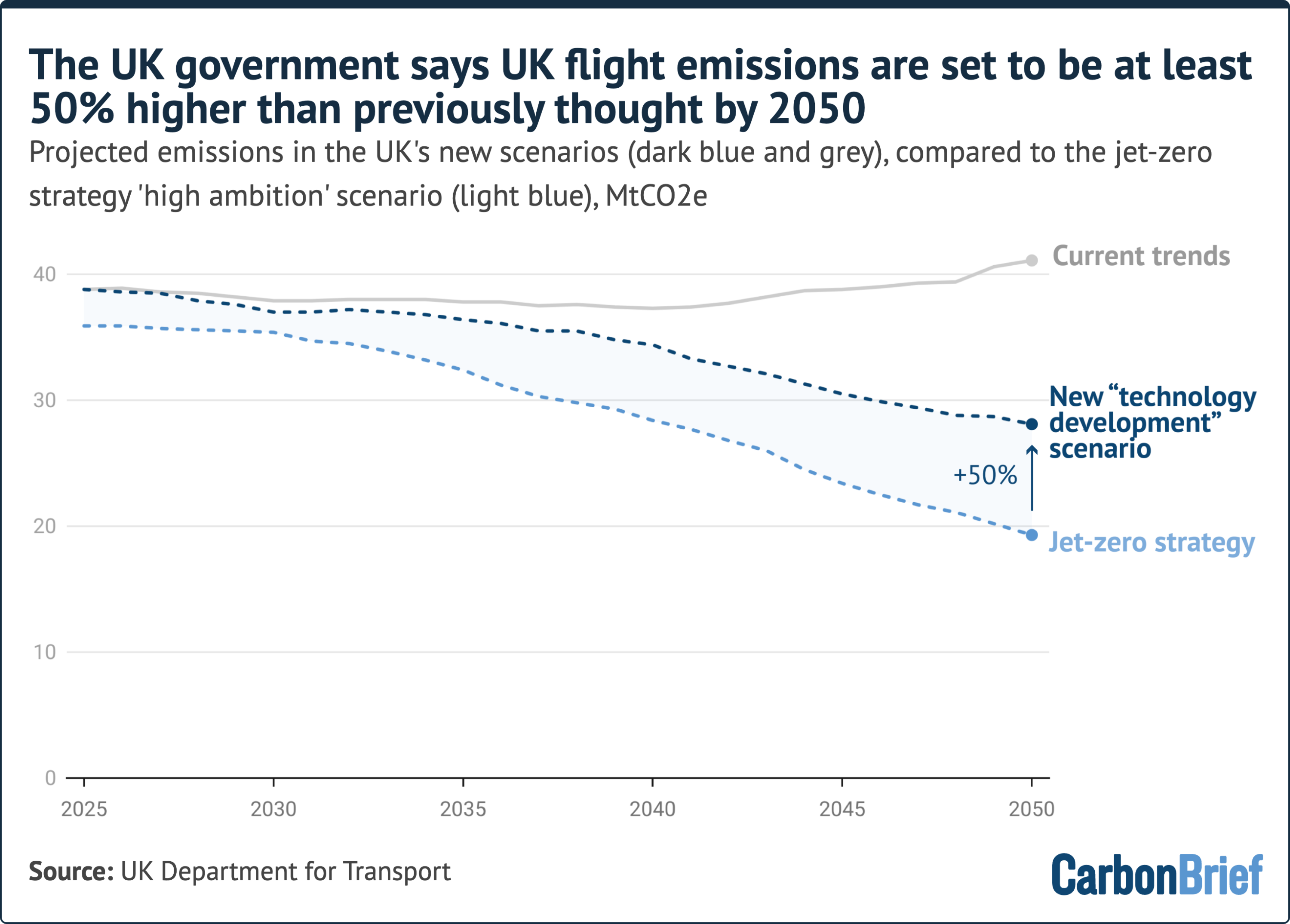
The United Kingdom’s path to achieving net-zero aviation by 2050 has encountered a significant reality check, as newly released government forecasts suggest that technological advancements will fall far short of initial projections. With the Labour government signaling its intention to greenlight a contentious third runway at Heathrow Airport, updated data reveals that the "high ambition" scenario for decarbonizing the skies is increasingly untenable. The revised outlook indicates that even with aggressive efficiency upgrades and the adoption of sustainable aviation fuels (SAFs), the sector’s emissions are projected to remain roughly 50% higher than the goals established by the previous administration’s "Jet Zero" strategy.
This recalibration of climate expectations arrives at a pivotal moment in UK infrastructure policy. As ministers continue to cite clean-aviation innovation as the cornerstone for justifying airport expansion, the gulf between promise and performance has sparked intense debate among climate scientists, policy analysts, and aviation industry stakeholders.
The Shrinking Promise of Techno-Fixes
The core of the government’s previous strategy relied on the assumption that a combination of battery-powered aircraft, hydrogen propulsion, and the widespread use of SAFs would decouple flight growth from carbon output. However, the June 2026 forecasts present a more sobering trajectory. While the original 2022 strategy envisioned a drop in aviation emissions to 19.3 million tonnes of carbon dioxide equivalent (MtCO2e) by 2050, the current "technology development" pathway estimates a figure closer to 28.1 MtCO2e.
The adjustment is driven by three primary factors: a downgrading of the anticipated uptake of sustainable fuels, a downward revision of annual fuel-efficiency gains, and a more cautious outlook on the commercial viability of electric aviation. Government analysts now anticipate that SAFs will constitute only 30% of the total fuel mix by 2050, a significant walk-back from the 50% target previously touted. Furthermore, the reliance on SAFs—which are often derived from limited waste products—has been described by independent research bodies as potentially unattainable at the volumes required to meet these targets.
The Aviation Impact Accelerator, which provided the data for these revised forecasts, noted that fuel-efficiency improvements are now projected at 1.3% per year, rather than the 2% previously assumed. Additionally, the role of battery-powered flight has been relegated to smaller, regional aircraft, effectively removing it as a solution for long-haul international travel within the required timeframe.
A Chronology of Policy Shifts
The evolution of the UK’s aviation policy reflects the shifting political landscape and the mounting pressure to balance economic growth with environmental commitments:
- 2022: The Conservative government launches the "Jet Zero" strategy, proposing a high-ambition pathway that claims to allow for airport expansion while reducing emissions to 19.3 MtCO2e by 2050.
- 2023–2024: Mounting academic and environmental scrutiny begins to challenge the reliance on early-stage technologies, with reports from the Climate Change Committee (CCC) warning that demand management is being ignored.
- June 2026: The UK government releases updated aviation forecasts that quietly lower expectations for carbon abatement, projecting a 50% increase in 2050 emissions compared to the original Jet Zero targets.
- Late 2026: The Labour government reaffirms its support for a third runway at Heathrow, citing technological progress, even as experts warn that current carbon budgets are already being exceeded.
- 2029: The anticipated date for the final planning decision regarding the Heathrow expansion.
The Economic and Environmental Conflict
The tension at the heart of this issue is the contradiction between the expansion of aviation capacity and the constraints of the Climate Change Act. By 2050, the government expects passenger numbers to be at least 50% higher than they are today. Under a "current trends" scenario—which assumes no additional policy interventions—aviation emissions could soar to 41.1 MtCO2e, nearly double the levels that climate advisors suggest are compatible with the UK’s net-zero obligations.
If these emissions are to be offset, the burden will shift to land-use policy. To neutralize the carbon impact of such high flight volumes, the UK would theoretically need to dedicate vast swaths of land—potentially an area twice the size of London—to reforestation. Alternatively, the country would have to rely on Direct Air Capture (DAC) and other carbon dioxide removal (CDR) technologies. However, these solutions remain in their infancy, with high costs and unproven scalability, leading critics to label the government’s approach as "budget-busting."

Expert Perspectives and Stakeholder Reaction
The reaction to the revised forecasts has been one of concern regarding the integrity of the government’s climate accounting. Tim Johnson, director of the Aviation Environment Federation (AEF), noted that while the new figures provide a "more honest" assessment, they effectively reopen the debate on the scale of greenhouse gas removals. "Less reliance on cleaner technology and fuels reopens the debate about the role and scale of greenhouse gas removals and ways to tackle the projected 50% growth in demand for air travel," Johnson stated.
Academic analysis has been equally critical. Dr. Lois Pennington, a research associate at the University of Manchester, has argued that the government is essentially ignoring the reality of the carbon budget. "For Heathrow, it means expansion can no longer be waved through on the promise of technology, and any approvals will be in the full knowledge that it will bust our legally binding carbon budgets," Dr. Pennington observed.
From the perspective of the aviation industry, the focus remains on the necessity of infrastructure to maintain the UK’s global connectivity. Industry representatives argue that capping passenger growth would result in "carbon leakage," where travelers simply shift their flights to hubs in other countries, thereby causing the same global emissions while sacrificing domestic economic benefits.
Broader Implications for Net-Zero
The situation highlights a fundamental challenge for the UK’s climate policy: can the aviation sector truly be "de-linked" from carbon, or is the government prioritizing short-term economic growth at the expense of long-term climate stability?
The reliance on future, unproven technologies to justify current infrastructure decisions creates a "lock-in" effect. By building a third runway, the UK commits to decades of increased flight capacity. If the promised carbon-saving technologies do not materialize at scale, the UK will be forced into a position where it must either implement highly unpopular demand-management measures—such as frequent flyer levies or capacity caps—or fail to meet its legal commitments under the Climate Change Act.
Furthermore, the revised forecasts have broader implications for other sectors. If aviation consumes a disproportionate share of the remaining "net-zero carbon budget" due to its failure to decarbonize, other sectors such as agriculture, heating, and manufacturing will be forced to shoulder a heavier burden to keep the UK on track.

As the 2029 deadline for the final Heathrow decision approaches, the government faces a binary choice: either align aviation expansion plans with the reality of slower-than-expected technological progress or accept that the aviation sector will require massive, costly, and potentially unfeasible offsets to remain within the law. For now, the "Jet Zero" ambition remains, but its path has become significantly narrower and more precarious than ever before.
Related posts: