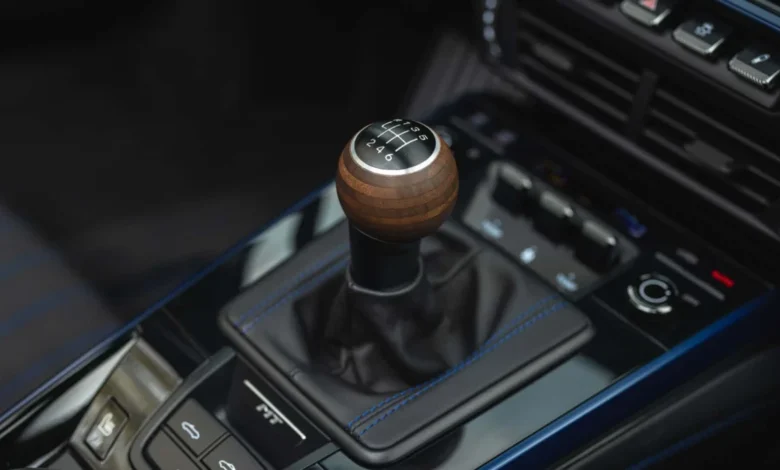
The automotive industry is currently navigating a complex transition as manufacturers reconcile the push toward electrification and high-efficiency dual-clutch transmissions (DCTs) with the enduring demand for the tactile, mechanical engagement of a traditional manual gearbox. A new patent filing from Porsche, recently uncovered at the European Patent Office under the reference number DE102025109563A1, suggests the Stuttgart-based automaker has developed a sophisticated solution to this dichotomy. The filing details a "shift-by-wire" system capable of emulating the physical experience of a manual transmission, complete with a third pedal, within a vehicle architecture that remains fundamentally automatic.
This technological evolution represents the latest iteration of a concept Porsche has been exploring for several months. While previous patent disclosures focused on the gear selector itself, this latest filing provides a comprehensive blueprint for a multi-modal transmission system. By leveraging software-defined control over a dual-clutch setup, Porsche aims to offer drivers the convenience of an automatic, the precision of a sequential gearbox, and the visceral involvement of a classic manual, all within a single powertrain package.
Chronology of the Shift-by-Wire Evolution
Porsche’s interest in redefining the driver’s interface with the transmission began in earnest as the brand faced the dual pressures of stricter emissions regulations and the decline of the manual gearbox in high-performance segments.
The trajectory of this development can be traced through a series of internal research and development milestones:
- Early 2024: Porsche engineers initiated the development of a monostable gear selector designed to mimic the physical resistance and feedback of mechanical linkages.
- Late 2024: Preliminary patent applications surfaced, detailing a "shift-by-wire" lever capable of operating as both a standard automatic shifter and a manual-mode selector.
- Early 2025: The current filing (DE102025109563A1) appeared, revealing the integration of a clutch pedal, which allows for a full simulation of manual driving dynamics in a vehicle that lacks a physical clutch plate connection to the engine.
Three Pillars of the Porsche Transmission System
The core of the patent lies in the flexibility of the transmission software. The system functions across three distinct configurations, which the driver can toggle depending on their driving environment or preference:
- Automatic Mode: In this configuration, the vehicle operates as a conventional DCT. The transmission control unit (TCU) manages all gear changes based on vehicle speed, throttle position, and engine load. The driver interacts with the system solely via the accelerator and a gear selector set to "Drive."
- Sequential Mode: This setting emulates the experience of modern racing gearboxes. Drivers engage the next gear or downshift using steering-wheel-mounted paddles or a center-console lever. This mode bypasses the need for the clutch pedal, focusing on rapid, millisecond-fast shifts typical of high-performance Porsche models.
- Simulated Manual Mode: This is the most complex configuration. The system introduces a third pedal that mimics the bite point of a traditional clutch. When the driver presses the pedal and moves the gear selector, the software instructs the DCT to decouple and re-engage in a manner that replicates the mechanical sensation of shifting gears. If the system detects poor synchronization—such as failing to reach the correct RPM before releasing the clutch—it is designed to replicate the "bucking" or "stalling" behavior of a traditional car, providing a realistic level of challenge for the enthusiast.
Industry Context and Competitive Landscape
Porsche is not the only manufacturer experimenting with software-assisted engagement. As the global fleet moves away from mechanical linkages, automakers are increasingly relying on "haptic feedback" and software logic to maintain brand identity for performance-focused models.
Koenigsegg, for instance, pioneered the "Light Speed Transmission" (LST) and the "Engage Shift System." Their approach similarly utilizes a sophisticated clutch and gearbox layout to bridge the gap between automatic efficiency and manual control. By allowing the driver to select a gear directly—rather than clicking through a sequential order—Koenigsegg has successfully maintained the spirit of manual driving in a hypercar that is technically an automated dual-clutch unit.
Furthermore, Ferrari has recently garnered attention for its 12Cilindri Manuale concept. The Italian automaker’s approach is arguably the most rigorous in the current market, as it deliberately introduces mechanical-style penalties for driver error. By allowing the vehicle to shudder or "stall" if the driver mistimes a shift, Ferrari is catering to purists who view the struggle of operating a manual transmission as an essential part of the driving experience.

Hyundai, meanwhile, has taken a different route, focusing on the democratization of this technology. Having filed patents for simulated shifting in electric vehicles, the Korean manufacturer is likely aiming to retain driver engagement in a future where combustion engines are no longer the standard. Hyundai’s system seeks to map the torque curve of an electric motor to mimic the power delivery of a combustion engine during a manual gear change.
Technical Implications and Engineering Feasibility
The transition from mechanical to "by-wire" systems is a significant shift in automotive engineering. In a traditional manual transmission, the gear lever is physically connected to the transmission via cables or rods, and the clutch is connected to a pressure plate via a hydraulic or cable system. This provides direct, tactile feedback to the driver.
Porsche’s proposal replaces these mechanical links with sensors and actuators. To succeed, the system must overcome the "latency" challenge. If there is a delay between the driver’s foot movement on the clutch pedal and the transmission’s reaction, the simulation will feel artificial. By utilizing high-speed CAN-bus communication and force-feedback actuators, Porsche intends to provide a realistic resistance level that changes based on the gear selected and the engine’s current state.
Importantly, this technology is fuel-agnostic. The patent documentation specifies that the system is compatible with both internal combustion engines (ICE) and hybrid powertrains. In a hybrid setup, the system can coordinate the electric motor’s torque to smooth out or sharpen the simulated shift, potentially allowing for even more granular control over the "feel" of the transmission.
Market Impact and the Future of the Enthusiast Segment
The decline of the manual transmission is primarily driven by three factors: the superior shift speeds of DCTs, the need for lower emissions, and the convenience sought by the average consumer. According to industry data, the "take rate" for manual transmissions in the United States and Europe has plummeted to low single digits, limited mostly to specialty performance cars.
Porsche’s simulated manual transmission addresses these challenges by decoupling the physical experience from the underlying mechanical complexity. This allows Porsche to continue building cars that meet modern emissions and safety standards while simultaneously marketing the "engagement" factor that defines the brand’s history.
For the collector and enthusiast market, this technology offers a compelling compromise. If implemented effectively, it could allow a vehicle to serve as a daily commuter with seamless automatic shifting, while providing a track-ready manual experience at the touch of a button.
Conclusion
The move toward simulated manual transmissions signals a broader shift in how automakers view the "driver-car relationship." As vehicles become increasingly autonomous and software-defined, the physical act of driving is being repositioned as a luxury, curated experience. Porsche’s patent is a clear indicator that the company intends to lead this transition, ensuring that even in an era of electrification, the driver remains a central, active participant in the machine’s operation. Whether this will satisfy the most stringent purists remains to be seen, but the filing confirms that Porsche is committed to keeping the "manual" experience alive, even if it is built on a foundation of code rather than cogs.