Aaron Rodgers and Mike McCarthy Split: Inside the Explosive Steelers Fallout and the Quarterback’s Lifelong Spiritual Evolution

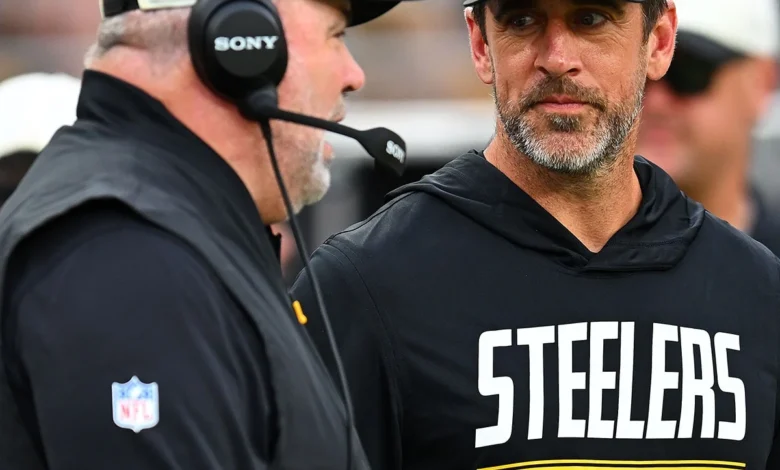
The relationship between veteran NFL quarterback Aaron Rodgers and Pittsburgh Steelers head coach Mike McCarthy has formally collapsed, culminating in a stunning benching, a public war of words, and Rodgers’ immediate release from the franchise. The dramatic breakdown of a professional partnership that once captured a Super Bowl in Green Bay has sent shockwaves through the National Football League, casting a harsh light on internal team dynamics, organizational accountability, and the turbulent twilight of one of the sport’s most polarizing careers.
The fracture point arrived rapidly during an already testing season for the Steelers. Following a disappointing loss to the Philadelphia Eagles on November 22, the 42-year-old quarterback learned he was being abruptly stripped of his starting duties in favor of teammate Mason Rudolph. The decision caught Rodgers entirely off guard, setting off a chain of events that exposed deep-seated dysfunctions within the Steelers’ coaching staff and ultimately led to his termination.
The Chronology of a Collapse
The seeds of the final confrontation were sown behind closed doors at the Steelers’ facility. According to Rodgers, his discussions with McCarthy leading up to the decision completely omitted any mention of a quarterback change. Speaking candidly on the November 25 episode of The Pat McAfee Show, Rodgers detailed the confusion that preceded his benching. He recalled participating in lengthy strategic conversations with McCarthy days prior, where the topic of demoting him to backup status was never broached.
The reality of the situation only surfaced when Rodgers overheard a phone call involving other team leadership. Upon hearing a team official express disbelief over the impending decision, Rodgers intervened, asking what was happening because he had been kept entirely in the dark.
This administrative blindside prompted Rodgers to escalate his grievances regarding McCarthy’s day-to-day leadership. Drawing on a shared history that spans over a decade—dating back to their highly successful tenure together with the Green Bay Packers—Rodgers did not mince words when evaluating the 63-year-old coach’s current operational capacity.
Accusations of Negligence and Internal Dysfunction
Rodgers’ public critique extended far beyond a standard disgruntled player complaining about playing time. He raised serious concerns regarding McCarthy’s physical and professional attentiveness, framing his criticisms not out of malice, but as a matter of team health and competitive necessity.
Among the most jarring allegations shared by the four-time league MVP was an incident during a routine quarterback meeting. Rodgers recounted that McCarthy arrived late, took his seat, and fell asleep, snoring loudly enough to wake himself up within minutes. After shuffling his papers in an attempt to recover composure, the head coach allegedly drifted off to sleep a second time before walking out of the room entirely.
"If you’re sleeping in meetings, you’re unhealthy," Rodgers stated during his media appearance, noting that McCarthy was failing to meet the rigorous demands required of an NFL play-caller. The quarterback asserted that McCarthy’s lapses in preparation extended to missing critical planning sessions ahead of crucial matchups, including the team’s preparations for the November 22 contest against the Philadelphia Eagles.
Recognizing the deteriorating state of the team’s leadership, Rodgers admitted that he initiated a direct confrontation with McCarthy just days before being rendered inactive. He recalled telling the head coach that organizational changes were mandatory for the betterment of the squad.
The Fallout and Official Team Response
The internal impasse proved insurmountable for the Steelers’ front office. Faced with an open rift between their franchise quarterback and their head coach, the organization moved swiftly to sever ties. On November 25, the Pittsburgh Steelers issued a concise, definitive statement via social media: "We have released QB Aaron Rodgers."
The move leaves the Steelers scrambling to stabilize their offense under Mason Rudolph while raising questions about McCarthy’s job security and the overall direction of the franchise. For Rodgers, the abrupt end to his tenure in Pittsburgh marks another chapter in a late-career trajectory defined by high-profile friction with front offices, coaching staffs, and media entities.
A Lifetime of Deconstruction: Beyond the Gridiron
While the explosive exit from Pittsburgh represents the latest professional crisis in Rodgers’ career, it mirrors a lifelong pattern of challenging institutional authority, established dogma, and traditional expectations. This psychological and spiritual evolution is explored in depth in the Netflix docuseries Aaron Rodgers: Enigma, which traces the quarterback’s journey from a conservative upbringing in Chico, California, to his current status as a vocal iconoclast.
Growing up in a rigid, small-town environment governed by a traditional theological framework, Rodgers found himself increasingly at odds with the black-and-white worldview presented by his family and the organized religion of his youth. The transition from Butte College to the University of California, Berkeley, served as a pivotal catalyst. Immersed in a culturally diverse and intellectually challenging collegiate atmosphere, Rodgers began to systematically question the dogmatic structures that had defined his early years.
The pursuit of spiritual enlightenment intensified following the Green Bay Packers’ victory in Super Bowl XLV during the 2011–12 season. Having achieved what many professional athletes consider the ultimate validation, Rodgers experienced a profound existential crisis, realizing that athletic triumph alone could not provide deep personal fulfillment.
Embracing Alternative Philosophies and Plant Medicine
In his quest for a broader understanding of existence, Rodgers turned to progressive thinkers, philosophy texts, and alternative spiritual leaders. He frequently credits authors and speakers like Rob Bell with helping him dismantle the rigid guilt-and-shame paradigms of his youth. This intellectual liberation granted him the confidence to voice his opinions more forcefully, a shift that invariably altered his relationships with institutions, authority figures, and family members.
In recent years, Rodgers has also spoken openly about his use of ayahuasca, a traditional plant-based brew used in Amazonian shamanic rituals, describing it as a transformative tool for mental, physical, and spiritual healing. This embrace of non-traditional therapies and counter-cultural ideologies further distanced him from the conventional expectations held by his relatives, who remained firmly rooted in traditional religious and social structures.
Family Estrangement and the Public Spotlight
Rodgers’ ideological divergence from his family eventually manifested as a deep, public estrangement. Long before his high-profile relationships with celebrities such as Olivia Munn, Danica Patrick, and Shailene Woodley thrust him further into the tabloid spotlight, underlying tensions existed between the quarterback and his family members, including his brothers Jordan and Luke, and his parents, Ed and Darla.
The private family rift burst into the public consciousness in 2016 during Jordan Rodgers’ appearance on the reality television show The Bachelorette. During an episode featuring a family hometown visit, viewers noticed two conspicuously empty chairs at the dinner table, which were publicly attributed to Aaron and his then-partner, Olivia Munn. Family members on the show expressed a desire for reconciliation, framing the absence as a tragic consequence of unresolved distance.
Rodgers, however, strongly disputed this portrayal. In Enigma, he characterized the inclusion of the empty chairs as a calculated publicity stunt orchestrated to capitalize on his fame. He maintained that he was never formally invited to the dinner and expressed deep frustration that private family dynamics were exploited for television entertainment.
Despite the enduring distance, Rodgers has consistently emphasized that his estrangement is not rooted in malice or spite. He attributes the divide to natural divergences on life’s timeline, acknowledging gratitude for the upbringing that shaped him while accepting that his family members operate from a fundamentally different perspective. While reconciliation remains an open possibility on the horizon, Rodgers continues to forge an independent path defined by uncompromising personal autonomy.
Broader Implications for the NFL Landscape
The dramatic convergence of Rodgers’ locker room conflict with Mike McCarthy and his introspective public revelations highlights the complex intersection of modern sports, personal psychology, and media culture. As Rodgers evaluates his next steps in professional football—or contemplates the end of a legendary playing career—the fallout in Pittsburgh serves as a cautionary tale regarding the fragility of aging coach-player relationships.
For the Steelers, the immediate task is navigating the remainder of the NFL season under challenging circumstances, attempting to salvage a competitive campaign while managing the fallout of a roster shakeup. For the broader NFL, the episode underscores a growing trend where veteran superstars command immense leverage, yet remain vulnerable to the tectonic shifts of institutional politics and organizational fatigue.
As the dust settles on Rodgers’ abrupt departure from the Steel City, the sports world is once again reminded that the most compelling narratives in professional athletics often unfold far away from the scoreboard, driven by human ambition, ideological evolution, and the relentless pursuit of individual truth.