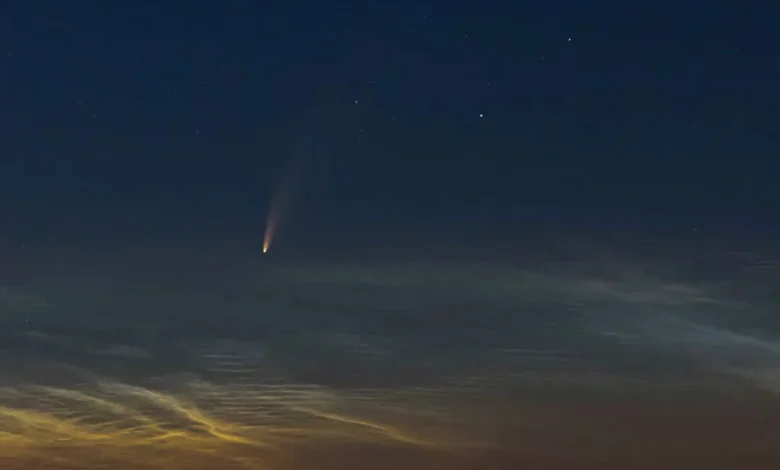
Early-morning stargazers across the Northern Hemisphere were treated to one of the most remarkable celestial spectacles of the 21st century when Comet C/2020 F3, universally known as Comet NEOWISE, made its spectacular apparition. Featuring this breathtaking cosmic visitor, NASA’s Astronomy Picture of the Day (APOD) highlighted a stunning, meticulously crafted time-lapse video captured from Italy, showcasing the icy wanderer ascending over the serene waters of the Adriatic Sea.
The featured video, credited to astrophotographer Paolo Girotti, was compiled from more than 240 individual frames captured over a continuous 30-minute window on the morning of July 8, 2020. This mesmerizing visual record captures the comet piercing through a foreground of luminous, undulating noctilucent clouds while a backdrop of distant stars remains fixed in the cosmos. For professional astronomers and casual observers alike, the visual masterpiece serves as a vivid reminder of the dynamic, ever-changing nature of our inner solar system.
The release of this archival footage coincides with a significant logistical transition for the long-running outreach initiative. NASA’s Astronomy Picture of the Day, a staple of digital astronomy education curated by professional astronomers Robert Nemiroff, Jerry Bonnell, Cecilia Chirenti, and Keighley Rockcliffe, is officially migrating its primary web hosting infrastructure from its historic domain at apod.nasa.gov to a unified platform housed at science.nasa.gov/apod. Despite the URL migration, the core mission of the platform—delivering a daily astronomical image accompanied by expert scientific commentary—remains unchanged.
Anatomy of a Great Comet: Understanding C/2020 F3
Comet NEOWISE earned the prestigious designation of a "Great Comet" due to a rare combination of survival, brightness, and visibility. Unlike the vast majority of comets that enter the inner solar system and subsequently disintegrate under the intense thermal and gravitational stress of the Sun, NEOWISE successfully rounded perihelion on July 3, 2020, passing within approximately 43 million kilometers of our star.
Astrophysical analysis revealed that the comet’s solid nucleus spans roughly five kilometers across. As solar radiation heated this primordial body of ice, rock, and dust, volatile materials sublimated violently, punching through the crust and spewing vast jets of gas and particulate matter. This outgassing formed a sprawling coma and two distinct, majestic tails: a curved, yellowish dust tail reflecting sunlight, and a straight, bluish ion tail composed of glowing gas swept back by the solar wind.
What truly distinguished Comet NEOWISE from other recent cometary visitors, such as Comets ATLAS and SWAN earlier that same year, was its unexpected structural resilience. While many expected the icy interloper to fizzle out or fragment entirely during its close solar encounter, NEOWISE maintained its integrity and remained bright enough to be clearly perceived with the unaided eye for over a month—a longevity rarely observed in modern cometary science.
Chronology of Discovery and Observation
The journey of Comet NEOWISE from an obscure blip on scientific instruments to a global cultural phenomenon unfolded over several intensive months in early 2020.
The timeline of the comet’s historic apparition is marked by several critical milestones:
- March 27, 2020: NASA’s Near-Earth Object Wide-field Infrared Survey Explorer (NEOWISE) space telescope detects the 18th-magnitude comet as it coasts through the inner solar system. At the time of discovery, the object is roughly 300 million kilometers from the Sun.
- June 11 to June 22, 2020: As the comet approaches perihelion, it enters the field of view of the Solar and Heliospheric Observatory (SOHO) spacecraft’s LASCO C3 instrument, showing a rapid increase in brightness and confirming its survival through the solar glare.
- Early July 2020: Observers in the Southern Hemisphere, followed rapidly by those in the Northern Hemisphere, begin reporting naked-eye visibility in the pre-dawn hours. The comet develops a prominent double tail, captivating millions of early risers.
- Mid-to-Late July 2020: The viewing geometry shifts. The comet transitions from a pre-dawn object to an evening spectacle, hanging low in the northwestern sky just after sunset. This transition massively increases public engagement, allowing casual observers to spot the celestial visitor without waking up before dawn.
- August 2020 onward: Comet NEOWISE gradually dims as it recedes from Earth and the Sun, heading back toward the distant Oort cloud on an orbital trajectory that will not return it to our skies for nearly 7,000 years.
Scientific Significance and Data Insights
From a research perspective, comets like NEOWISE function as pristine, cryogenic time capsules. Because they formed in the frigid outer reaches of the protoplanetary disk roughly 4.6 billion years ago and have spent most of their existence far from the warming rays of the Sun, their internal composition remains largely unaltered since the birth of the solar system.
Data gathered by space- and ground-based observatories during the 2020 apparition provided planetary scientists with unprecedented opportunities to study the distribution of organic molecules, silicates, and water isotopes within a long-period comet. Spectroscopic analyses confirmed the presence of diatomic carbon, cyanide, and various silicate dust grains, offering clues regarding the chemical inventory available during the formation of the terrestrial planets. Furthermore, the tracking of dust trail evolution helped researchers better understand how cometary debris spreads along orbital paths, providing critical insights into the mechanics behind annual meteor showers.
The imaging techniques utilized by astrophotographers like Paolo Girotti also contribute tangibly to science through public science engagement. High-resolution time-lapses and stacked long-exposure images help document atmospheric phenomena—such as the interaction between high-altitude noctilucent clouds and lower-level weather systems—while simultaneously fostering a broader public appreciation for observational astronomy.
Institutional Context and the Evolution of APOD
The featuring of the NEOWISE time-lapse video highlights the enduring legacy of the Astronomy Picture of the Day service, which was established in 1995 by Robert Nemiroff and Jerry Bonnell at Michigan Technological University and NASA’s Goddard Space Flight Center. For more than three decades, APOD has served as a foundational digital resource for science communication, bridging the gap between complex astrophysical research and the general public.
The recent migration of the platform’s main site to science.nasa.gov/apod reflects a broader institutional effort by NASA to consolidate its vast educational and scientific outreach repositories under a unified, highly secure, and modern web architecture. Agency representatives emphasize that while the Uniform Resource Locator (URL) is updating, the foundational editorial standards, daily curation process, and academic collaborations that have defined APOD since the mid-1990s remain completely unchanged.
Broader Impact and Implications for Future Skywatching
The cultural resonance of Comet NEOWISE cannot be overstated. Occurring during a period of global uncertainty and lockdowns in the summer of 2020, the comet provided a unifying, awe-inspiring distraction for millions of people around the world. Stepping outside into the quiet pre-dawn or evening air to locate a wandering mountain of ice millions of kilometers away offered a profound perspective shift for a global audience confined largely to their homes.
Looking forward, planetary defense and near-Earth object tracking programs continue to monitor the skies for the next great cometary visitor. While surveys like NEOWISE (and its successor mission, NEOWISE/NEOCAM adaptations) have dramatically improved our ability to catalog potentially hazardous asteroids, unpredictable long-period comets descending from the Oort Cloud remain wild cards of the cosmos. As demonstrated by the events of July 2020—and immortalized in high-definition time-lapses along the Adriatic Sea—these icy intruders have the unique capacity to unite humanity in shared wonder, reminding observers of our place within a vast, dynamic, and endlessly fascinating universe.