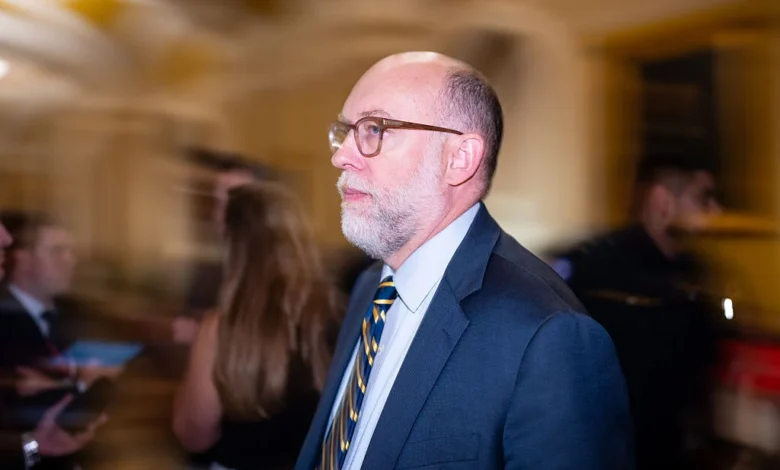
The landscape of American biomedical research faces an unprecedented structural shift as the current administration moves to consolidate executive authority over the National Institutes of Health (NIH). Recent reports confirmed by major news outlets indicate that the White House is drafting an executive order that would grant Russell Vought, the director of the Office of Management and Budget (OMB), unilateral veto power over every individual grant awarded by the NIH. This development follows a series of high-stakes clashes between political appointees and the scientific establishment, marking a significant departure from the traditional model of merit-based funding that has defined the agency since its inception.
The move represents the culmination of a long-standing tension between the administration and the nation’s premier medical research body. The NIH, with an annual budget of $47 billion, serves as the primary engine for global biomedical innovation. Its funding mechanisms—historically insulated from political intervention—have supported everything from basic molecular biology to the clinical trials that underpin the modern biotechnology sector. By seeking to install the OMB as a final gatekeeper, the administration aims to fundamentally alter how these resources are allocated, shifting the criteria from scientific merit to alignment with the current executive’s policy and personal priorities.
A Chronology of Institutional Friction
The effort to exert control over the NIH is not a sudden emergence but the result of a multi-year campaign to reshape federal science policy. Following the transition into the second Trump term, the administration’s approach to the NIH was characterized by immediate attempts to dismantle existing research paradigms.
In the summer of 2025, the administration terminated a wide array of grants focusing on pandemic preparedness and health disparities. This was accompanied by a proposal to cut the NIH budget by nearly 50%, a measure that was ultimately rejected by Congress. During this period, the administration also bypassed standard scientific review processes, relying on the Department of Government Efficiency (DOGE) to dictate the cancellation of specific research projects. These actions faced significant legal pushback, with courts eventually voiding the policy behind the grant terminations, ruling that the process lacked the necessary statutory grounding.
Undeterred by judicial and legislative setbacks, the administration pivoted toward structural reform. In May 2026, the OMB proposed new funding guidelines that would have prioritized political considerations over peer-review scores. While Congress successfully placed those rules on hold in September 2026, the administration’s determination to bypass legislative oversight remains evident in the current push for an executive order.
The Harvard Connection and Political Motivations
The recent escalation of the conflict appears to be deeply intertwined with the administration’s ongoing disputes with academic institutions, most notably Harvard University. Reports suggest that Vought has leveraged the president’s desire to compel financial settlements from top-tier universities.
Earlier in his second term, the president suspended federal funding to several elite institutions, conditioning the restoration of these grants on substantial payments to the federal treasury. Harvard challenged this policy in court, successfully securing a judicial order in September 2025 that restored $2.6 billion in funding. Despite this legal defeat for the administration, the executive branch has continued to demand $1 billion from the university as part of a settlement agreement.
In a pivotal White House meeting held in mid-September 2026, Vought reportedly presented the plan for OMB control over NIH grants as a strategic tool to maintain leverage over Harvard. The proposal suggests that if the NIH’s grant process is under the direct oversight of the OMB, the administration would gain a granular, project-by-project mechanism to restrict funding to specific universities that remain in the administration’s disfavor.
The Resistance of the NIH Leadership
The opposition to this plan has come from an unexpected source: current NIH Director Jay Bhattacharya. Since taking office, Bhattacharya has been vocal about his desire to "right perceived wrongs" within the scientific community, particularly regarding the handling of the COVID-19 pandemic. His tenure has been marked by a focus on reorienting the agency’s priorities and aligning them with his own skepticism toward conventional public health interventions.
However, despite his ideological alignment with many of the administration’s goals, Bhattacharya reportedly clashed with Vought during the September meeting. His objection highlights a critical divide between political appointees who view the NIH as a policy instrument and the agency’s leadership, who must contend with the operational realities of managing 64,000 active grants annually.
Operational and Legal Implications
The practical implications of the proposed executive order are significant. Historically, the NIH has relied on a rigorous peer-review system, where external experts evaluate proposals based on scientific merit, feasibility, and potential impact. This system provides an objective basis for allocating funds. The introduction of an OMB veto creates a secondary layer of review that, by design, lacks scientific peer evaluation.

The administrative burden alone poses a threat to the agency’s function. Neither the OMB director nor the NIH director possesses the capacity to provide a substantive, merit-based review of every grant proposal. If the veto power is exercised, it risks creating a massive backlog in funding, potentially leading to the failure of the NIH to exhaust its congressionally mandated budget. This outcome would, in effect, result in a de facto funding cut—a scenario that appears to be consistent with the broader fiscal goals of the current administration.
From a legal perspective, the move faces severe scrutiny. Administrative law in the United States requires that executive actions not be "arbitrary and capricious." Legal experts argue that the implementation of a political veto over scientific research—without a clear nexus to statutory authority or objective criteria—would likely be struck down by the federal judiciary. The challenge, however, lies in the issue of standing. To overturn the order, an entity must demonstrate "injury in fact," meaning that researchers or institutions would likely need to have a grant rejected under the new system before they could initiate litigation. In the interim, the policy could disrupt the continuity of critical biomedical research, causing irreparable harm to ongoing trials and longitudinal studies.
Broader Impact on the Scientific Ecosystem
The uncertainty surrounding federal funding is already reverberating through the academic and biotechnology sectors. Research institutions are reporting increased anxiety regarding the long-term stability of grant cycles. Because many NIH grants support multi-year projects, the threat of sudden, politically motivated termination creates an environment of extreme volatility.
Furthermore, the erosion of the peer-review process threatens the credibility of the NIH’s output. For decades, the NIH "merit score" has served as a global gold standard for scientific quality. If the process becomes subject to political vetting, the prestige associated with NIH funding may diminish, potentially causing a "brain drain" of top-tier scientists who may find the climate for research in the United States increasingly untenable.
As the administration moves toward finalizing this executive order, the scientific community remains in a state of alert. While the judicial branch has previously served as a check on the administration’s attempts to bypass institutional norms, the potential for significant damage to the nation’s research infrastructure during the period of implementation remains high. The outcome of this struggle will not only define the future of the NIH but will also establish a critical precedent for the relationship between political power and scientific inquiry in the United States.