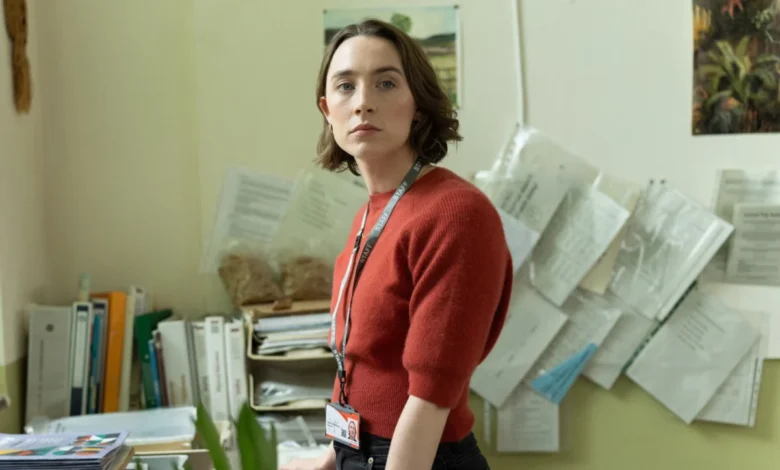
The cinematic release of Bad Apples on September 18, 2026, marked a significant pivot for lead actress Saoirse Ronan, who portrays Maria, a primary school teacher whose professional and personal life unravels following a series of ethically fraught decisions. Adapted from the 2017 Swedish novel De Oönskare by Rasmus Andersson, the film explores the psychological erosion of an educator pushed to the brink by an unruly student. As the narrative progresses, the film employs a carefully curated selection of music to mirror the protagonist’s descent into chaos, utilizing both a bespoke score and an eclectic array of needle-drop tracks to anchor its tonal shifts.
Narrative Context and Adaptation Background
The source material for the film, Rasmus Andersson’s De Oönskare, garnered critical acclaim for its unflinching examination of the power dynamics within a modern classroom. When the rights were acquired for a feature adaptation, the creative team sought to translate the novel’s claustrophobic atmosphere into a visual medium. Saoirse Ronan’s casting as Maria was central to this vision, as the role requires a nuanced portrayal of someone transitioning from a dedicated educator to a figure defined by desperation and moral ambiguity.
The film follows Maria as she struggles to maintain order in a classroom that has become increasingly volatile. Her inability to effectively manage a specific student leads her to make choices that deviate from established school protocols. These decisions do not occur in a vacuum; they reflect the systemic pressures placed on contemporary educators, a theme that resonates throughout the film’s two-hour runtime. The supporting cast, which includes Jacob Anderson, Rakie Ayola, Robert Emms, Sean Gilder, Kerry Howard, Jaye Jacobs, Eddie Waller, and Nia Brown, provides a robust backdrop for Ronan’s performance, representing the various institutional and social pressures Maria faces.
The Score: Chris Roe’s Atmospheric Composition
The emotional landscape of Bad Apples is largely dictated by the original score, composed by Chris Roe. Known for his work on projects such as The Salt Path, Blue Jean, and After Love, Roe has developed a reputation for minimalist, tension-driven compositions that complement intimate character studies. For Bad Apples, Roe opted for a soundscape that emphasizes the isolation of the protagonist.
Critics have noted that the score avoids traditional melodramatic swells, instead favoring subtle, dissonant instrumentation that mirrors Maria’s fraying mental state. In industry discussions regarding the film’s post-production phase, it was highlighted that the score was developed in tandem with the editing process to ensure that the musical cues served to heighten the stakes of Maria’s decision-making process without telegraphing the outcome to the audience. This collaborative approach between director and composer is increasingly standard in high-stakes psychological dramas, where the score acts as an invisible narrator.
Needle-drops: A Curated Selection
While the score provides the film’s structural backbone, the needle-drops—songs licensed for specific scenes—serve as jarring reminders of the world outside the classroom. The most prominent of these is the 1970 classic O-o-h Child by The Five Stairsteps. Used in a pivotal scene, the track serves as a stark, ironic contrast to the events unfolding on screen. The song’s message of hope and endurance is subverted by the reality of Maria’s increasingly isolated and compromised situation.
The complete list of featured songs in the film includes:
- On Saturday Afternoons In 1963 – Rickie Lee Jones
- Appalachian Spirit – Roy Edwin Williams
- Give It All You Got – Mark and Helen Johnson
- Happy Feet – Janne Schaffer
- O-o-h Child – The Five Stairsteps
These selections indicate a broad temporal and stylistic range. Rickie Lee Jones’ 1978 track, for instance, provides a nostalgic, grounded texture that contrasts with the more modern, aggressive elements of the score. By integrating these tracks, the film’s music supervisors successfully bridged the gap between personal narrative and cultural signifiers, grounding the story in a recognizable reality that makes Maria’s decline feel all the more personal.
Chronology of Production and Release
The development of Bad Apples was characterized by a rigorous pre-production schedule. Following the acquisition of the rights to the novel, the production team began principal photography in late 2025. The film was shot in various locations to simulate the environment of a mid-sized urban school district, with post-production concluding in the summer of 2026.
- Early 2025: Rights for De Oönskare secured; screenplay adaptation enters final drafts.
- September 2025: Principal photography commences with Saoirse Ronan attached as the lead.
- February 2026: Filming concludes; Chris Roe begins work on the score.
- August 2026: Final sound mixing and color grading are completed.
- September 18, 2026: Worldwide theatrical release.
The release strategy for Bad Apples focused on a global theatrical rollout, reflecting the international appeal of the original novel and the stature of its lead actress. The decision to release in September allowed the film to capture early autumn audiences, typically a prime window for adult-oriented dramas and psychological thrillers.
Industry Implications and Broader Impact
The reception of Bad Apples serves as a case study for the adaptation of contemporary European literature for international markets. By focusing on the universal struggle of professional burnout and moral compromise, the film has managed to transcend its Swedish origins to reach a global audience. The reliance on music—both original and pre-existing—highlights how modern filmmakers utilize sound design to communicate complex emotional states where dialogue might otherwise fall short.
The inclusion of high-caliber talent behind the camera, such as Chris Roe, signals a commitment to the "prestige drama" category. These films often rely on a cohesive sensory experience to distinguish themselves in a crowded marketplace. The soundtrack, therefore, is not merely an accompaniment but a strategic asset. By releasing the soundtrack alongside the film, the production team ensured that the sonic identity of Bad Apples remained accessible to audiences, further extending the film’s presence in the public consciousness beyond the cinema.
Furthermore, the film’s focus on the teacher-student dynamic invites a broader conversation about the state of modern education. While the film is a fictionalized drama rather than a documentary, its themes of classroom management and institutional oversight have sparked minor discourse within educational forums regarding the pressures placed on primary school teachers. The portrayal of Maria as a deeply flawed protagonist forces the audience to confront the difficulty of maintaining professional ethics when faced with circumstances that are, by all metrics, untenable.
Conclusion
Bad Apples stands as a significant entry in the 2026 film calendar, distinguished by its strong lead performance and its precise, intentional use of music. Through the synergy of Chris Roe’s score and a deliberate selection of needle-drops, the film manages to articulate the internal conflict of its protagonist with profound clarity. As the industry continues to explore the intersection of literature and film, the success of this adaptation suggests that audiences remain highly receptive to narratives that prioritize psychological depth and atmospheric integrity. The soundtrack, now available for streaming, offers a permanent record of the film’s emotional trajectory, serving as a vital component of the overall viewer experience. Whether analyzed for its narrative structure, its musical choices, or its social commentary, Bad Apples remains a compelling example of modern cinematic storytelling, reflecting the complexities of the human condition through the lens of a single, compromised life.