Neagley Ending Explained Who Killed Tommy Crane and the Resolution of the Amazon Prime Video Spin-off Series

The expansion of the Reacher universe has reached a critical juncture with the release of the Amazon Prime Video series Neagley. Premiering all eight episodes on September 16, 2026, the series pivots the focus from the nomadic Jack Reacher to his most trusted former military colleague, Frances Neagley, portrayed once again by Maria Stern. While the original series relies heavily on Reacher’s brute force and deductive instincts, the spin-off, helmed by creators Nick Santora and Nicholas Wootton, shifts the genre into a psychological crime thriller that delves deep into the trauma and investigative prowess of its lead character.
The narrative architecture of Neagley is built upon a dual-track structure: a contemporary mystery involving a lethal pharmaceutical conspiracy and a character-driven exploration of Neagley’s lifelong struggle with haphephobia—the pathological fear of being touched. As the series reaches its conclusion, it ties these two threads together in a way that provides both narrative closure for the immediate case and emotional evolution for the protagonist.
The Anatomy of a Conspiracy: Uncovering the Truth Behind Tommy Crane
The inciting incident of the series is the suspicious death of Tommy Crane, a long-time friend of Neagley. Initial evidence suggested a straightforward, if tragic, suicide, with reports indicating that Crane had walked into the path of a subway train while under the influence of narcotics. However, Neagley’s investigation reveals a far more sinister reality orchestrated by a clandestine organization.
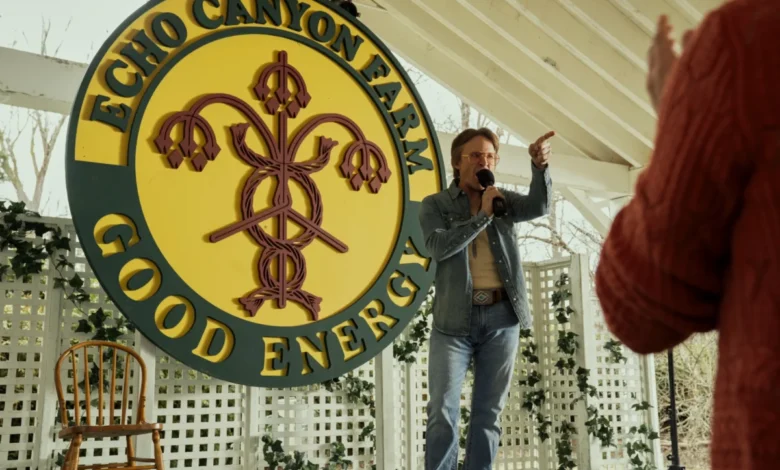
The investigation leads Neagley to Echo Canyon, a secluded location serving as the base for a cult-like commune. This group, led by the charismatic and dangerous Lawrence Cole (Damon Herriman), was not merely a spiritual collective but a testing ground for illicit pharmacological research. The central substance in question is Tranqlara, a powerful, experimental psychedelic drug.
Data unearthed during the series suggests that the drug was developed by pharmaceutical executive Pierce Woodrow, who operated under the shadow of significant financial backing from Arvid Rawlings, a Swedish billionaire with global interests. Tommy Crane, having stumbled upon the true nature of the commune and the role it played in testing this volatile substance, became a liability. He was ultimately murdered by the operatives running the operation, who administered a lethal dose of Tranqlara to simulate a drug-induced accident. This revelation shifts the narrative from a personal grievance into a high-stakes corporate thriller, mirroring the systematic corruption often explored in the broader Reacher franchise.

Chronology of Events and the Echo Canyon Climax
The final episode of the series serves as the crescendo for the investigation, characterized by high-octane tactical sequences and moral ambiguity. The timeline of the finale begins with Neagley and her support team infiltrating the Echo Canyon facility. Their primary objective is the recovery of the drug research data, which would serve as irrefutable evidence against Woodrow and Rawlings.
Simultaneously, the antagonist forces—mercenaries under the direct command of Arvid Rawlings—are dispatched to the underground silo to incinerate all remaining evidence. The resulting confrontation between Neagley’s team and the mercenary force culminates in a significant firefight within the bunker. Neagley successfully secures the research data and facilitates the rescue of several surviving cult members, including the character Keno (Jasper Jones). The sequence concludes with the total destruction of the Echo Canyon facility, resulting in the death of Lawrence Cole, who remained within the collapsing structure.
The final loose end, Arvid Rawlings, is addressed not through standard law enforcement channels, but through a cold, calculated act of vigilante justice. Neagley, operating outside the bounds of traditional jurisdiction, confronts Rawlings and forces a dose of the very substance his company created upon him. The series leaves no ambiguity regarding his fate, depicting him in a final, harrowing scene wandering into traffic under the influence of the drug, where he is struck by a transport vehicle.
Psychological Context: The Origins of Haphephobia
Perhaps the most significant development in the series is the exploration of Neagley’s phobia. Throughout the Reacher series, Neagley’s aversion to physical touch has been a defining character trait. The spin-off finally contextualizes this as a trauma-based response to her father’s history as a police officer.
In her youth, Neagley witnessed her father execute Elliot Percy, a known predator. For years, Neagley harbored the belief that she had been the victim of Percy’s abuse. The finale reveals a devastating shift in perspective: the victim of the abuse was not Neagley, but Tommy Crane. Her father had discovered this atrocity and took the law into his own hands to eliminate Percy. However, the psychological damage was inflicted upon Neagley during the aftermath of that event. Her father, in an attempt to protect her, grabbed her forcefully and declared that no one would ever touch her again—a gesture that inadvertently instilled the very phobia that has dictated her adult life.
The narrative arc of her healing is subtle. Upon discovering her father’s death in the hospital, she finds a letter of apology that provides a modicum of closure. The symbolic turning point arrives at his funeral, where she initiates a handshake with Jack Reacher—a gesture that signifies a tentative, monumental step toward overcoming her condition. Yet, the series maintains a grounded sense of realism; when Detective Hudson Riley expresses romantic interest, Neagley declines, noting that she "can’t" engage in such intimacy, indicating that while progress has been made, the psychological scars remain a barrier to full recovery.

Broad Implications for the Reacher Universe
The introduction of Neagley as a standalone series carries significant implications for the future of the franchise on Amazon Prime Video. By successfully transitioning a supporting character into a lead role, the production team has validated the depth of the source material created by Lee Child.
From a structural standpoint, the series highlights the viability of a "procedural-plus" format—one that balances the investigative rigor of a police procedural with the high-stakes action of a spy thriller. The success of the casting, which pairs veteran performer Maria Stern with a strong ensemble including Greyston Holt, Adeline Rudolph, Matthew Del Negro, and Damon Herriman, suggests a robust strategy for expanding the universe through character-specific spin-offs rather than mere sequels.
Furthermore, the series provides a template for exploring the "darker" corners of the Reacher mythos. While the main Reacher series often focuses on large-scale conspiracies affecting regional safety, the Neagley series demonstrates that the franchise can effectively tackle contemporary social issues, such as the ethics of the pharmaceutical industry and the long-term psychological effects of childhood trauma, without losing the intensity that defines the brand.
Analysis of the Narrative Success
The decision to conclude the series with a definitive, albeit morally grey, resolution for the primary antagonists aligns with the tone established in the broader franchise. The audience for this series expects a brand of justice that is often unavailable within the formal legal system. By having Neagley act as both judge and jury for Arvid Rawlings, the show maintains its core identity.
Moreover, the emotional payoff regarding her father’s past adds a layer of depth that elevates the show above a standard action vehicle. By connecting the villainy of the past (Percy) to the villainy of the present (Rawlings and Woodrow), the writers successfully created a cohesive narrative thread that justifies the existence of a spin-off. The production quality, coupled with the commitment to the established character lore, suggests that Neagley will remain a cornerstone of the Prime Video action catalog for the foreseeable future.
In conclusion, Neagley serves as a sophisticated addition to the Reacher universe. It provides a definitive answer to the mystery of Tommy Crane’s death while simultaneously offering a nuanced look at the protagonist’s internal struggle. With the evidence recovered and the perpetrators neutralized, the series concludes on a note of cautious optimism for Neagley, suggesting that while she may not be "cured" of her past, she is finally moving toward a future defined by her own terms rather than her previous traumas.