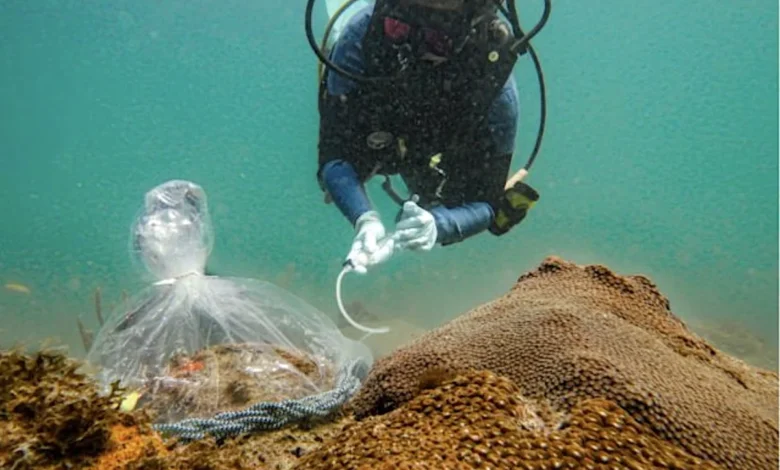
Probiotic treatment of Montastraea cavernosa colonies using a whole-colony bagging technique. Frontiers in Marine Science

The health of the Florida Reef Tract—the only living barrier reef in the continental United States—has faced an existential threat since 2014, when the first reports of stony coral tissue loss disease (SCTLD) emerged near Miami. This highly lethal, water-borne pathogen has since decimated dozens of coral species, stripping them of their living tissue and leaving behind stark, white skeletons. However, a breakthrough study published in Frontiers in Marine Science offers a glimmer of hope: the application of a specific probiotic bacterial strain, MCH1-7, has shown significant promise in halting the progression of the disease through a novel whole-colony bagging technique.
The Emergence of the MCH1-7 Strain
The journey toward this discovery began in 2018, when researchers at the Smithsonian Marine Station identified a naturally resilient coral colony. While surrounding corals succumbed to the rapid, tissue-sloughing effects of SCTLD, one specific colony of Montastraea cavernosa, or great star coral, remained remarkably healthy. Scientists isolated the bacteria associated with this resistance and identified the strain MCH1-7.
The efficacy of this probiotic lies in its production of a bioactive compound known as tetrabromopyrrole (TBP). TBP is a naturally occurring metabolite that appears to act as a potent antimicrobial agent against the pathogens responsible for SCTLD. Biologist Jennifer Sneed, a key figure in the research at the Smithsonian Marine Station, has noted that TBP may serve a dual purpose in the marine ecosystem: it acts as both a protective shield against infection and a chemical cue that encourages coral larvae to settle on healthy, protected substrate.
Chronology of the Research
The investigation into MCH1-7 has spanned several years, moving from initial laboratory identification to intensive field trials.
- 2014: Initial reports of SCTLD appear off the coast of Florida, rapidly spreading across the reef tract.
- 2018: Researchers discover a naturally resistant M. cavernosa colony, leading to the isolation of the MCH1-7 bacterial strain.
- 2021-2024: The research team conducts multi-year field trials in the Florida Keys to test various delivery mechanisms for the probiotic, specifically comparing topical paste application against whole-colony bagging.
- 2025: Results are published in Frontiers in Marine Science, confirming that the bagging method significantly outperforms direct lesion treatment, providing protection for up to 2.5 years.
Methodology: Bagging vs. Topical Treatment
The study aimed to determine the most effective way to administer the probiotic to wild coral colonies. Researchers tested two primary methods: a topical paste applied directly to infected lesions and a whole-colony bagging method.
The topical paste method, while easier to deploy, proved largely ineffective at halting the systemic spread of the disease within the colony. Because SCTLD is a multi-focal disease that often advances across the entire surface of the coral, localized treatment failed to address the underlying bacterial load throughout the organism.
In contrast, the whole-colony bagging method involved placing a weighted, flexible bag over the M. cavernosa colony. Once sealed, researchers injected a seawater-probiotic slurry into the enclosure, allowing the bacteria to saturate the entire coral surface. This "whole-colony" approach ensured that the MCH1-7 strain could colonize the coral mucus and establish a defensive barrier against the invading pathogens. The team monitored these treated corals for 2.5 years post-application, providing a robust dataset on the long-term viability of the treatment.
Statistical Efficacy and Environmental Impact
The data collected by the research team presents a compelling case for the scalability of the bagging method. Corals treated via the bagging technique experienced an average tissue loss of only 7% over the monitoring period. Conversely, untreated control colonies subjected to the same environmental conditions lost an average of 35% of their tissue to the disease.
This reduction in mortality is significant, not only for the individual coral colonies but for the ecological integrity of the reef. M. cavernosa is a foundational species; it provides complex structural habitat for a vast array of fish, crustaceans, and invertebrates. By preserving these colonies, researchers are protecting the architectural complexity of the reef, which is vital for biodiversity and coastal storm protection.

Furthermore, the researchers performed environmental impact assessments to ensure that the introduction of the MCH1-7 strain did not negatively affect other nearby Caribbean coral species. The results indicated that the treatment is highly targeted and does not disrupt the microbiome of healthy, non-target corals, addressing a primary concern regarding the use of "bio-augmentation" in sensitive marine environments.
Logistical Challenges and Future Directions
Despite the promising results, lead author Kelly Pitts and the team at the Smithsonian Marine Station are cautious about characterizing this discovery as a "cure-all." The implementation of the bagging method requires significant logistical support. It involves specialized equipment, precise underwater deployment by trained scientific divers, and extensive time for the retrieval of materials.
"It’s important to understand that this is the very beginning," Pitts stated. "This is definitely not a cure-all, but we’re definitely moving in the right direction." The team acknowledges that while the bagging method is more labor-intensive than topical applications, its success rate and durability justify the investment. Current efforts are now shifting toward optimizing the material transport process and determining how to apply this technique across larger, more complex reef structures.
Broader Implications for Marine Conservation
The success of MCH1-7 represents a fundamental shift in how marine biologists approach reef restoration. Traditionally, the focus has been on nursery propagation—growing corals in protected areas and outplanting them. However, if those outplanted corals are immediately susceptible to disease, the long-term viability of restoration efforts remains low.
Probiotic therapies offer a strategy to increase the resilience of wild populations before they succumb to environmental stressors. This "pre-emptive" approach—treating corals with beneficial bacteria before or during the early stages of an outbreak—could be a vital component of a broader management strategy for the Florida Reef Tract.
Beyond the specific case of SCTLD, this research provides a framework for future studies. As climate change continues to increase ocean temperatures, coral reefs worldwide are experiencing higher rates of bleaching and disease. The methodology developed by the Smithsonian team provides a repeatable model for identifying, testing, and deploying bacterial solutions to save foundational marine species.
Critical Analysis and Expert Perspective
The scientific community has viewed these findings as a necessary evolution in marine pathology. By moving away from purely pharmacological interventions (such as antibiotic pastes, which can lead to bacterial resistance) and toward biological, probiotic-based solutions, researchers are working in tandem with the natural evolutionary adaptations of the corals themselves.
However, experts note that while localized probiotic intervention is essential, it remains a "patchwork" solution. It cannot address the root causes of coral decline, such as warming oceans, nutrient runoff, and ocean acidification. The utility of the MCH1-7 probiotic is as a defensive measure to keep reef-building species alive until larger, global climate policies can stabilize the environment in which they live.
The next phase of the research will likely involve expanding the testing to include other species of coral and investigating whether the probiotic can be applied via less labor-intensive methods, such as drone-assisted or automated delivery systems. For now, the successful application of the bagging method on Montastraea cavernosa serves as a proof-of-concept that science can indeed buy time for ecosystems facing an uncertain future.
The research conducted by the Smithsonian Marine Station highlights the power of interdisciplinary collaboration, combining microbiology, ecology, and diving expertise to address one of the most pressing environmental challenges of the 21st century. As the scientific community continues to monitor the treated colonies, the data will provide further insights into the long-term stability of the probiotic barrier and its potential to halt the march of stony coral tissue loss disease across the Caribbean.