Earth Overshoot Day 2025 marks a record-breaking moment of ecological deficit for humanity

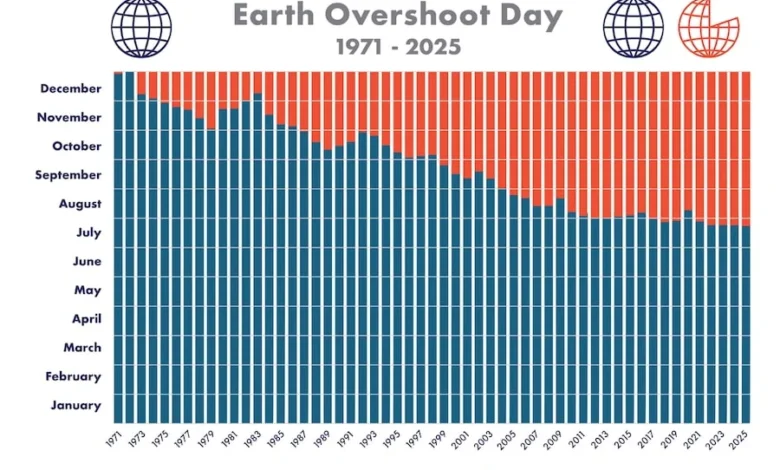
On July 24, 2025, humanity reached Earth Overshoot Day, the earliest date in recorded history that global demand for natural resources surpassed what the planet’s ecosystems can regenerate within a single calendar year. This milestone, calculated annually by the Global Footprint Network, serves as a sobering indicator of the widening gap between human consumption and the biosphere’s biocapacity. By July 24, the world had exhausted its annual budget of biological resources—including timber, water, food, and carbon absorption capacity—effectively operating on "ecological credit" for the remainder of the year.
This year’s date, surpassing the previous records of July 25 set in 2022 and 2023, underscores a persistent trend of over-consumption that has accelerated significantly over the past half-century. As the date continues to shift earlier into the calendar, scientists and economists are increasingly warning that the current trajectory of resource extraction is not only unsustainable but poses systemic risks to global stability.
The Historical Evolution of Ecological Debt
The concept of Earth Overshoot Day was popularized in 2006 by Andrew Simms, a political economist and campaigner, in partnership with the Global Footprint Network. However, the phenomenon of ecological deficit is a much older and more insidious development. To understand the gravity of the current situation, researchers have retroactively modeled consumption patterns dating back to the early 20th century.
In 1972, humanity was living within the planet’s means, with Earth Overshoot Day theoretically falling on December 31. By 1979, the date had moved up to November 3. During the 1980s, despite minor fluctuations caused by economic shifts, the trend remained firmly downward. By 1989, the date hit October 12. Throughout the 1990s, the speed of consumption increased, and in 1999, the world crossed into the September threshold. The 21st century has seen this acceleration intensify; by 2018, the world reached the July threshold for the first time.
The Global Footprint Network’s recent recalibrations have refined these historical models, providing a clearer picture of how quickly industrialization and population growth have outpaced natural replenishment. The temporary return to an August date in 2020, largely driven by the global economic slowdown associated with the COVID-19 pandemic, served as a temporary anomaly rather than a structural shift, as the world quickly returned to record-breaking consumption levels in subsequent years.
The Math of Over-Consumption
The calculation for Earth Overshoot Day is derived from the relationship between the planet’s biocapacity—the amount of productive area available to regenerate resources—and humanity’s ecological footprint, which measures the demand for these resources. Currently, humanity is consuming nature 1.8 times faster than the Earth can replenish it.

This global average masks significant disparities between nations. While the global date is July 24, if every country lived like the United States, the date would have occurred in early spring. Conversely, nations with smaller ecological footprints maintain a much lower impact on the global budget. The depletion of freshwater aquifers, the clearing of forests for industrial agriculture, and the exhaustion of oceanic fish stocks represent the tangible impacts of this deficit.
Beyond physical resource extraction, the carbon footprint is the single largest contributor to the overshoot. The atmosphere’s capacity to absorb carbon without triggering catastrophic climate change is finite. When humanity emits more carbon than the world’s forests and oceans can sequester, that "excess" adds to the ecological debt. Today, carbon emissions account for a significant portion of the total ecological footprint, acting as the primary driver pulling the Overshoot Day forward.
Perspectives from the Scientific Community
The implications of this debt are increasingly being linked to the framework of "planetary boundaries," a concept developed by a team of scientists led by Johan Rockström. According to recent assessments, humanity has already crossed seven of the nine identified planetary boundaries, which include climate change, biosphere integrity, and land-system change.
"We are stretching the limits of how much ecological damage we can get away with," said Lewis Akenji, a board member of the Global Footprint Network, in a recent statement. "It is now a quarter into the 21st century and we owe the planet at least 22 years of ecological regeneration, even if we stop any further damage now."
Akenji’s remarks highlight a critical, often misunderstood aspect of the crisis: the cumulative effect. Even if the date were to stabilize, the debt already accrued remains unpaid. The ecological damage is cumulative, meaning the planet is experiencing a "compounding interest" effect of degradation. Scientists argue that the longer we remain in overshoot, the more difficult it becomes to restore the resilience of natural systems, potentially leading to irreversible tipping points in biodiversity and climate stability.
Pathways to Correction: The Power of Possibility
Despite the severity of the data, the Global Footprint Network maintains that the situation is not irreversible. Their "Power of Possibility" campaign identifies specific, scalable solutions that could fundamentally shift the date back toward the end of the year.
The most significant impact would come from a global transition in energy production. Cutting global carbon emissions by 50% could move the Earth Overshoot Day back by approximately three months. This would involve a rapid, systemic shift away from fossil fuels toward a decarbonized energy grid.

Other high-impact strategies include:
- Food System Reform: Reducing global food waste by 50% would shift the date by 13 days. Given that approximately one-third of all food produced for human consumption is lost or wasted, this represents a massive opportunity for resource conservation.
- Renewable Energy Expansion: Scaling renewable electricity to provide at least 75% of global demand could push the date by 26 days.
- Policy Frameworks: The implementation of a global "Green New Deal" aimed at large-scale, sustainable infrastructure and economic reform is estimated to have the potential to shift the date by 42 days.
Mathis Wackernagel, co-founder of the Global Footprint Network, emphasizes that the choice is ultimately a matter of policy and intent. "Because of the nature of physics, overshoot cannot last," Wackernagel stated. "It will end either by deliberate design or dumped-on disaster. It should not be too hard to choose which one is preferable, particularly in light of so many possible choices."
Broader Economic and Societal Implications
The economic ramifications of living in an ecological deficit are profound. As resources become scarcer, their prices become increasingly volatile, threatening the stability of global supply chains. Agriculture, in particular, is highly sensitive to the depletion of soil health and water supplies. As these foundations of production are eroded, food insecurity becomes a more probable outcome for vulnerable populations.
Furthermore, the reliance on ecological credit implies a fragile global economy. When a society depends on resources that are effectively being borrowed from the future, any disruption—whether from climate-induced weather events or geopolitical instability—can lead to severe, cascading failures. The 2025 date serves as a warning that the "buffer" provided by natural systems is thinning.
Moving forward, the focus for policymakers and corporate leaders is shifting from merely minimizing impact to actively regenerating the biosphere. This includes adopting circular economic models, where waste is eliminated, and resources are kept in use for as long as possible. The transition from a linear "take-make-dispose" economy to a circular one is increasingly viewed as the only viable path to aligning human economic activity with the regenerative capacities of the planet.
Conclusion
The arrival of Earth Overshoot Day on July 24, 2025, is more than a statistical curiosity; it is a structural indictment of current global consumption patterns. While the data reflects a long-term trend of degradation, the existence of viable solutions—ranging from energy reform to waste reduction—offers a clear roadmap for mitigation. As the global community confronts the reality of finite resources in an era of infinite growth expectations, the challenge of shifting the date becomes the central geopolitical and economic task of the 21st century. The path toward a sustainable future requires a fundamental redesign of how societies produce, consume, and value the natural capital upon which all human existence depends.