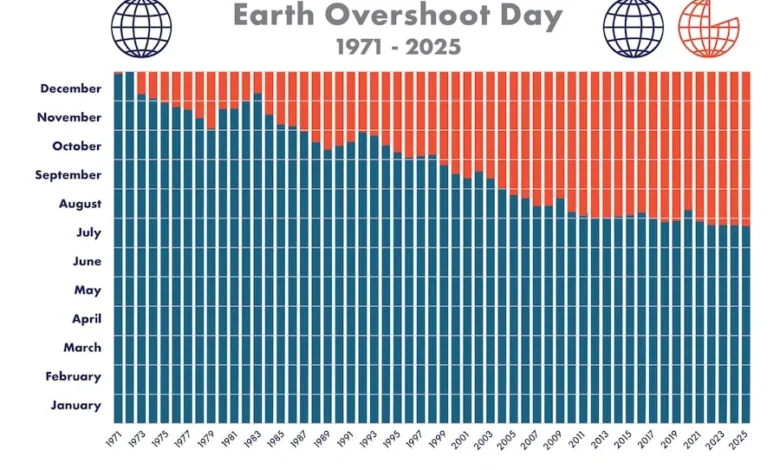
The Historical Trajectory of Ecological Deficit
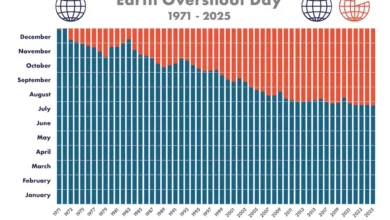
The concept of Earth Overshoot Day was popularized in 2006 by Andrew Simms, a prominent political economist, in partnership with the Global Footprint Network. While the initiative began as a way to quantify the ecological footprint of human activity, recent efforts to refine historical data have revealed a more alarming long-term trend. Scientists have retroactively calculated dates dating back to the early 1970s, painting a vivid picture of rapid industrial acceleration and resource depletion.
In 1972, the world lived within its ecological means, hitting its "overshoot" point on December 31. By 1979, the date had shifted to November 3, marking the beginning of a persistent trend of overconsumption. Throughout the 1980s and 1990s, the date moved steadily backward in the calendar. By 1999, it occurred on September 25. The transition into the 21st century saw an even more aggressive acceleration; in 2006, the year the index was launched, the date fell on August 22.
The arrival of the date in July for the first time in 2018 signaled a new phase of environmental pressure. Despite a brief, pandemic-induced reprieve in 2020, the date has remained firmly entrenched in July. The previous record of July 25 was established in 2022 and 2023. By hitting July 24 in 2025, humanity has set a new, concerning precedent, demonstrating that even with increased awareness regarding climate change and sustainability, the fundamental drivers of ecological depletion—industrial agriculture, fossil fuel dependence, and unsustainable urban sprawl—remain largely unaddressed at the necessary scale.
Analyzing the Mechanics of Overshoot
To understand why July 24 is significant, one must examine the metrics of the ecological footprint. The Global Footprint Network tracks six primary categories: cropland, grazing land, fishing grounds, built-up land, forest products, and carbon demand. Carbon emissions currently represent the largest component of humanity’s footprint, accounting for a significant portion of our reliance on "nature’s budget."

When humans emit more carbon dioxide than the world’s forests and oceans can sequester, that excess is effectively "borrowed" from the future. This creates a compounding debt. Every year that we exceed the planet’s biocapacity, we deplete natural capital, such as groundwater reserves, soil health, and biodiversity, rather than living off the interest provided by annual biological growth.
The implications of this are not merely theoretical. Researchers have identified nine "planetary boundaries"—critical thresholds that, if crossed, could lead to irreversible environmental shifts. Humanity has already breached seven of these boundaries, including climate change, biodiversity loss, and nitrogen cycle disruption. The arrival of Earth Overshoot Day is a functional indicator that we are operating in the "danger zone" for these boundaries, increasing the risk of systemic collapse in agricultural yields, fresh water availability, and climate stability.
The Voices of Urgency: Official Responses
The announcement of the 2025 date has drawn sharp rebukes from the scientific and policy communities. Lewis Akenji, a board member of the Global Footprint Network, emphasized the historical debt owed to the planet. "We are stretching the limits of how much ecological damage we can get away with," Akenji noted. "It is now a quarter into the 21st century, and we owe the planet at least 22 years of ecological regeneration, even if we stop any further damage now."
Akenji’s statement highlights a critical shift in the discourse: the transition from "sustainability" to "regeneration." Simply slowing the rate of depletion is no longer sufficient; the current level of ecological debt necessitates a restorative approach to global economic policy.
Mathis Wackernagel, the co-founder of the Global Footprint Network, framed the dilemma as a choice between design and disaster. "Because of the nature of physics, overshoot cannot last," Wackernagel stated. "It will end either by deliberate design or dumped-on disaster." His words reflect a growing consensus among environmental scientists that the current trajectory is physically unsustainable. If global markets and governments do not consciously choose to restructure, the environment will eventually enforce its own limits through resource shortages, economic volatility, and climate-induced catastrophes.

Pathways to Correction: The Power of Possibility
While the data for 2025 is grim, researchers insist that the trajectory is not immutable. The "Power of Possibility" campaign, led by the Global Footprint Network, identifies specific, actionable strategies that could push the date of Earth Overshoot Day back toward December.
- Decarbonizing Energy: The most significant impact can be achieved through a radical reduction in carbon emissions. A 50% reduction in global carbon emissions would shift the date back by approximately three months. This requires a systemic transition to renewable energy sources, including solar, wind, and geothermal, alongside improvements in energy efficiency.
- Transforming Food Systems: Current agricultural practices are both a major emitter of greenhouse gases and a primary driver of land-use change. Reducing global food waste by 50% would push the date by 13 days. Furthermore, shifting diets toward more plant-based proteins reduces the land and water footprint required to feed the global population.
- Policy Integration: Large-scale initiatives, such as a global "Green New Deal," could shift the date by as much as 42 days. Such policies would involve legislative mandates for circular economies, where resources are reused and recycled rather than discarded, and the protection of carbon-sequestering biomes like the Amazon rainforest and peatlands.
- Renewable Infrastructure: Generating at least 75% of global electricity from renewable sources would result in a 26-day delay of the overshoot date. This would require substantial international cooperation to fund infrastructure in developing nations, ensuring that economic growth does not come at the expense of ecological stability.
Broader Implications for Global Stability
The arrival of Earth Overshoot Day on July 24 serves as a diagnostic tool for the global economy. It highlights that the current model of perpetual growth is incompatible with a finite planet. Economists are increasingly looking toward "degrowth" or "steady-state" economic models, which prioritize human well-being and environmental health over traditional GDP growth.
The social implications are equally significant. Regions that are already experiencing the effects of resource scarcity—such as water shortages in the Middle East or crop failures in Sub-Saharan Africa—are often the first to feel the impact of this annual deficit. As the date moves earlier, the competition for remaining resources is expected to intensify, potentially fueling geopolitical conflicts and mass migration.
Ultimately, the data surrounding July 24, 2025, represents a challenge to global leadership. The tools and technologies required to move the date are readily available; what is missing is the political will to implement them at the necessary scale. As Wackernagel pointed out, the choice is between intentional, structured change or the involuntary collapse forced by ecological reality. As we move into the latter half of 2025, the focus for policymakers must shift from short-term economic gains to the long-term viability of the Earth’s life-support systems. Failure to do so will likely result in an even earlier Earth Overshoot Day in 2026, further cementing the cycle of depletion that threatens our common future.