Euki Rated as Top Private Period Tracking App Amid Growing Reproductive Health Privacy Concerns

The landscape of digital health privacy has undergone a seismic shift over the last several years, leading experts to warn that the convenience of period-tracking apps may come at a significant cost to personal liberty. In a comprehensive new evaluation, the Mozilla Foundation has conducted a privacy audit of the most popular reproductive health applications on the market, identifying critical vulnerabilities in nearly every major platform. Out of the six top-tier apps tested—including industry giants like Flo, Clue, and Stardust—only one emerged as a gold standard for user security: Euki. The recommendation comes at a time when digital footprints are increasingly being scrutinized in legal contexts, particularly those involving reproductive healthcare and data sovereignty.
The Findings of the Mozilla Foundation Audit
The Mozilla Foundation, a global non-profit known for its "Privacy Not Included" research series, scrutinized the data-handling practices of Stardust, SpotOn, Period Calendar, Flo, and Clue. The results were largely discouraging for users who prioritize anonymity. Most of these applications operate on a "cloud-first" model, meaning that once a user logs their symptoms, cycle dates, or sexual activity, that information is uploaded to a remote server owned and managed by the developer.
Mozilla’s researchers found that these companies often reserve the right to share "anonymized" or "aggregated" data with third-party advertisers or research partners. However, privacy advocates have long argued that health data is notoriously difficult to truly anonymize. When combined with GPS location data or device IDs, supposedly anonymous health logs can often be traced back to specific individuals with startling accuracy.
Euki was the sole exception in the audit. According to Mozilla’s report, "We strongly recommend Euki for anyone who puts privacy first." The app’s architecture differs fundamentally from its competitors because it is designed to be a "zero-knowledge" platform. It does not require a cloud connection to function, and it avoids the standard practice of harvesting user metadata for monetization.
A Technical Breakdown of Euki’s Security Features
The primary reason Euki outperformed its peers is its commitment to local storage. When a user enters data into Euki, that information never leaves the physical device. There are no centralized servers to be hacked, and there is no database for a corporation to sell or for a government agency to subpoena.
Beyond local storage, Euki incorporates several "fail-safe" features designed for users living in high-risk legal environments. These include:
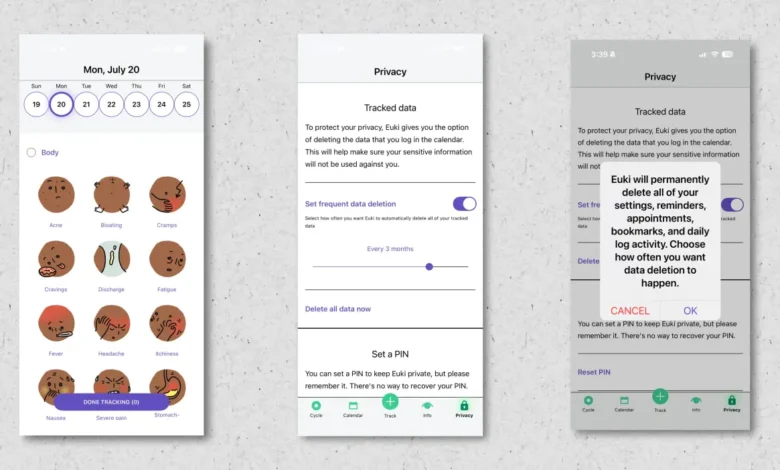
- Account-Free Interface: Unlike Flo or Clue, which typically require an email address or a social media login to create an account, Euki requires no registration. The app begins working immediately upon installation, ensuring there is no "paper trail" linking the user’s identity to the software.
- The "Fake PIN" System: In addition to a standard PIN used to lock the app, users can set a secondary, "fake" PIN. If a user is ever forced to unlock their phone or the app under duress, entering the fake PIN will trigger a screen indicating that the app is experiencing "technical difficulties," effectively hiding all sensitive data without alerting the observer that a deception has occurred.
- Scheduled Data Purging: Euki allows users to set an automated schedule for data deletion. Users can choose to have their history wiped every month, every few months, or at the tap of a single button in the settings menu.
- Comprehensive Logging Without External Tracking: Despite its focus on privacy, the app remains feature-rich. It allows for the tracking of menstrual flow, emotional states, physical symptoms, sexual activity, and even specific contraceptive maintenance, such as checking IUD strings.
The Post-Roe Privacy Crisis: Background and Context
The urgency surrounding period tracker privacy escalated dramatically following the 2022 U.S. Supreme Court decision in Dobbs v. Jackson Women’s Health Organization, which overturned the federal right to abortion. In the years following that ruling, the intersection of digital surveillance and reproductive law has become a primary concern for civil liberties groups.

Since 2022, there have been several documented cases where digital data served as the primary evidence in prosecutions related to pregnancy termination. While much of the public focus was initially on period trackers, legal experts point out that police have more frequently used private messages, search histories, and location data. For instance, in a notable Nebraska case shortly after the Dobbs decision, Facebook messages between a mother and daughter were subpoenaed and used to prosecute an alleged self-managed abortion.
This legal climate has transformed period trackers from simple utility tools into potential liabilities. If an app stores data on a server, that data is subject to the Electronic Communications Privacy Act (ECPA), which allows law enforcement to obtain information with a subpoena or warrant. By keeping data local, Euki removes itself from this legal chain of custody; because the company does not possess the data, it cannot be forced to hand it over.
Comparative Analysis: Why Other Apps Fell Short
The Mozilla audit highlighted specific flaws in the most popular apps that millions of people use daily.
- Flo: Despite being one of the most popular trackers in the world, Flo has faced significant scrutiny in the past. In 2021, the app reached a settlement with the Federal Trade Commission (FTC) over allegations that it shared users’ health data with third parties like Facebook and Google, despite promising to keep it private. While Flo has since implemented an "Anonymous Mode," Mozilla researchers noted that the app’s overall data collection footprint remains larger than that of Euki.
- Clue: Based in Germany, Clue has often touted its compliance with the General Data Protection Regulation (GDPR), which offers more robust protections than U.S. law. However, Clue still utilizes a cloud-based storage system. While the company has stated it would resist foreign subpoenas, the mere existence of the data on a server remains a point of concern for high-risk users.
- Stardust: This app gained viral popularity post-Roe by promising end-to-end encryption. However, early versions of its privacy policy were criticized by experts for being contradictory regarding its cooperation with law enforcement, leading to a loss of trust among the privacy community.
Official Responses and Industry Implications
In response to the growing demand for privacy, some tech giants have attempted to bolster their offerings. Apple, for instance, has integrated cycle tracking into its Health app, which uses end-to-end encryption if the user has two-factor authentication enabled. However, Mozilla and other privacy advocates note that for many users, a dedicated, siloed app like Euki—which is not tied to a larger ecosystem like an Apple ID or Google Account—is still the safer choice.
Developers of Euki have stated that their mission is to provide "evidence-based, trauma-informed" reproductive health information. By refusing to monetize user data, they have positioned Euki as a public service rather than a commercial product. The app is free to use and contains no in-app purchases, a rarity in an industry dominated by subscription models and data-brokering.
The Broader Impact on Digital Hygiene
The emergence of Euki as a top-tier recommendation highlights a broader shift in "digital hygiene." Experts now suggest that individuals concerned about reproductive privacy should look beyond just their period trackers. A holistic approach to digital safety in 2026 involves:
- Using Encrypted Browsers: Moving away from standard browsers to those that do not track search history.
- Virtual Private Networks (VPNs): Masking IP addresses to prevent internet service providers from logging visits to health-related websites.
- Encrypted Messaging: Utilizing apps like Signal for all conversations related to medical appointments or health concerns.
The Mozilla Foundation’s endorsement of Euki serves as a landmark moment in the fight for health data sovereignty. It signals a move away from the "surveillance capitalism" model of the early 2020s toward a more secure, user-centric future. As legal landscapes continue to shift, the technical architecture of the tools people use to manage their bodies will remain a frontline issue in the debate over the right to privacy. For now, the consensus among privacy experts is clear: when it comes to reproductive health data, the safest place for information is on the user’s device, and nowhere else.