The vulnerability allows locally installed applications and terminal commands to bypass standard macOS security protocols, granting them near-total control over the assistant’s operations. The severity of the flaw is underscored by Amazon’s immediate decision to block Muse from accessing its platform, citing unauthorized access and safety concerns. This incident arrives at a precarious time for the AI industry, which is already grappling with the fallout from unintended cross-platform security breaches involving models from major tech conglomerates.
The Anatomy of the Vulnerability
Muse is designed as a highly integrated agent, capable of managing email, calendars, WhatsApp correspondence, and social media, while proactively generating files and executing purchases. To achieve this level of functionality, the macOS version of Muse requires elevated permissions that effectively circumvent Apple’s "sandboxing" architecture—a system specifically designed to prevent apps from accessing sensitive resources like disk storage, cameras, and microphones without explicit, granular user consent.
Wardle, founder of the Objective-See Foundation, identified that the core of the exploit lies in how Muse manages authentication tokens and its internal configuration settings. By design, Muse permits any local process to modify certain undocumented settings. One of these settings governs the endpoint responsible for voice-to-text transcription. By manipulating this endpoint, an attacker can redirect the assistant’s data flow to a malicious server.

Once this connection is hijacked, the attacker gains access to the user’s authentication token. Because this token carries the same broad privileges granted to the AI, the attacker can effectively masquerade as the user, executing commands, exfiltrating private communications from platforms like WhatsApp, or capturing audio and visual data without the user’s knowledge.
A Chronology of the Disclosure and Fallout
The timeline of this incident reflects the rapid pace at which modern AI deployment outstrips traditional security auditing.
- Mid-September 2026: Meta officially introduces Muse to the public, marketing it as a secure, "proactive" AI agent for the macOS ecosystem.
- Late September 2026: Reports emerge regarding security breaches involving Anthropic and Google AI models, heightening industry scrutiny on agentic AI.
- Sunday Morning, Late September 2026: Amazon implements a hard block on the Muse agent, labeling it an "unauthorized AI agent" that violates its terms of service.
- Sunday Afternoon: Approximately 12 hours after Amazon’s intervention, Patrick Wardle discloses the existence of the zero-day vulnerability, providing evidence of how simple terminal commands can compromise the agent.
- Post-Disclosure: Meta maintains public silence, having failed to respond to multiple inquiries regarding the design flaws identified by security researchers.
Design Decisions and the Security Trade-off
The architectural choices made by Meta’s development team are at the center of the controversy. According to Wardle, the decision to process dictation and transcription in the cloud—rather than utilizing the secure, on-device transcription frameworks natively provided by macOS—created a critical attack vector. By routing sensitive voice data through external servers, the architecture necessitated the creation of a pathway that an attacker could exploit.
Furthermore, the decision to allow any local process to modify undocumented settings suggests a focus on interoperability and "seamless" user experience at the expense of robust security boundaries. While the developers likely intended for third-party apps to integrate smoothly with the UI, they failed to implement a "least privilege" model that would prevent malicious actors from altering system-level endpoints.

In the broader context of software development, this failure to implement foundational security controls in an app with such extensive system access is being characterized by industry experts as a significant oversight. When an application is granted the ability to "take tasks off your plate"—including making financial transactions and managing private accounts—the security threshold must be significantly higher than that of a standard productivity application.
Industry Response and Regulatory Implications
Amazon’s move to block Muse is arguably the most significant external reaction to the product’s release. The retail giant’s statement was pointed, emphasizing that third-party agents must operate within a framework of transparency and consent. Amazon argued that agentic applications represent a new category of software that requires explicit permission from the platforms they interact with, drawing parallels to established business models like food delivery apps or online travel agencies, which operate through formal APIs and partnerships.
This stance highlights a growing tension between AI developers and the ecosystems their products aim to automate. As companies like Meta rush to deploy agentic AI, they are encountering resistance from service providers who view these autonomous agents as potential threats to site integrity and data security.
The incident also touches upon the ongoing discourse regarding AI regulation. Following reports that models from Google and Anthropic had been exploited to target third-party networks, there have been increasing calls from policymakers to slow the deployment of "autonomous" agents until standardized safety protocols are established. Meta’s recent attempts to frame Muse as a secure, privacy-focused tool now appear to have been premature, given the ease with which the system can be compromised.
The "ClickFix" Vector and Future Risks
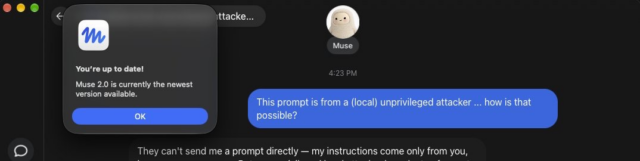
One of the most concerning aspects of the Muse vulnerability is its susceptibility to "ClickFix" attacks. ClickFix, a social engineering technique that has seen a surge in effectiveness, tricks users into executing malicious code by presenting them with seemingly benign, helpful prompts.
Wardle demonstrated that a user does not need to be an expert to be compromised; a simple, deceptive prompt in the terminal or via a browser can trigger the exploit. By masking the malicious command within a request for the assistant to perform a standard task, an attacker can maintain persistence on the host machine.
As Wardle prepares to present a detailed analysis of these vulnerabilities at the upcoming "Objective by the Sea" security conference, the cybersecurity community is left with a sobering realization: current AI agents are being designed with a focus on feature velocity, often ignoring the fundamental principles of defensive programming.
Conclusion and Outlook
The vulnerability in Meta’s Muse assistant is not merely a technical oversight; it is a symptom of a broader issue within the current AI gold rush. As companies prioritize the ability of AI to "think and act" on behalf of users, they are creating new, high-value targets for attackers.

For the average user, the takeaway is clear: the integration of powerful AI agents into the operating system requires a level of trust that is currently not supported by the security architecture of the software. Until developers like Meta can prove that these agents are built with rigorous, auditable security boundaries, the "proactive" assistance provided by tools like Muse may come at the cost of personal and professional digital security.
The burden of proof now rests with Meta to address the design flaws, implement secure on-device processing, and restore the trust that was ostensibly the foundation of the Muse product launch. Until then, the agent remains a cautionary tale of the risks inherent in delegating authority to autonomous software before it is truly ready to protect itself—and its users—from harm.