President Donald Trump Delivers Scathing, Hour-Long Address at Rescheduled White House Correspondents’ Dinner

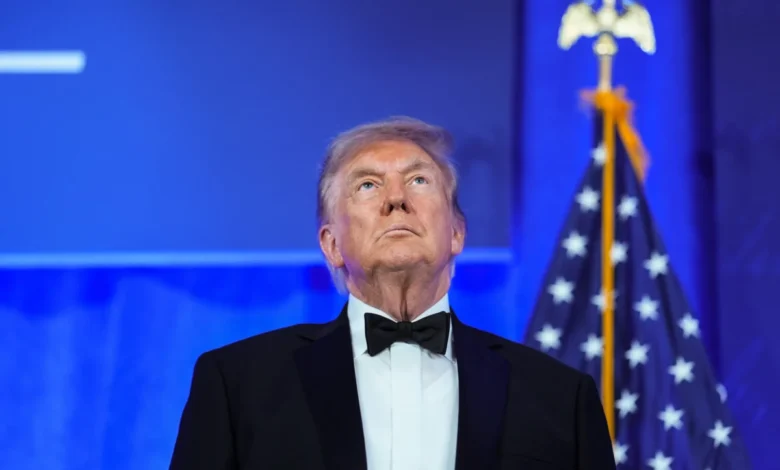
President Donald Trump made his inaugural appearance at the White House Correspondents’ Association (WHCA) Dinner, delivering a lengthy and contentious speech that spanned over an hour. The rescheduled gala, held Friday evening in Washington, D.C., saw the President target numerous journalists, politicians, and celebrities with whom he has publicly clashed. Trump’s address, characterized by its rambling nature, marked a significant departure from the traditional tone of the event, which typically features a comedian roasting the sitting president.
The President began his remarks by acknowledging the assembled journalists, stating, "I am delighted to be here at the White House Correspondents’ Dinner. Amazing people, a lot of people that I like. Some I don’t like at all, but I respect most of them." However, this conciliatory opening quickly gave way to a more confrontational stance. Trump appeared to grapple with the intended tone of the evening, musing aloud, "What do we do here? Is this supposed to be fun? Am I supposed to be serious? Am I supposed to be a comedian? So I guess you said, maybe a little bit of everything." This uncertainty foreshadowed the barrage of criticisms that would follow.
Trump’s address focused heavily on his well-documented adversarial relationship with the press, which he has consistently labeled as "fake news." He drew a parallel between the awards presented at the WHCA dinner and the Academy Awards, asserting, "This evening it’s really all about the fake news media and your handling of prizes – writing and producing and performing made-up stories like the Academy Awards." He further criticized the Academy Awards’ declining viewership, attributing it to their perceived anti-Trump stance. "They took on Trump. They hit me all night long," he stated, implying that such actions led to a significant drop in ratings, mirroring his critique of media outlets.
A central theme of Trump’s speech was his assertion that the media’s financial viability is inextricably linked to his public persona. "When I’m gone, you’re all going to be broke. Your business model is going to be finished. No, it’s true. When I’m not around, you’re going to be broke. There’s not going to be anybody to report on. Nobody gives a damn about anybody else," he declared. This statement underscored his belief that his controversial and attention-grabbing nature is the primary driver of news consumption and, consequently, media revenue.
The President elaborated on his decision to abstain from previous WHCA dinners, citing unfair treatment by the press. "I thought the press treated me very, very unfairly, and I don’t know. I think I made the right decision because they need to go where maybe you’re not wanted, but they did want me. They wanted me for ratings, and they wanted me for other reasons, but not for love," he explained. He claimed this boycott was a first in presidential history, highlighting his long-standing estrangement from the organization and its members.
Trump also took aim at the entertainment industry figures often associated with the event, criticizing comedians like Jimmy Kimmel, Jimmy Fallon, and Stephen Colbert. "These guys – they’re terrible. They’re terrible. Stephen Colbert. These are people without talent. They have no talent, but they are not comedians. They’re not funny people. They’re angry people. They’re sick people," he opined. The decision by the WHCA to forgo a comedian this year, opting instead for a mentalist, Oz Pearlman, was implicitly framed by Trump as a recognition of the perceived lack of comedic talent among those who have critiqued him.
The President’s address commenced at 9:33 p.m. and concluded approximately 64 minutes later, making it one of the longest speeches in the history of the event. During his remarks, Trump engaged in a peculiar anecdote involving Paramount CEO David Ellison, suggesting that Ellison planned to rename the WHCA dinner the "Trump White House Correspondents’ Dinner" next year. "He told me that, and I like that very much. We’re going to change the name of it, OK?" Trump stated, drawing a parallel to his unsuccessful efforts to associate his name with the Kennedy Center.
Further adding to the evening’s unconventionality, Trump offered a seemingly misplaced compliment to Bari Weiss at CBS News, calling her "a wonderful woman," which elicited a surprised reaction from the audience. He also acknowledged the challenging role of White House press secretary Karoline Leavitt, noting, "She has to deal with all of you all the time, and you can be very difficult. You can be very, very difficult people." He then pivoted to his own perceived sensitivity, adding, "But I’m probably being a little bit oversensitive. Sometimes I really do think that some of you don’t like me."
The President’s rhetoric often veered into hyperbole and personal attacks. He characterized the attendees as "the largest group of Trump derangement syndrome people ever put together at one time, I suspect," a phrase that has become a hallmark of his political discourse. Trump has previously equated "Trump derangement syndrome" with a genuine medical condition, a viewpoint not supported by mainstream medical consensus.
His most pointed criticisms were reserved for perceived adversaries. He singled out Don Lemon, labeling him "the winner of the lowest ratings and the lowest IQ on television" and "the dumbest man on television." He then directly addressed CNN anchor Kaitlan Collins, who had received a WHCA award for her coverage of a confrontation between Trump and Ukrainian President Volodymyr Zelensky. While offering a backhanded congratulatory remark, Trump dismissed the award as "fake" and stated Collins "shouldn’t get the award." CNN Worldwide CEO Mark Thompson issued a firm response, asserting, "We stand by our journalists and the integrity and fair mindedness with which the CNN team reports the news. Honest, accurate journalism may sometimes irritate politicians, but our right to report and present that reporting to the public without government interference is fully protected by the U.S. Constitution. CNN will continue to exercise this right."
Trump’s commentary on Collins took a peculiar turn as he described her as "a young, active woman" but criticized her for not smiling. He then attempted a convoluted joke involving a Bud Light sponsorship and transgender influencer Dylan Mulvaney, referencing the backlash the brand experienced in 2023. "Dylan Mulvaney cost Bud like $35 million in market cap. It was the worst commercial ever made, by the way," Trump remarked, underscoring his engagement with cultural controversies.
The President also commented on CNN anchor Anderson Cooper, recalling a period when he felt Cooper covered him favorably. "I like Anderson actually because he’s covered me well for many years, and he went bad as soon as I went for politics," Trump stated, suggesting a perceived shift in Cooper’s reporting due to political alignment.
The list of individuals and entities targeted by Trump’s verbal attacks extended to California Governor Gavin Newsom, U.S. Representative Ilhan Omar, Senators Elizabeth Warren and Chuck Schumer, Rosie O’Donnell (whom he called "a sick older woman"), CNN’s Jake Tapper, and musician Bruce Springsteen. Regarding Springsteen, Trump questioned his appearance and career trajectory, lamenting, "What the hell happened to that guy? He looks like hell." He further criticized Springsteen’s performances for including political commentary, humorously renaming his tour "Bored in the USA."
Trump’s long-standing animosity towards the press is well-documented. Beyond his frequent accusations of "fake news" and personal insults directed at journalists, he has initiated lawsuits against multiple news organizations, including The New York Times, The Wall Street Journal, CNN, ABC News, and CBS News’ "60 Minutes," over coverage he deemed unfavorable.
Significantly, the Wall Street Journal reporters who received the Katharine Graham Award for Courage and Accountability for their story about a purported birthday letter from Trump to Jeffrey Epstein were present at the dinner. Trump, who has denied authoring the letter, had filed a $20 billion defamation lawsuit over the story, a legal action the Journal’s lawyers decried as "an affront to the First Amendment." While a judge initially dismissed the suit, Trump refiled a complaint in May 2026, and the case remains pending. Trump’s interaction with the award recipients was described as an awkward handshake followed by a gesture of mock resignation. "This has not been an easy evening. All these awards… Do I get a say in those awards?" Trump quipped during his remarks, highlighting the tension surrounding the awards presented that evening.
Towards the conclusion of his lengthy address, Trump alluded to a potential fourth term in office, donning a "Trump 2028" hat. This move was accompanied by a reiteration of his unsubstantiated claims of winning the 2020 U.S. presidential election. He also expressed his intention to attend the correspondents’ dinner in 2027.
In a particularly unusual segment, Trump directed a joke at Robert F. Kennedy Jr., his Secretary of Health and Human Services. The President made a series of bizarre remarks involving a cow and "male raccoon roadkill" as hypothetical menu items, concluding with "We love Bobby."
The WHCA dinner, held at the Waldorf Astoria hotel in Washington, D.C., was rescheduled following an incident on April 25th. That initial gathering was disrupted by what authorities described as an attempted assassination of President Trump. A gunman was apprehended by security personnel at the Washington Hilton. Trump referenced the security threat during his speech, expressing gratitude to law enforcement officers for their actions.
Outgoing WHCA President Weijia Jiang, a senior White House correspondent for CBS News, delivered opening remarks. She shared hosting duties with Fox News’ Jacqui Heinrich, who is slated to assume the presidency of the organization for the 2026-27 term. The absence of a comedian, a traditional element of the WHCA dinner, and the presence of a mentalist instead, underscored the unique and often tense atmosphere surrounding this year’s event, particularly in light of the President’s highly anticipated and delivered remarks. The event serves as a stark reminder of the ongoing friction between the executive branch and the fourth estate, a dynamic that Trump has amplified throughout his presidency. The extended duration of his speech and the breadth of his criticisms suggest a strategic use of the platform to reinforce his narrative and directly challenge the media’s role and credibility.