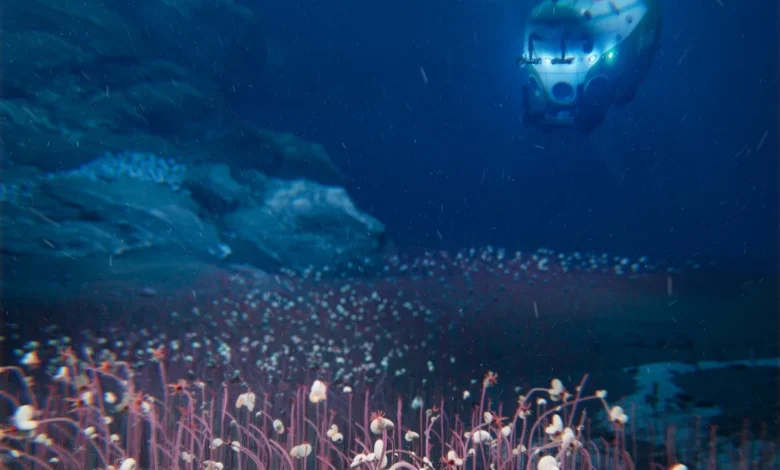
In a landmark discovery that fundamentally reshapes our understanding of biological limits, researchers have identified an expansive, thriving ecosystem of mollusks, tubeworms, and crustaceans nearly six miles below the surface of the Pacific Ocean. The study, published in the journal Nature, details the discovery of the deepest chemosynthesis-based community ever documented, found during a series of 23 exploratory dives by the Chinese manned submersible Fendouzhe. This finding suggests that the hadal zone—the deepest reaches of Earth’s trenches—is not the barren, desolate desert scientists once imagined, but rather a complex environment capable of supporting vibrant life even in the absence of sunlight.
The discovery was made across the Kuril-Kamchatka and western Aleutian trenches, as well as the Mariana Trench, covering a staggering distance of over 1,500 miles. At depths ranging from 3.6 to 5.92 miles, the researchers observed a diverse array of organisms, including siboglinid polychaetes and various bivalves, thriving in total darkness.
A Chronology of Exploration and Discovery
The exploration of the deep sea has historically been limited by extreme pressure, freezing temperatures, and total darkness. For decades, the abyss was considered largely abiotic, save for microscopic organisms.
- 1960: Don Walsh and Jacques Piccard became the first humans to reach the bottom of the Mariana Trench aboard the bathyscaphe Trieste, providing the world with its first glimpse into the Challenger Deep.
- 2012: Filmmaker and explorer James Cameron conducted a solo dive, describing the environment as "alien" and "desolate," reinforcing the narrative that the deep ocean was a biological void.
- 2020–2024: The Chinese Academy of Sciences initiated a series of systematic dives using the Fendouzhe submersible, designed specifically to withstand the crushing pressures of the hadal zone, which can exceed 1,000 times atmospheric pressure at sea level.
- 2025: The publication of the study in Nature confirmed that the 23 dives conducted in the previous year had successfully mapped a massive, continuous network of chemosynthetic life, effectively overturning the "isolated pocket" theory of deep-sea biology.
The Science of Chemosynthesis: Life Without Sun
Because sunlight cannot penetrate the depths of the hadal trenches, the organisms discovered by the research team do not rely on photosynthesis, the process that powers life on the surface. Instead, these creatures utilize chemosynthesis. This biochemical process involves the conversion of carbon-containing molecules and nutrients into organic matter using the oxidation of inorganic compounds—specifically hydrogen sulfide and methane—as an energy source.
The study indicates that the ecosystem is sustained by fluids rich in methane and hydrogen sulfide, which travel through subterranean faults. These fluids seep through cracks in the ocean floor, creating a chemical landscape that supports microbial mats. The tubeworms and bivalves observed by the team were found clustered directly around these microbial mats, indicating a highly specialized symbiotic relationship. Isotopic analysis performed by the researchers suggests that this methane is produced microbially from organic matter deposited on the seafloor, creating a closed-loop system of energy production that is independent of the solar cycle.
Implications for Carbon Cycling and Marine Biology
The discovery of such a widespread community of organisms has significant implications for global carbon cycling models. Previously, scientists believed that carbon sequestration in the deep ocean occurred primarily through the slow "marine snow" of decaying organic matter drifting down from the surface. The presence of these extensive chemosynthetic communities suggests that the deep-sea floor acts as a more active site for carbon processing than previously accounted for.
"Given the geological similarities across various hadal trenches globally, it is highly probable that these chemosynthesis-based communities are more widespread than we ever anticipated," noted lead author Xiatong Peng. By identifying that these ecosystems are not mere anomalies but rather a regular feature of the deep-ocean landscape, the study forces a recalibration of how marine biologists estimate the total biomass of the planet.

Co-author Mengran Du, a marine geochemist with the Institute of Deep-sea Science and Engineering, highlighted the density of the life found: "What makes our discovery groundbreaking is not just its depth, but the astonishing abundance and diversity. We aren’t looking at a few scattered organisms; we are looking at a vibrant oasis in a vast, dark desert."
Environmental Concerns and Deep-Sea Mining
The timing of this discovery coincides with a period of intense geopolitical and economic debate regarding the future of the seafloor. As nations and corporations look toward the deep ocean for critical minerals required for the green energy transition—such as cobalt, nickel, and manganese—the specter of deep-sea mining has become a focal point of environmental advocacy.
Marine scientists have long warned that the seafloor is a delicate, slow-growing environment. Because these organisms exist in a stable, low-energy environment, they are exceptionally vulnerable to physical disturbance. Mining activities, which involve heavy machinery scraping the ocean floor or creating massive sediment plumes, could irreparably damage these newly discovered habitats before they are even fully understood.
The International Seabed Authority (ISA) is currently tasked with creating a regulatory framework for deep-sea mining. However, as of mid-2025, no consensus has been reached. Critics argue that the discovery of such extensive biological communities provides a compelling argument for a moratorium on mining until more research can be conducted to assess the potential for extinction of species that have not yet been cataloged.
Expanding the Frontier of Human Knowledge
The Fendouzhe expedition has provided more than just data; it has provided a window into the evolution of life in extreme conditions. The presence of complex invertebrates, including spiky crustaceans, sea lilies, and sea cucumbers, alongside the primary chemosynthetic organisms, suggests a sophisticated food web. This indicates that the energy derived from the Earth’s crustal heat and chemical seepage supports a multi-trophic level ecosystem.
For the scientific community, the focus now shifts to identifying how many other "oases" exist in the unmapped gaps of the ocean floor. With the deepest parts of the ocean covering a significant portion of the Earth’s crust, the realization that these regions are inhabited by complex, non-photosynthetic life forms suggests that our map of the biosphere is incomplete.
As the researchers continue to analyze the samples and video footage collected during the 2024 expeditions, the broader scientific community remains attentive to what these findings mean for the study of astrobiology. If life can thrive in the high-pressure, chemical-rich environments of the Mariana Trench, it provides a terrestrial analog for the types of environments that might exist on icy moons such as Europa or Enceladus, where internal heat and chemical reservoirs could theoretically support life far from the reach of the sun.
This discovery serves as a reminder that the most significant frontiers left to explore are not in the stars, but beneath the waves of our own oceans. As the debate over the exploitation of the seabed continues, the "vibrant oasis" found by the Fendouzhe team stands as a testament to the resilience of life and the urgent necessity of protecting the final, largely undisturbed wilderness of Earth.