The pursuit of pristine night skies has long driven astronomers, researchers, and astrophotography enthusiasts to the highest and most remote corners of the globe. Against the backdrop of the towering Himalayas, a recent astronomical capture from the Hanle Dark Sky Reserve in Ladakh, India, has brought renewed attention to one of the solar system’s most elusive optical phenomena: the zodiacal light. Often referred to in historical texts and folklore as the "false dawn," this faint, pyramidal glow of sunlight scattered by interplanetary dust particles was recently photographed in stunning clarity just before the onset of astronomical twilight.
Released as a featured image by NASA’s Astronomy Picture of the Day (APOD)—which continues its transition from its legacy home at apod.nasa.gov to its modernized platform at science.nasa.gov/apod—the photograph highlights not only the breathtaking geographic isolation of the Ladakh region but also modern science’s evolving understanding of where the zodiacal light originates. As professional astronomers and amateur stargazers alike look up to decipher the cosmos, this striking image serves as a visual reminder of the interconnected debris disk that permeates our inner solar system.
Main Facts of the Celestial Display
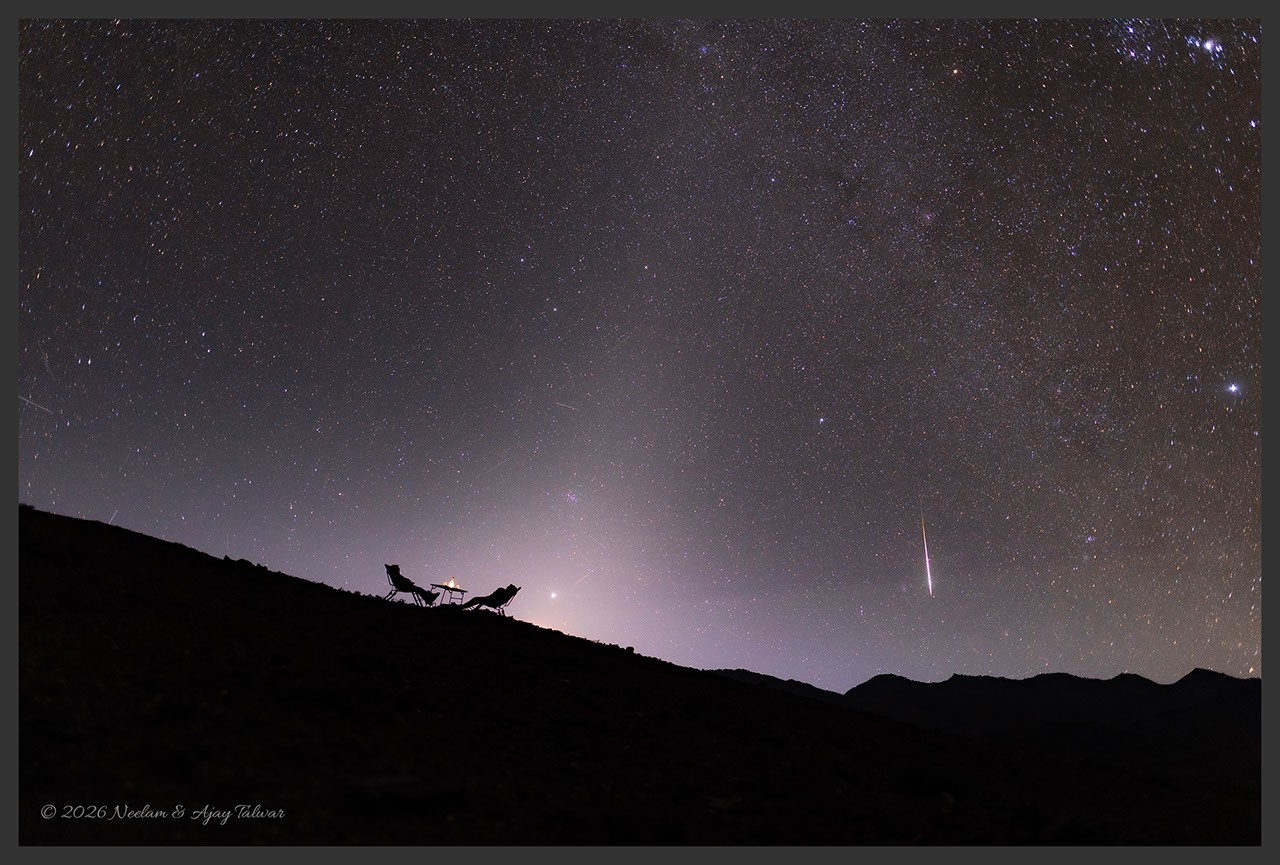
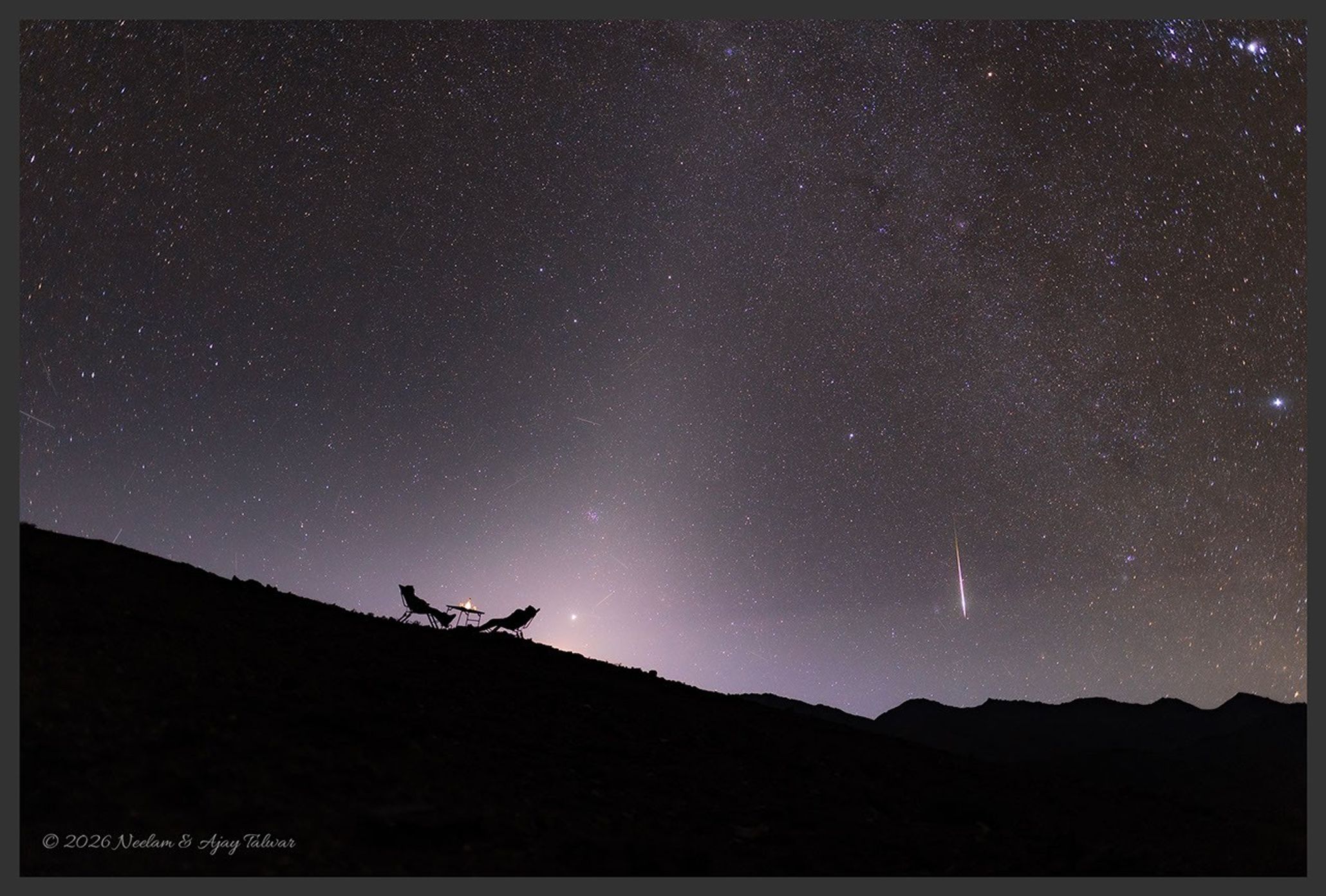
The award-winning astrophotography frame was captured during a September star party at the Hanle Dark Sky Reserve, situated in the rugged and high-altitude terrain of Ladakh, India. Perched at approximately 4,500 meters (nearly 14,800 feet) above sea level, the reserve provides an optimal haven for deep-sky observation. The extreme altitude places observers above a significant portion of Earth’s moisture-laden and turbulent atmosphere, drastically reducing light pollution and atmospheric distortion.
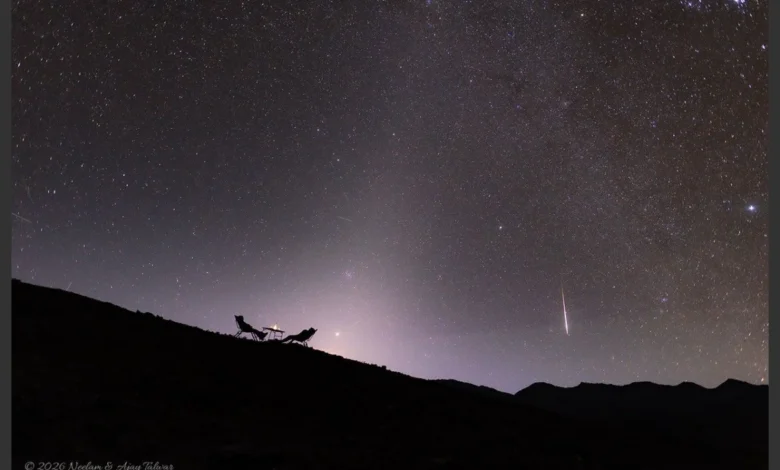
In the captured skyscape, two individuals are seen seated quietly, looking upward into a star-studded expanse. Rather than a uniform night sky, the frame reveals a distinct, luminous band of light stretching upward from the eastern horizon. This glowing wedge is the zodiacal light—sunlight backscattered toward Earth by microscopic dust grains residing in the inner solar system.
Adding to the visual composition, the bright gas giant planet Jupiter is captured shining intensely, seemingly immersed within the faint zodiacal glow near the eastern horizon. As the eye follows the luminous zodiacal band higher toward the celestial zenith, other prominent celestial landmarks emerge. These include M44, also known as the Beehive Cluster, a famous open star cluster in the constellation Cancer, alongside a distinctly yellowish-tinged Mars positioned near the center of the frame. Faint streaks of meteors cutting across the atmosphere further punctuate the serenity of the high-altitude night.
Background Context and the Mystery of the Zodiacal Light
For centuries, astronomers debated the exact nature and origin of the zodiacal light. Visible just after sunset in the west during spring or just before sunrise in the east during autumn, the phenomenon appears as a cone of soft light aligned with the plane of Earth’s orbit around the Sun, known as the ecliptic.
Historically, scientists suspected that the dust responsible for scattering the sunlight originated primarily from comets passing through the inner solar system or from the continuous, grinding collisions of asteroids within the main asteroid belt located between Mars and Jupiter. However, modern interplanetary spacecraft missions have radically reshaped these long-held hypotheses.
A breakthrough in understanding came via serendipitous detections made by NASA’s Juno spacecraft during its cruise phase and subsequent orbits of the Jovian system. Data gathered by Juno’s instruments provided compelling evidence that upends classical models. Rather than relying solely on distant comets or the asteroid belt, recent studies published in planetary science journals suggest that Mars itself serves as a dominant source of the interplanetary dust responsible for the zodiacal light observed from Earth. The planet’s thin atmosphere, bombarded constantly by meteoroids and subjected to massive global dust storms, ejects fine particulate matter into space, where solar radiation pressure and gravitational dynamics eventually distribute it into a vast cloud enveloping the inner solar system.
Chronology of the Hanle Dark Sky Reserve
The setting of this recent astronomical feature is just as compelling as the science behind the imagery. The evolution of the Hanle Dark Sky Reserve represents a major milestone in global astro-tourism and professional scientific collaboration in South Asia.
- December 2022: The Indian government officially announced the establishment of the Dark Sky Reserve around the Indian Astronomical Observatory (IAO) at Hanle, located in the cold desert region of Ladakh. Spanning an area of roughly 1,073 square kilometers, the reserve encompasses the village of Hanle and surrounding high-altitude lands.
- 2023–2024: Local authorities, in partnership with the Indian Institute of Astrophysics (IIA) and various conservation groups, implemented strict lighting ordinances. These regulations mandated the shielding of outdoor lights, the use of warm-toned low-emission bulbs, and the promotion of homestay astronomy tourism to protect the pristine night skies from light pollution.
- September 2025–2026: The reserve has steadily grown into a premier international destination for star parties, professional research workshops, and astrophotography expeditions. High-altitude events held during late summer and early autumn routinely draw astronomers seeking optimal transparency and dark skies free from urban interference.
- September 2026: The publication of the zodiacal light skyscape on NASA’s Astronomy Picture of the Day platform brings global visibility to the Ladakh reserve, cementing its status as one of the premier windows to the universe on Earth.
Supporting Data and Observational Challenges
Observing the zodiacal light requires a very specific set of environmental and astronomical conditions, making photographic captures like the one from Hanle exceptionally rare.
- Altitude and Air Mass: At 4,500 meters, observers look through less than 60 percent of Earth’s total atmospheric column. This drastically minimizes Rayleigh scattering and particulate haze, which would otherwise wash out the faint, diffuse glow of interplanetary dust.
- Horizon Clarity: Because the zodiacal light lies close to the horizon during twilight hours, any low-lying clouds, industrial smog, or artificial light domes can completely obscure it. The remote Himalayan desert of Ladakh naturally mitigates these terrestrial obstructions.
- Moon Phase and Twilight: The phenomenon is notoriously sensitive to light pollution from the Moon. Capturing the zodiacal light requires a completely moonless window, typically during the new moon phase, and must be timed precisely between the end of astronomical twilight at night and the beginning of morning twilight.
Official Responses and Institutional Transitions
The daily dissemination of astronomical imagery by NASA continues to serve as an invaluable bridge between professional research institutions and the global public. The recent feature comes at a time of significant digital restructuring for the agency’s public outreach initiatives.
The primary hosting infrastructure for the Astronomy Picture of the Day is currently migrating from its longtime domain at apod.nasa.gov to the consolidated platform at science.nasa.gov/apod. Despite the structural URL migration, the core mission established by creators Robert Nemiroff and Jerry Bonnell remains unchanged: to feature a unique image or photograph of the cosmos every day, accompanied by an accessible, scientifically rigorous explanation authored by professional astronomers.
While institutional representatives have emphasized that the scientific integrity and daily curation schedule of APOD will remain unaltered during the platform transition, the move underscores NASA’s broader effort to unify its digital science communication under a single, highly secure, and accessible web architecture.
Broader Impact and Implications for Astrophotography and Science
The intersection of high-altitude conservation, planetary science discoveries, and public engagement highlights a growing appreciation for night sky preservation. As urban sprawl and satellite constellations increasingly complicate both professional and amateur astronomy, designated sanctuaries like the Hanle Dark Sky Reserve demonstrate that proactive environmental management can successfully protect our view of the cosmos.
Furthermore, the connection between Martian dust storms and the faint glow visible in Earth’s night sky illustrates the deeply interconnected nature of our solar system. Dust generated on a distant, rust-colored neighboring world drifts across millions of miles of interplanetary space, interacting with sunlight to paint a subtle pyramid of light that human eyes have marveled at for millennia.
As initiatives like NASA’s APOD continue to spotlight these fleeting atmospheric and celestial alignments, they inspire a new generation of scientists, conservationists, and astrophotographers to look past the glow of city lights and recognize the fragile, dynamic beauty of our shared cosmic neighborhood.