Guenther Steiner Believes Italian Fandom is Yet to Fully Embrace Kimi Antonelli Amidst Ferrari Dominance


The burgeoning talent of Andrea Kimi Antonelli, the 19-year-old Italian sensation making waves in Formula 1, is not yet receiving the full adoration of his home nation’s motorsport fanbase, according to former Haas team principal Guenther Steiner. Steiner suggests that the deep-seated, almost sacred, allegiance to Scuderia Ferrari, Italy’s iconic Formula 1 marque, is currently overshadowing the impressive achievements of Antonelli, who is carving out his own significant path in the sport.
Steiner, speaking on The Red Flags Podcast following Antonelli’s dominant sixth victory of the season at Spa-Francorchamps, articulated his observations on the unique dynamics of the Italian motorsport public. "I spoke with a few Italian journalists in Spa about this because I get the same feeling – he doesn’t get the credit he deserves somehow," Steiner stated, highlighting a sentiment he has gathered from direct conversations within the paddock.
To illustrate his point, Steiner drew a compelling parallel with another Italian sporting star, Jannik Sinner, who has captured the nation’s attention with his meteoric rise in the world of tennis. "In Italy, you’ve now got two very good sportsmen," Steiner noted. "Jannik Sinner in tennis, who is just walking away [with it], and then you’ve got Kimi Antonelli. But Kimi doesn’t get the same credit as Jannik Sinner, and I find that one weird, to say the least."
The former team principal attributed this perceived disparity directly to the enduring and powerful emotional connection Italians have with Ferrari. "It has to do with Ferrari being seen as the Italian team, the national team," Steiner explained. "More people still need to get used to the fact that there is an Italian F1 driver, who is actually world-class, and not only a team, because there wasn’t one for a very, very long time." This sentiment underscores a historical context where national pride in Formula 1 has been intrinsically linked to the performance and success of the Maranello-based outfit. For decades, Italian F1 representation was synonymous with Ferrari drivers, making the emergence of a non-Ferrari Italian driver a new paradigm for some fans to process.
Despite this observed hesitancy, Steiner remains fundamentally optimistic about Antonelli’s prospects of winning over the Italian public. "He deserves more, and I think there is now a growing awareness [that] this guy is actually special," he added, expressing confidence in Antonelli’s inherent talent and the likelihood of his performances eventually resonating more deeply.
Steiner further elaborated on his call for a broader appreciation, suggesting a slight recalibration of focus for Italian motorsport enthusiasts. "We need to pay more attention to him and maybe let Ferrari go a little bit," he advised. When pressed on whether this implied an "either/or" situation for fan allegiance, Steiner clarified his stance, emphasizing a more inclusive approach. "Maybe just do not put all your eggs in that basket: Ferrari. There is somebody out there who you can cheer on. He deserves more than he gets at the moment in Italy." This suggests a desire for Italian fans to diversify their support and recognize excellence regardless of team affiliation, especially when it comes from a fellow countryman achieving remarkable feats.
A Season of Unprecedented Success for Antonelli
Andrea Kimi Antonelli’s 2026 season has been nothing short of spectacular, positioning him as one of the most compelling narratives in Formula 1. While his Mercedes teammate, George Russell, entered the season with considerable expectations as a proven contender, it has been the young Italian who has consistently outshone his more experienced colleague, emerging as a genuine championship threat.
The season’s trajectory for Antonelli began with a bang, securing early victories that immediately signaled his intent. Back-to-back wins in China and Japan in the opening races of the season propelled him to the top of the drivers’ standings, a remarkable feat for a driver in his debut year and at such a young age. These early successes not only demonstrated his raw speed and race craft but also his ability to handle pressure on the global stage.
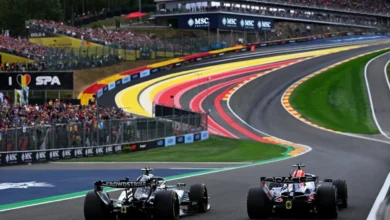
His winning streak continued with further triumphs in the prestigious Monaco Grand Prix, a testament to his precision and nerve on the tight street circuit, followed by a dominant performance in Canada. His victory in Miami added another significant feather to his cap, showcasing his adaptability to different track conditions and racing styles. The most recent win at Spa-Francorchamps, a circuit steeped in Formula 1 history and known for its demanding nature, further cemented his championship aspirations.

As of the Belgian Grand Prix, Antonelli sits comfortably at the summit of the drivers’ championship, boasting an impressive 204 points. This places him a substantial 45 points ahead of his nearest competitor, seven-time world champion Lewis Hamilton, who is currently in second place with 159 points. This points gap, achieved midway through the season, highlights Antonelli’s consistent performance, strategic prowess, and the formidable package that Mercedes has provided him.
The Ferrari Factor: A Historical Perspective
The Italian passion for Formula 1 is inextricably linked with the legacy and allure of Scuderia Ferrari. Founded in 1929, Ferrari is not merely a racing team; it is a cultural institution in Italy, representing national pride, engineering excellence, and a history of unparalleled success. For generations, the Prancing Horse has been the undisputed symbol of Italian motorsport dominance.
The team’s iconic red livery is instantly recognizable worldwide, and its fanbase, known as "tifosi," is renowned for its fervent devotion. Many Italian families have grown up with Ferrari as their primary, and often only, Formula 1 allegiance. This deep-rooted emotional connection means that any driver associated with Ferrari, or even simply an Italian driver performing well outside of Maranello, faces a unique challenge in capturing the same level of widespread adoration.
Historically, Italian drivers have achieved great success with Ferrari, including legends like Alberto Ascari, Nino Farina, and more recently, drivers who have enjoyed periods of significant triumph with the team. The absence of a consistently competitive Italian driver outside of the Ferrari sphere for an extended period has further solidified the team’s monopoly on national F1 identity. This makes Antonelli’s current success, albeit with Mercedes, a significant development that requires a recalibration of fan expectations and loyalties.
The Emergence of a New Italian Hero?
Guenther Steiner’s observations point to a subtle but significant shift occurring within the Italian motorsport landscape. While the allure of Ferrari remains potent, the undeniable talent and consistent success of Andrea Kimi Antonelli are gradually building a case for broader national recognition. His performances are not just individual achievements; they represent a potential new era for Italian drivers in Formula 1, one that could expand beyond the traditional Ferrari stronghold.
The implication of Steiner’s remarks is that Italian fans may need to embrace the idea of supporting a world-class Italian driver irrespective of the team he represents. This is a challenge that transcends mere sports fandom; it touches upon national identity and the evolution of sporting culture. Antonelli’s journey is not just about winning races; it’s about carving out a new narrative for Italian excellence in motorsport.
Looking Ahead: The Future of Antonelli’s Fandom
The coming races will be crucial in observing how this dynamic unfolds. Antonelli’s continued success, coupled with potential further insights from figures like Steiner and other Italian motorsport commentators, could sway public opinion. The increasing visibility of his achievements, particularly if he maintains his championship lead or secures the title, will inevitably amplify his profile and draw more attention.
The comparison with Jannik Sinner is particularly apt. Sinner’s rise has captivated Italy, demonstrating a national appetite for sporting heroes. If Antonelli can continue his impressive form and translate his on-track dominance into broader public recognition, he has the potential to become a national icon in his own right, transcending even the deeply ingrained Ferrari narrative. The question remains whether the Italian fanbase will fully embrace this new chapter in their motorsport history, celebrating Antonelli’s individual brilliance as much as their cherished team’s legacy. The journey for Antonelli to capture the hearts of all Italian fans is ongoing, but his performance on the track is undoubtedly laying a strong foundation for future adoration.