New York Relaxes Staff Dress Code Ban on Indigenous Mascots While Defending Core Policy Against Federal and Local Challenges

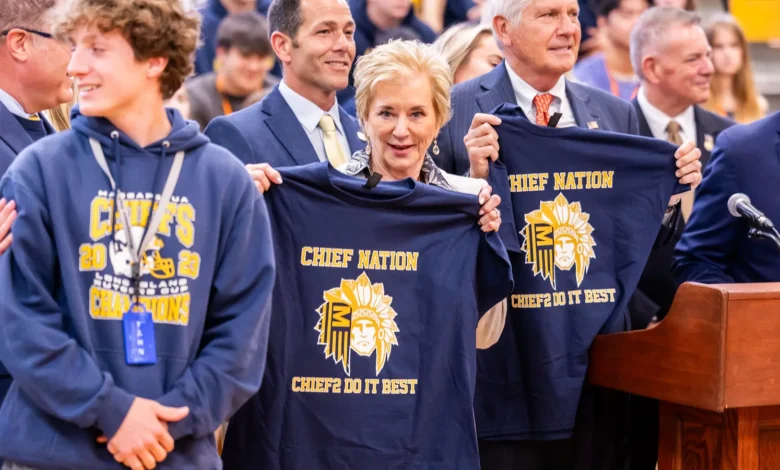
The state of New York is pressing forward with its controversial prohibition of Native American mascots in public schools, holding firm even as it navigates intense legal resistance from local school districts and mounting pressure from federal authorities. However, amidst a complex web of ongoing litigation, state officials have quietly agreed to scale back a specific component of the sweeping regulatory framework established in 2023. According to recent court filings, the New York State Attorney General’s Office has chosen to repeal a provision that barred school employees from wearing or displaying Indigenous names, logos, or apparel on school grounds or during school-sponsored events.
While this localized retreat has been celebrated as a major victory by defiant districts, the overarching ban on institutional Native American mascots, team names, and imagery remains fully intact. The decision highlights the escalating tensions between state educational regulators, local school boards asserting historical heritage and municipal autonomy, and federal oversight bodies attempting to intervene on constitutional and civil rights grounds. As the legal battles weave their way through appellate courts, the controversy continues to ignite national debates over cultural representation, educational priorities, and the boundaries of state versus local control.
Origins of the Ban and the Push for Inclusive Learning Environments
The regulatory conflict began in earnest when the New York State Education Department introduced a policy proposal aimed at eliminating the use of Indigenous names, mascots, and logos across all public school districts. At the time of its formulation, state education officials and supporting advocacy groups argued that stereotypical or caricatured depictions of Native Americans create a hostile and exclusionary environment for Indigenous students, ultimately undermining academic success and social well-being. Proponents of the ban pointed to various psychological and sociological studies indicating that race-based mascots can negatively impact the self-esteem of minority students while perpetuating harmful cultural stereotypes among their peers.
Under the initial framework, the New York Board of Regents established a strict timeline requiring all non-compliant public school districts to transition away from prohibited mascots, imagery, and team names by the year 2025. While some districts quickly complied, scrubbing decades-old iconography from gym floors, athletic uniforms, and stadium banners, others elected to mount an aggressive defense. For many communities, these mascots were viewed not as derogatory caricatures, but as long-standing traditions meant to honor the rich regional history and deep-rooted heritage of the Indigenous tribes that originally inhabited the area.
Legal Battles and the Employee Dress Code Retreat
Resistance from local educational authorities materialized swiftly in the courts. As early as 2023, several Long Island school districts filed lawsuits against the state, challenging the constitutionality and procedural validity of the mandate. Among the most prominent litigants were the Massapequa Union Free School District and the Wantagh Union Free School District. In its legal filings, the Massapequa Board of Education argued that its historical mascot directly referenced the deep heritage of its Long Island community and was intended as a tribute to local Native American roots, rather than an offensive caricature.
Beyond the cultural arguments, districts raised significant financial concerns. Transitioning away from established athletic identities carries a substantial economic burden for public school systems. Expenses associated with replacing physical infrastructure, repainting gymnasiums, redesigning websites, and purchasing entirely new sets of athletic uniforms and marching band apparel can quickly escalate into hundreds of thousands, or even millions, of dollars. For instance, school districts in other states facing parallel mandates—such as a district in Minnesota that estimated compliance costs at roughly $1 million—have underscored the heavy financial strain such transitions place on local taxpayers.
Recognizing the mounting legal hurdles and the complexities of enforcing micro-level regulations, the office of New York State Attorney General Letitia James submitted a court update on October 16 indicating a strategic retreat on one specific front. The state agreed to repeal the section of the mascot ban that prohibited school employees from wearing or promoting Indigenous names, logos, or apparel while on school property or at official functions.
JP O’Hare, a spokesperson for the New York State Department of Education, clarified the state’s position in an October email, noting that while the broader institutional ban remains legally sound, the state would henceforth recommend that the Board of Regents leave employee dress code decisions to local school boards. This approach aligns the handling of mascot-related apparel with standard personnel decisions and employee attire policies managed at the district level.
Local Triumphs and Demands for Total Repeal
The state’s decision to walk back the employee apparel restriction was immediately hailed by the Massapequa School District as a profound triumph for institutional autonomy. In an official statement released in late October, the Massapequa Board of Education characterized the development as a significant victory for local control and a vindication of their legal strategy.
"From the beginning, we have maintained that the state’s Native American mascot regulation represents an unconstitutional overreach," the board stated. "The state’s recommendation to return authority over employee apparel to local school districts is an important acknowledgment that these decisions should be made locally, not dictated by Albany."
Despite celebrating this partial concession, the district and its legal allies have made it clear that their fight is far from over. Massapequa and Wantagh officials have continued to pressure New York Governor Kathy Hochul and the Board of Regents to completely rescind the broader statewide ban. Meanwhile, several related claims brought forward by the Wantagh school district and other co-plaintiffs remain active in the state’s appeals circuit, setting the stage for potentially landmark judicial rulings on the limits of state educational mandates.
Federal Escalation and Title VI Investigations
Compounding the state-level legal battles, New York has found itself locked in a high-stakes standoff with federal authorities. The state’s strict enforcement of the mascot ban has drawn fierce opposition from the federal government, with prominent officials asserting that the state’s policies infringe upon civil rights and improperly penalize communities wishing to celebrate local history.
Last year, the U.S. Department of Education initiated a formal investigation into the New York Department of Education, probing potential violations of Title VI of the Civil Rights Act of 1964, which prohibits discrimination based on race, color, or national origin in programs and activities receiving federal financial assistance. Within weeks of launching the inquiry, federal education officials concluded that the state agency was indeed in violation of civil rights protections.
The federal pushback intensified under the administration’s leadership. In an April statement, U.S. Education Secretary Linda McMahon sharply criticized New York’s regulatory approach, accusing state leaders of attempting to erase local heritage.
"The U.S. Department of Education will not stand by as the state of New York attempts to rewrite history and deny the town of Massapequa the right to celebrate its heritage in its schools," McMahon stated. "While New York chooses to prioritize erasing Native Americans, their rich history, and their deep connection to the state, it is requiring schools to divert time and resources away from what really matters: educating our students."
Following the state’s refusal to voluntarily alter its regulations in response to the federal findings, the U.S. Department of Education escalated the matter by referring the case to the Department of Justice for formal enforcement proceedings. Although no recent public updates have been issued regarding the status of that referral, the federal intervention underscores the extraordinary polarization surrounding the mascot issue.
Broader National Trends and Future Implications
New York’s legislative and legal struggle is not happening in a vacuum. The debate over Native American imagery in public education reflects a broader, nationwide reckoning regarding cultural representation, institutional symbolism, and historical accountability.
According to trademark and branding legal services firm Lutzker & Lutzker, Maine became one of the first states in the nation to enact a comprehensive statewide ban on Native American mascots in public schools back in 2019. In the years following, the movement gained significant momentum across the country. By April 2023, data compiled by legal analysts indicated that more than 21 states had either successfully enacted legislation or were actively considering policies to restrict or eliminate the use of Native American mascots in K-12 public education.
Proponents of these widespread bans argue that eliminating caricatures and romanticized tropes is a necessary step toward fostering inclusive educational environments and respecting modern Native American nations. Conversely, opponents and traditionalists—bolstered by supportive federal figures and local school boards—continue to argue that the regulations trample upon local heritage, infringe upon community traditions, and impose undue financial burdens on school districts already grappling with budgetary constraints.
As New York navigates the appellate courts and absorbs ongoing federal scrutiny, the ultimate resolution of the mascot controversy remains uncertain. While the state has shown a willingness to compromise on employee dress codes to streamline its legal defense, its resolve to eliminate institutional Indigenous mascots is being tested like never before. The outcome of these legal and political showdowns will likely serve as a crucial precedent for educational jurisdictions nationwide as they wrestle with the intersection of local autonomy, state regulatory power, and cultural sensitivity.