The Great American Workforce Gap: Why a Record Labor Shortage is Looming Despite the Rise of Artificial Intelligence

While the prevailing public discourse remains fixated on the disruptive potential of generative artificial intelligence and high-profile layoffs within the technology sector, a more fundamental and potentially more damaging crisis is beginning to take root in the United States economy. This emerging reality is not a surplus of workers replaced by machines, but rather a profound and historic scarcity of human talent. From the specialized cleanrooms of semiconductor fabrication plants to the front lines of geriatric healthcare, recruiters and economists are sounding a collective alarm: the United States is entering the most significant labor shortage in its modern history, a phenomenon that threatens to stifle economic growth and compromise national security.
Matt Walsh, CEO of the Phoenix-based executive search firm Blue Signal, highlights the absurdity of the current market in high-demand technical sectors. In fields such as semiconductor production, Walsh suggests that the traditional metrics of unemployment no longer apply. He notes that for certain highly specialized roles, the unemployment rate is effectively "negative 20 percent," a hyperbolic reflection of the fact that there are simply no available bodies to fill open requisitions. This sentiment stands in stark contrast to the anxiety felt by many recent college graduates who fear that AI will automate their career paths before they even begin.
The Divergence of Perception and Reality
The anxiety surrounding AI is not entirely unfounded. Recent data suggests that the integration of AI tools has begun to compress the number of entry-level positions available in fields like data entry, basic coding, and administrative support. Furthermore, tech giants like Meta have explicitly cited AI-driven restructuring as a factor in massive workforce reductions. However, economists argue that these headlines are masking a much larger, structural problem. The issue facing the American economy is not a lack of work, but a lack of workers.
Projections from the Georgetown University Center on Education and the Workforce indicate that this talent deficit could "hobble the American economy for years to come." Similarly, the labor market analytics firm Lightcast describes the situation as the "largest labor shortage the country has ever seen." The consequences extend beyond mere economic inconvenience; JPMorganChase has warned that the "pervasive talent deficit" constitutes a national security risk, as it limits the country’s ability to build essential infrastructure, compete in global markets, and protect its domestic interests.
The shortage is remarkably broad, spanning sectors that AI is currently unable to replicate. Thousands of vacancies are projected for nurses, physicians, teachers, civil engineers, pharmacists, and mental health counselors. The physical economy is also under pressure, with critical deficits expected among construction workers, electricians, and airplane mechanics. As Ron Hetrick, Lightcast’s principal economist, observes, the very people required to keep a functional society running are the ones the nation is struggling to produce.
A Chronology of the Demographic Cliff
The roots of this crisis are found in a confluence of demographic and social trends that have been building for decades. The most significant driver is a simple matter of biology and timing: a protracted decline in the national birthrate is coinciding with the mass retirement of the "Baby Boomer" generation.
Between 2024 and 2032—the window during which the final cohort of Baby Boomers will reach Social Security eligibility—approximately 18 million college-educated workers are expected to exit the workforce. During that same period, fewer than 14 million new workers are projected to enter the labor pool. This creates an immediate net deficit of 4 million workers. When accounting for economic growth and the increasing technical requirements of modern jobs, Lightcast estimates the actual gap could be as high as 6 million.

This "demographic cliff" is further complicated by a series of secondary factors:
- Declining College Enrollment: Since its peak in 2010, college and university enrollment has dropped by nearly two million students.
- Reduced Immigration: Census Bureau data shows that immigration rates have slowed significantly, even though foreign-born workers historically fill nearly half of home health aide roles and 20 percent of nursing and pharmaceutical positions.
- Workforce Disengagement: A growing number of working-age Americans have left the labor force entirely, citing a lack of affordable childcare, substance abuse issues, or early retirement.
- The 2010 Birthrate Slump: The decline in birthrates that began around 2010 ensures that the pool of college-age Americans will continue to shrink by an additional 13 percent through 2041.
The Mismatch: The "Widget Factory" of Higher Education
One of the most pressing challenges identified by economists is the misalignment between the degrees students are pursuing and the needs of the labor market. Ron Hetrick argues that the American educational system functions like a "factory" producing workers that society no longer requires in high volume.
"We have pumped so many young people into business and finance," Hetrick noted, while industries like healthcare and engineering are starved for talent. This mismatch creates a paradoxical environment where recent graduates in saturated fields struggle to find work, while employers in critical infrastructure sectors cannot find a single qualified applicant.
The data supports this concern. While the number of jobs requiring associate or bachelor’s degrees is forecasted to grow, the number of students majoring in essential fields like healthcare and the physical sciences is not keeping pace with demand. This educational inertia prevents the workforce from adapting to the technological and demographic shifts of the 21st century.
Sectoral Impacts: From Semiconductors to Skilled Trades
The impact of the labor shortage is already visible in the nation’s most vital industries. In the semiconductor sector—a cornerstone of modern technology and military hardware—the payroll is expected to grow by 115,000 jobs by 2030. However, current projections suggest a shortfall of 67,000 workers, particularly technicians and engineers with advanced degrees.
In the healthcare sector, the shortages are becoming a matter of public safety. By 2038, the U.S. Health Resources and Services Administration projects a deficit of over 100,000 registered nurses and nearly 250,000 licensed practical nurses. The shortage of primary care physicians and mental health counselors is already leading to long wait times for appointments in rural and urban areas alike.
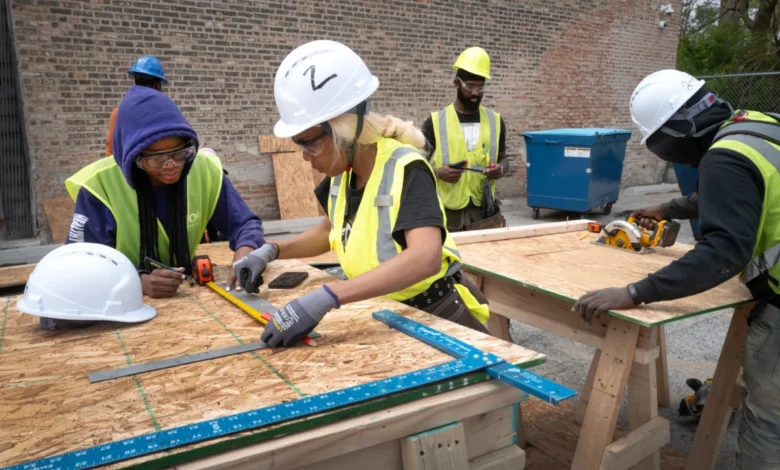
The "physical economy" is perhaps the most insulated from AI but the most vulnerable to labor shortages. The Building Talent Foundation reports that the construction industry is seeing only half the number of new entrants needed to maintain current growth. Branka Minic, CEO of the foundation, points out that while AI like ChatGPT can write code, it cannot "finish an unfinished building." Despite starting wages in some skilled trades reaching $50 an hour, the cultural push toward four-year degrees has left these essential roles unfilled.
State and Policy Responses: A Scramble for Talent
Recognizing that the labor shortage is a localized crisis with national implications, state governments have begun implementing aggressive strategies to attract and retain talent.

In Minnesota, lawmakers are considering legislation that would offer in-state tuition to children of parents who move to the state for work, regardless of where the student attended high school. Other states, such as Missouri and Colorado, have merged their higher education and workforce development agencies to ensure that curricula are directly tied to industry needs.
In Pennsylvania, the situation is particularly dire. The state needs to increase the number of post-secondary credential holders by more than 4 percent annually just to fill 218,000 yearly vacancies through 2032. This is a monumental task in a state where college enrollment has been steadily declining. To combat this, some states are offering student loan forgiveness programs for graduates who agree to stay and work in high-demand fields like nursing or teaching.
National Security and the Economic Path Forward
The labor shortage is not merely a domestic economic issue; it is a strategic vulnerability. A report from the Bipartisan Policy Center’s Commission on the American Workforce, co-chaired by former governors Bill Haslam (R-TN) and Deval Patrick (D-MA), argues that the U.S. is "not preparing people for the world that’s coming."
The JPMorganChase analysis further emphasizes that a talent deficit in manufacturing and defense slows production lines for essential military equipment. If the United States cannot staff the factories that produce semiconductors or the shipyards that build naval vessels, its ability to project power and maintain economic independence is diminished.
To address this, experts suggest a multi-pronged approach:
- Nimble Educational Systems: Developing shorter, more responsive credentialing programs that allow workers to pivot quickly into high-demand roles.
- Immigration Reform: Utilizing targeted immigration to fill critical gaps in healthcare and technical engineering.
- Workforce Re-engagement: Improving access to childcare and addressing substance abuse to bring the "missing" millions of Americans back into the labor pool.
- Cultural Shift: Validating the skilled trades as a lucrative and stable career path, as evidenced by young workers like Seth Russell, a 22-year-old welder in California who entered the workforce debt-free and found immediate stability.
Conclusion: The Boiling Frog Metaphor
The labor shortage is often described by recruiters like Matt Walsh through the metaphor of the "boiling frog." Because the shortage has worsened gradually over years of declining birthrates and slow-moving retirement waves, the public has yet to feel the "pain" acutely enough to demand systemic change. However, as wait times for medical procedures grow and infrastructure projects stall, the reality of the workforce gap will become impossible to ignore.
As Allison Shrivastava, an economist at Niche, notes, the economy is approaching a point where no sector will be left untouched. While the world watches the development of AI with a mixture of awe and fear, the true challenge of the coming decade will be finding enough human beings to maintain the foundations of modern society. The "workforce cliff" is no longer a distant projection; it is a current reality that will define the American economic landscape for the next twenty years.